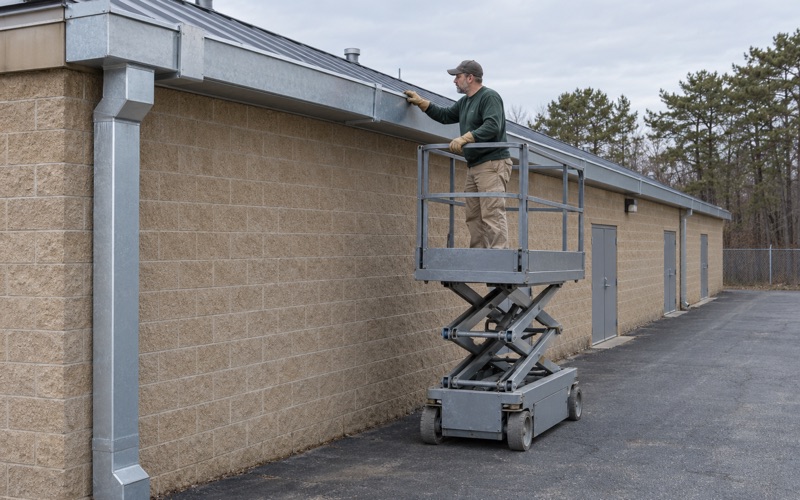
Brick Quality Gutters has spent more than 20 years installing, repairing and cleaning gutters in West Belmar, and the work here turns on one question most homeowners never ask out loud: where does the water go once it leaves the roof? On a lot with a wide lawn that question can wait. On a street of houses set close together, it is the first thing we look at, before a single length of gutter is measured.
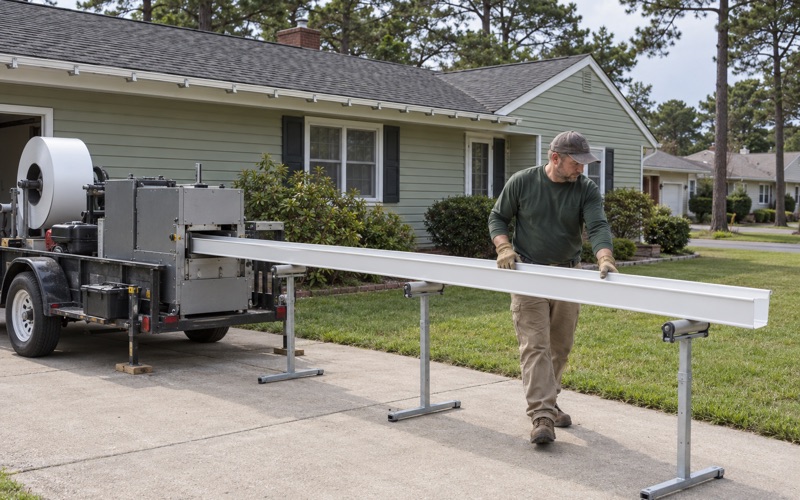
Our approach starts at the roof and ends at the ground. We size each gutter run and each downspout for the area of roof that actually drains into it, form seamless gutters on site from coil so every run is one piece, and then walk each downspout to the spot where its water lands. When that spot is against your foundation, or pointed straight at the house next door, we say so on the estimate and offer a fix.
This page covers what changes about gutter work on a tight residential grid. It explains why the sewer is not an outlet, how extensions and turned downspouts solve most side-yard problems, and why a smaller house often needs more careful sizing rather than less.
West Belmar’s Close-Set Houses and the Side Yard Between Them
A dense grid of detached homes
West Belmar is a census-designated place inside Wall Township, covering 0.47 square miles of land with Route 35 along its western edge. At the 2010 census it held about 2,325 housing units per square mile, and recent Census estimates count 1,158 of its 1,240 housing units as one-unit detached houses. That combination is unusual: nearly every home stands on its own lot, yet the lots sit close enough that the space between two houses is often just a side yard.
For gutters, that density changes the job more than the roof style does. A downspout on the side of a West Belmar house usually discharges into the same narrow strip of ground that the neighbor’s downspout uses. Two roofs can end up draining into one shared low spot, and neither owner may realize it until a basement wall stays damp after every storm.
Why the neighbor’s foundation matters to your downspout
When we plan a downspout on a close-set lot, we look at both foundations, not just yours. A downspout that dumps water three feet from your wall may be doing its job for your house while sending that same water downhill toward the house next door. On a spacious lot the water spreads out and soaks in; in a tight side yard it has fewer places to go.
That is why we follow every downspout to the point where its water ends up and note what is on the other side of the property line. If a discharge looks likely to run toward a neighbor’s wall or walkway, we suggest a different outlet location before we hang anything. It is a small step that heads off the kind of dispute nobody wants with the people next door.
What we check on the first visit
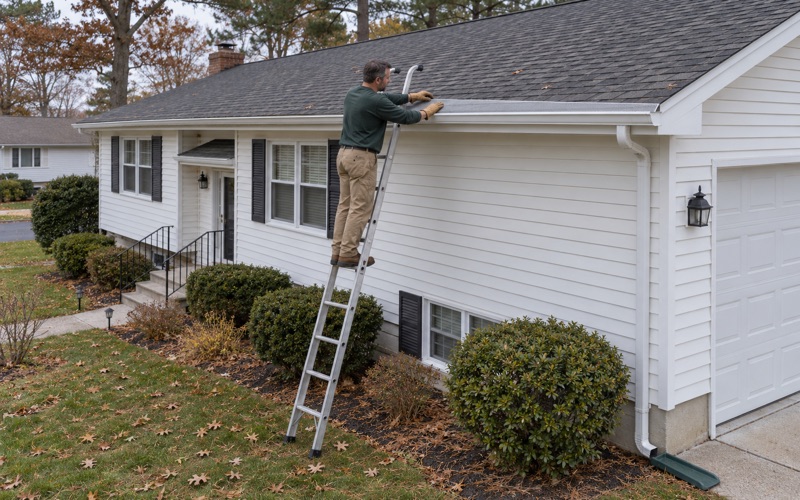
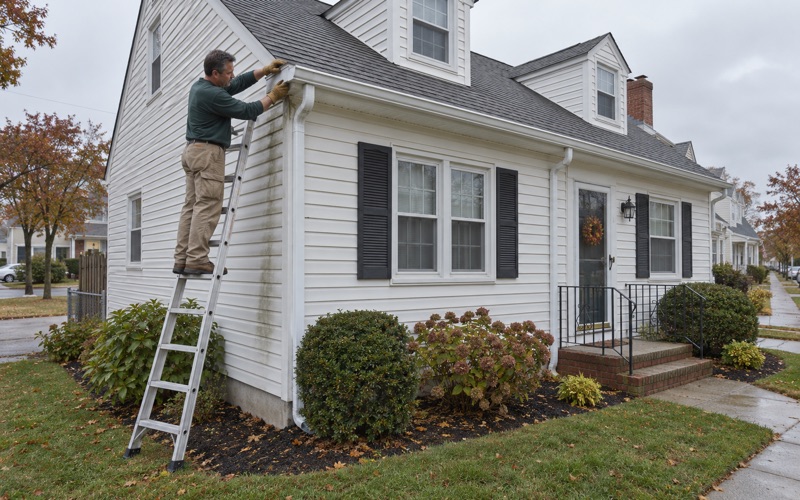
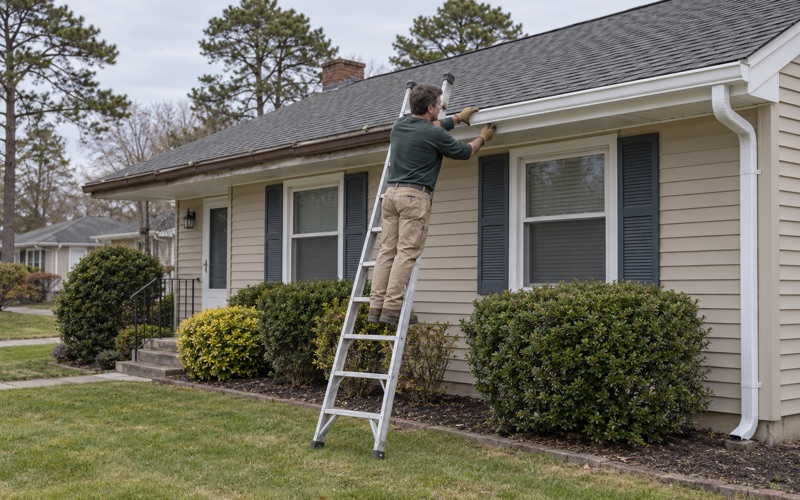
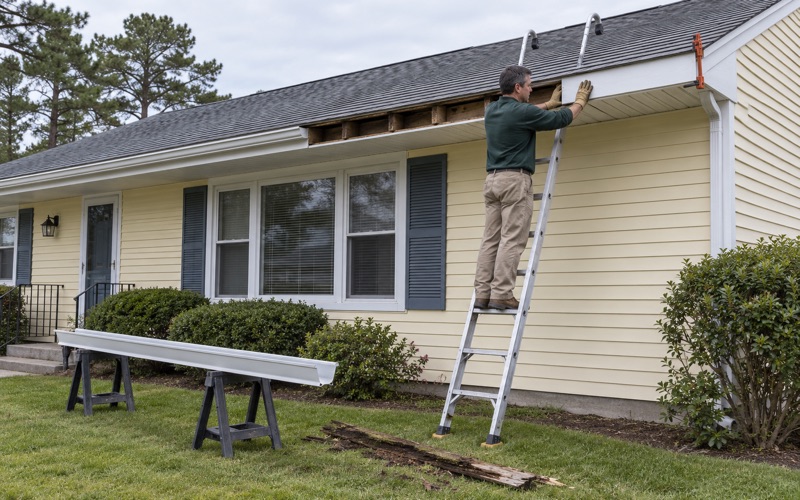
On a first visit we walk the full perimeter, measure each roof plane that feeds a gutter, and mark where every existing downspout lets go. We also check the fascia board behind the gutter for rot, because new gutters fastened to soft wood pull loose within a season or two. If we find soft fascia, we show it to you before anything is replaced, so the decision stays yours.
We also look at the ground itself. For new grading, the 2021 New Jersey edition of the International Residential Code (R401.3) calls for the lot to fall a minimum of 6 inches within the first 10 feet from the foundation. Older side yards were not always graded that way, and a downspout plan has to work with the slope that is actually there.
Looking for gutters closer to Pine Lake Park? See Gutters in Pine Lake Park.
Why Roof Water Can’t Go Into the Sewer in Wall Township
What the township sewer code says
Because West Belmar is unincorporated, its sewer rules come from the Township of Wall. Wall Township Code Section 222-39, in Chapter 222 (Water and Sewers), lists roof leaders, sump pumps and downspouts among the connections that are not allowed into the sanitary sewer. In plain terms, rainwater from your roof is not supposed to end up in the sewer line that carries household wastewater.
We have read that section through a search excerpt rather than the full text, so we are careful not to say more about it than it says. What it makes clear is enough for planning purposes: piping a downspout into the sewer is not a drainage option in Wall Township. The water has to be managed on the lot.
When an old leader runs into a pipe
Some homeowners find a downspout that disappears into the ground and assume it connects to a storm line or a dry well. Sometimes that is true, and sometimes nobody knows where it goes. If we come across a leader running into a buried pipe, we flag it and recommend confirming where that line actually ends before relying on it.
An old connection to a sewer line is a code problem, not a feature to keep. If one turns up, the usual answer is to disconnect it at grade and redirect the downspout onto the lot with an extension or an underground line to a safe outlet. We explain the options and put each on its own estimate line, so you can see what each fix involves.
Leaving the yard to do the work
With the sewer ruled out, the lot itself becomes the drainage system. West Belmar sits at about 30 feet of elevation with no water frontage, so roof water here is a question of yard drainage rather than tides. That puts the emphasis on where each downspout discharges and how the ground carries water away from both houses.
In practice this means more thought goes into the last few feet of every downspout than into the gutter itself. A well-sized gutter is wasted if its downspout empties into a pocket between two foundations. We plan the outlet first and work backward to the gutter layout.
Extensions, Splash Blocks and Turning a Downspout
Splash blocks and short extensions
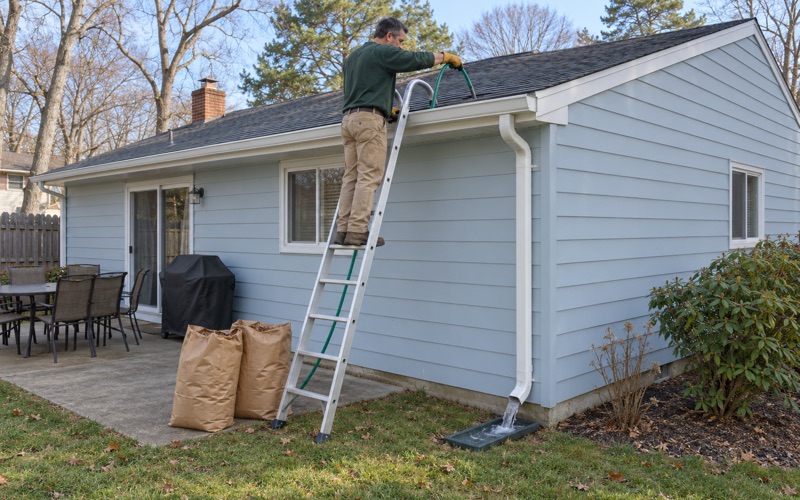
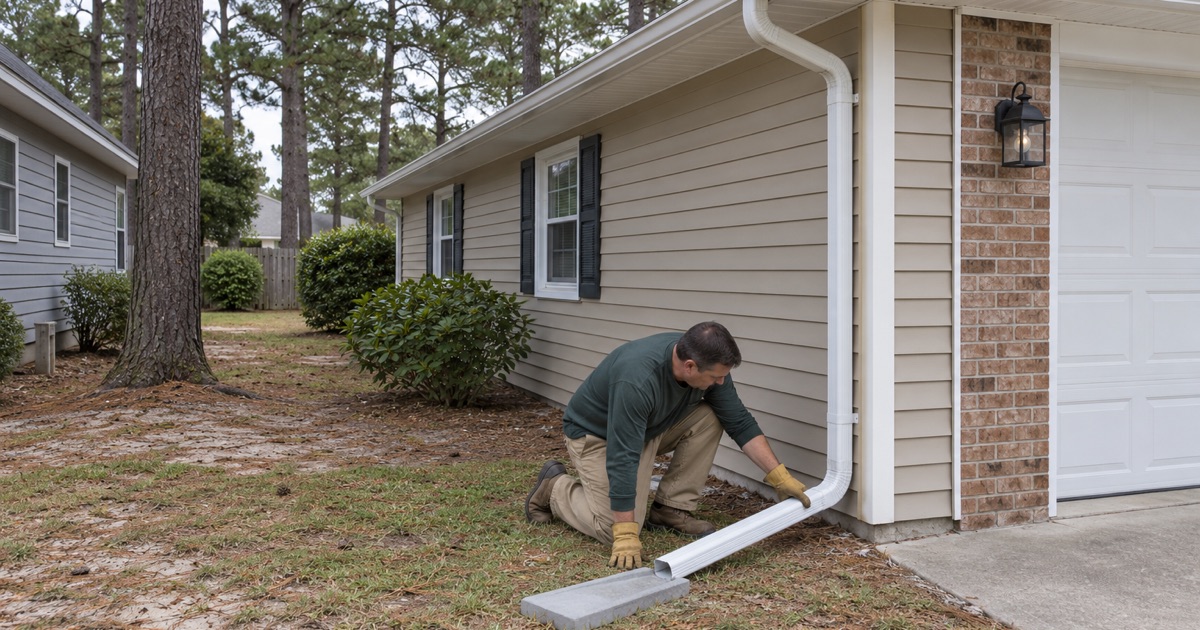
The simplest fix for a downspout that empties too close to the house is a splash block or a short downspout extension. A splash block slows the water and spreads it across the surface, which helps on a lot where the ground already slopes away. An extension carries the water a few more feet before releasing it, which can be enough to clear a flower bed or a basement window well.
On a narrow side yard, though, a long extension can end up pointing straight at the neighbor’s house. We size extensions to reach open ground on your side of the line, and when the side yard is too tight for that, we look at other routes. Hinged extensions that flip up for mowing are an option where the strip doubles as a walkway.
Turning a downspout toward the street or the back yard
Often the best answer is to move or turn a downspout rather than lengthen it. A downspout on the side of the house can sometimes be relocated toward the front or rear corner, where the water has room to spread across a lawn instead of pooling between two walls. With A and B elbows we can angle the bottom section toward the open side of the lot.
Moving a downspout also changes how the gutter above it drains, so we recheck the slope and outlet placement on that run. Seamless gutters formed on site make this easier, because we can set a wide-flange outlet exactly where the new downspout needs to be without adding a seam that might leak later.
Underground lines and pop-up emitters
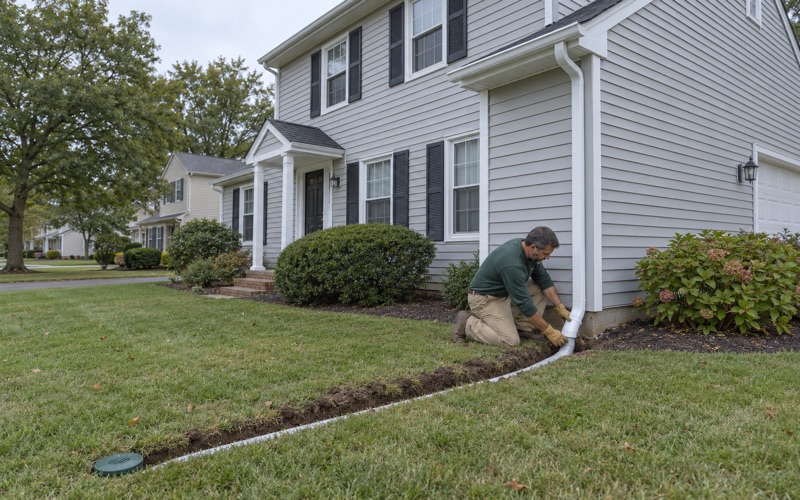
Where there is no surface route that keeps water away from both houses, an underground downspout line is the next step. The downspout connects to a buried pipe that carries water to a pop-up drainage emitter in a part of the yard that can take it, such as a front lawn. The emitter lifts open when water flows and closes again when it stops.
We propose an underground line only when the surface options fall short, because it adds cost and digging. When we do, the estimate shows the route, the length of pipe and where the emitter will sit. Our cleaning visits flush every downspout, buried lines included, so a clog does not quietly send water back toward the foundation.
Gutters Sized for a Small Lot
Sizing by roof area, not by habit
A small footprint does not mean a small gutter. A steep roof plane on a compact house collects water quickly and can send it to a short gutter run with only one place to drain. We measure the roof area that feeds each run and size the gutter and downspout to match, which usually means 6-inch K-style seamless gutters with 3x4 downspouts on the runs that carry the most water.
Bigger downspouts also matter on a tight lot because they let us use fewer of them. When every outlet has to be placed with the neighbor in mind, carrying the same water through two well-placed downspouts beats squeezing in a third that lands in the wrong spot.
Guards, hangers and hardware for the shore
Gutter guards help a lot on lots with mature trees nearby, but the right screen depends on what falls on your roof. Pine needles slip through coarse guards that work fine for oak leaves, so we match the guard to the debris we see, with stainless steel micro-mesh where needles are the problem. We fasten gutters with hidden hangers rather than spike and ferrule, since hangers hold the shape of the gutter better over time.
Salt air at the Jersey Shore wears on fasteners and sealants faster than inland air does. We pick hangers, screws and tripolymer gutter sealant with that in mind, and we name the materials on the estimate so you know exactly what is going on your house.
Older houses and matching the style
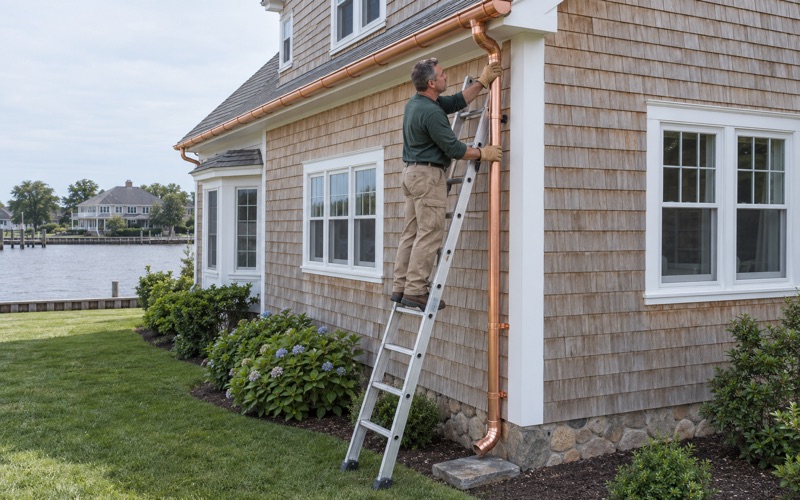
Census estimates count 567 West Belmar housing units built in 1939 or earlier, and some of those homes suit a different gutter than a modern K-style. Where it fits the age and style of the house, we offer half-round gutters with a double-bead profile or 16-ounce copper gutters that weather to a patina. For painted fascia and trim on pre-1978 houses, we follow the EPA Renovation, Repair and Painting rule.
Estimates, contracts and photos
Every estimate lists new gutters and repair work on separate lines, because New Jersey taxes them differently: new gutters can be an exempt capital improvement, while repairs are taxable. Our contracts follow the state’s home improvement rules, including the three-day cancellation notice. After each cleaning or repair we send before-and-after photos, which owners of rental houses and second homes find useful when they cannot be there to look.
- 20+ Years Experience
- Free Written Estimates
- Before-and-After Photos