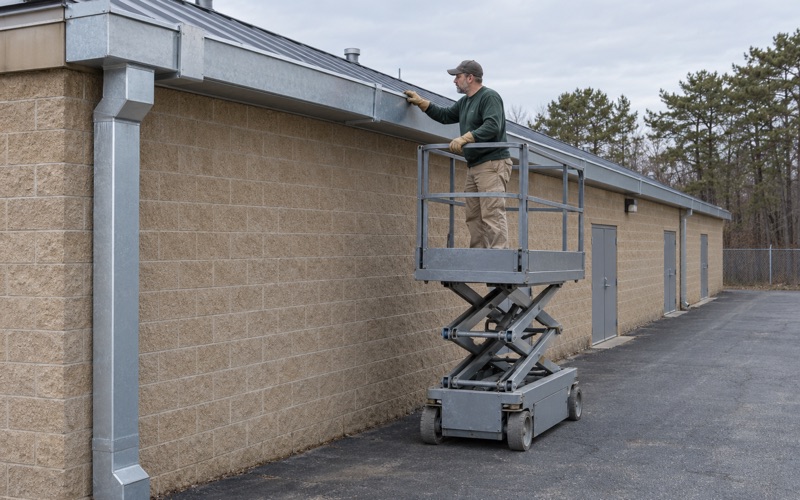
Brick Quality Gutters has worked on gutters in Spring Lake Heights and along the Jersey Shore for more than 20 years, and much of our work in this borough begins with a question about who answers for the roofline. A homeowner decides for one house. A building owner or property manager answers for a row of tenants and a state record, and the gutters are part of that answer.
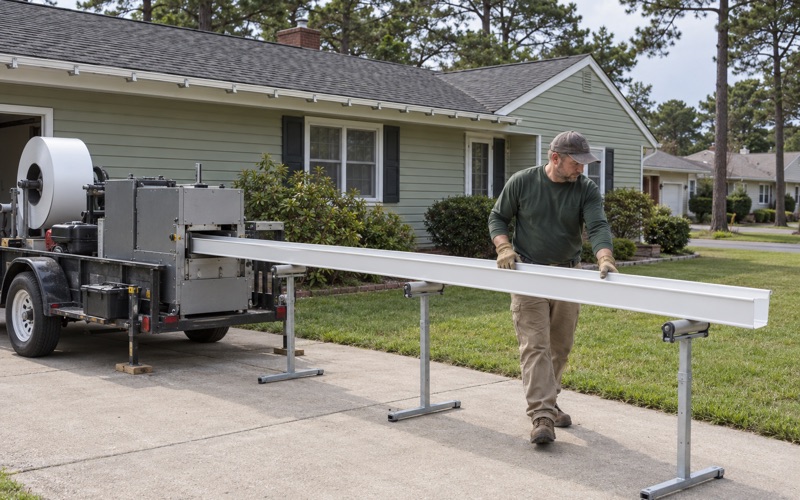
We install seamless gutters formed on site from coil, so each run of a building comes off the machine as one piece with no joints along the eave. Gutter and downspout sizes are worked out from the roof area that drains into each run, which matters on wide multi-unit roofs where one leader can carry far more water than it would on a small cape.
Then we follow every downspout to the spot where its water lands. When it empties against a foundation, a walk or a parking area, we propose an extension or an underground line and list it on the estimate. New gutters and repair work sit on separate lines because New Jersey taxes them differently, and our contracts follow the state’s home improvement rules, including the three-day cancellation notice.
Apartment Buildings and the Leaders-and-Drainpipes Rule
Spring Lake Heights holds more apartment housing than its size suggests. Census estimates (ACS 2024 five-year) put 928 of the borough’s 2,777 homes in buildings of three or more units, roughly one home in three, and 833 of its 938 renter households live in those buildings. For gutter work, that makes landlords and managers a large share of the people we answer to here.
Buildings Registered With the State
New Jersey treats a building of three or more dwelling units as a multiple dwelling. The NJ DCA Bureau of Housing Inspection covers these buildings, including condominiums and cooperatives, and owners register each one and recertify it every year. The law also calls for a five-year cyclical inspection of registered buildings.
For an owner, registration means the building’s upkeep is measured against a written state standard rather than the habits of whoever last cleaned the gutters. We keep that in mind on every quote, and we write our estimates and invoices so a property manager can file them with the building’s maintenance records.
What N.J.A.C. 5:10-7.5 Says
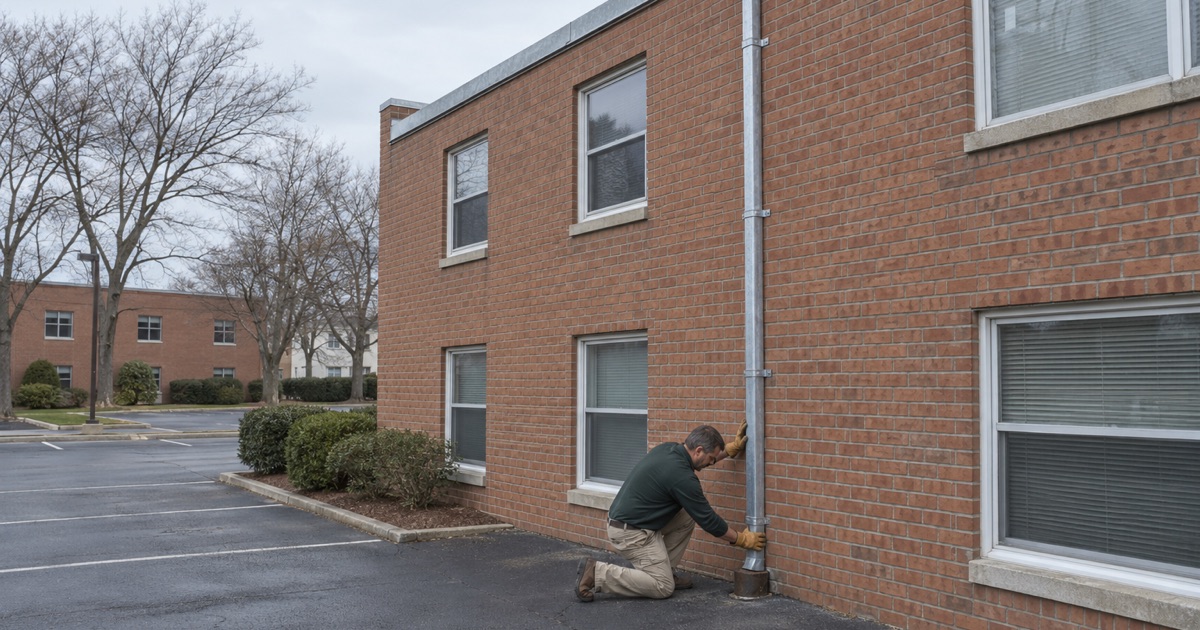
The state’s maintenance code for multiple dwellings, N.J.A.C. 5:10, has a section devoted to leaders and drainpipes. Section 5:10-7.5 says that leaders and drainpipes shall be securely fastened to the building and maintained in good condition, free of leaks. It also requires that they be kept clean and free of obstructions.
The same section asks that they direct storm water into draining systems and away from the foundation walls of the structure. Put simply, a sagging gutter, a leaking corner or a downspout packed with leaves is a maintenance item under the code, not just an annoyance for the ground-floor tenant watching water sheet past the window.
How We Answer Each Part of the Rule
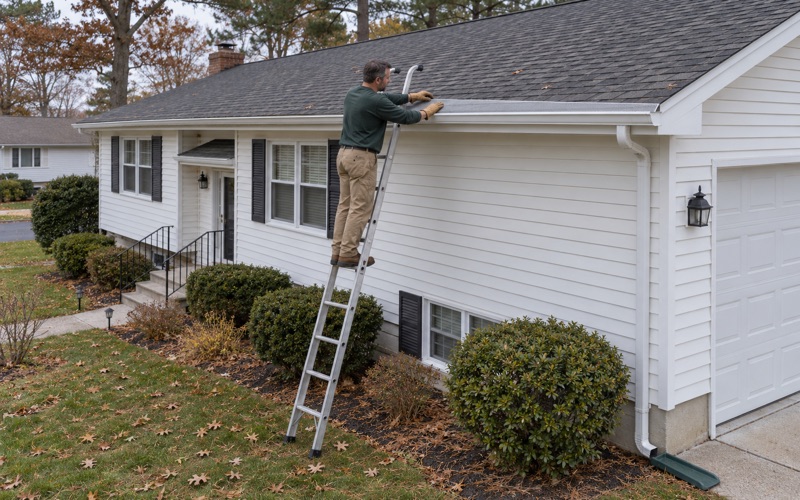
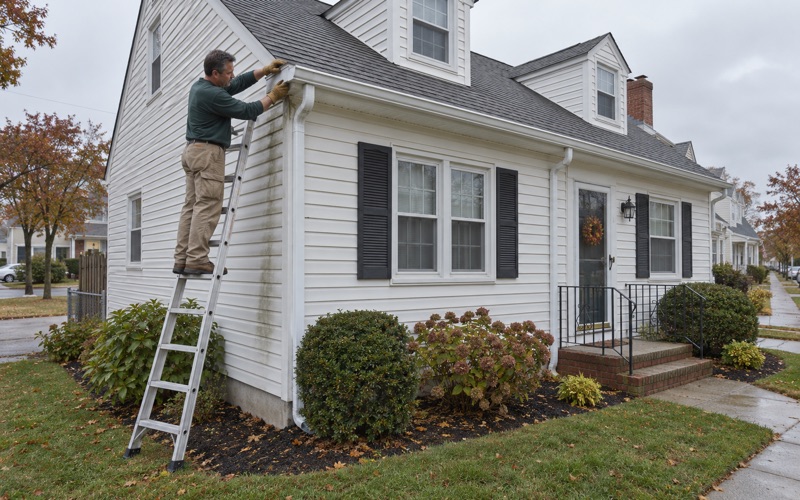
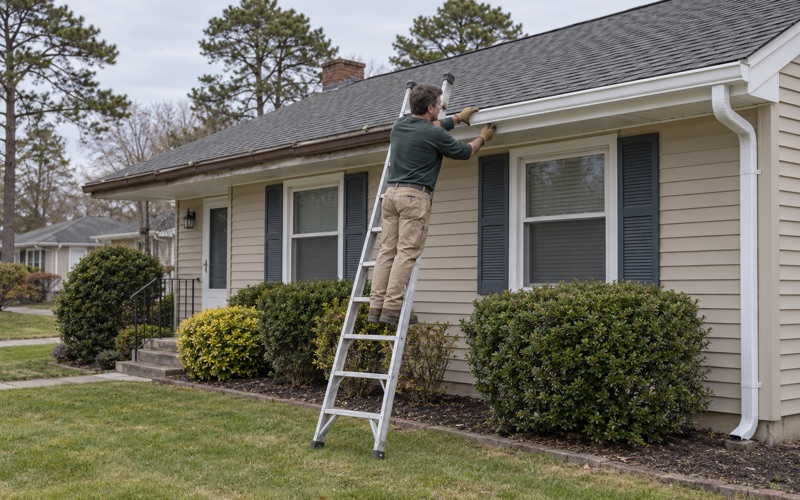
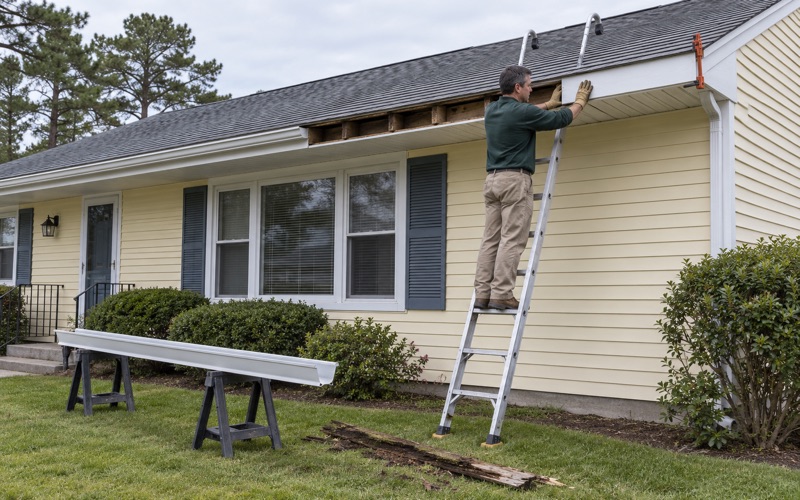
Fastening is where we start on an older building. Most of the borough’s housing went up between 1960 and 1989, 1,822 units by the census count, and older spike and ferrule hangers tend to work loose as fascia ages. We check the fascia for rot first, show the owner any soft wood before we replace it, and then hang the new gutters on hidden hangers.
Leaks and obstructions come next. Seamless runs remove the joints where most leaks begin, and we seal corners, miters and end caps with tripolymer gutter sealant. For the drainage clause, we trace each leader to grade and note on the estimate where its discharge sits too close to a foundation wall.
Looking for gutters closer to Wall? See Gutters in Wall.
Townhouse and Condominium Gutters: Association or Owner
Attached homes are the borough’s other large group. The census counts 524 attached units, 399 of them owner-occupied, so a townhouse owner and an association often share a roofline along with the question of who pays for the gutters on it.
Read the Master Deed Before the Ladder Goes Up
In an association, we check the master deed or call the management office before we quote, so the owner knows whether the gutters belong to the unit or to the common elements. Responsibility differs from one community to the next, and a document gives a better answer than a neighbor’s memory of who paid last time.
When the gutters turn out to be a common element, the owner’s part is usually to report the problem and let the management office schedule the work. When the unit owner holds them, we quote to the owner directly and match profile and color, so one unit’s new run does not stand out from the rest of the row.
Warranty Terms Change on Attached Homes
Manufacturer warranties treat attached housing differently from a detached house. The Alside Rainware 20-year limited warranty, for example, keeps its 20-year term only when the product is installed on a detached, single-family residence owned by natural persons. Otherwise the term is ten years, and the warranty names a condominium or duplex as its example.
We tell condominium and townhouse owners about that difference before they sign, because it changes how they should weigh the purchase. A ten-year term on a shared building is still worth having, and it is better planned around up front than discovered after a claim.
Registration Does Not Reach Every Building
Some condominium buildings sit outside the state program altogether. Sections of not more than four units with owner-occupied units can be exempt from DCA registration, so a small cluster of townhouses may fall outside it while a larger building next door is inside. The association’s records or the management office will say which applies.
Leaders, Foundations and the Sanitary Sewer Ban
Where a leader sends its water matters as much as how well the gutter catches it. On a multi-unit building, a single leader can drain a long stretch of roof, and the place where it empties is often a walkway, a parking area or a basement wall.
Borough Code § 14-1.4
Spring Lake Heights settles one option outright. Borough code § 14-1.4 says that no person shall connect or cause to be connected into any sanitary sewer located within the borough any drain or leader designed to collect ground or surface waters. Roof water cannot go into the sanitary line, whatever the age of the building.
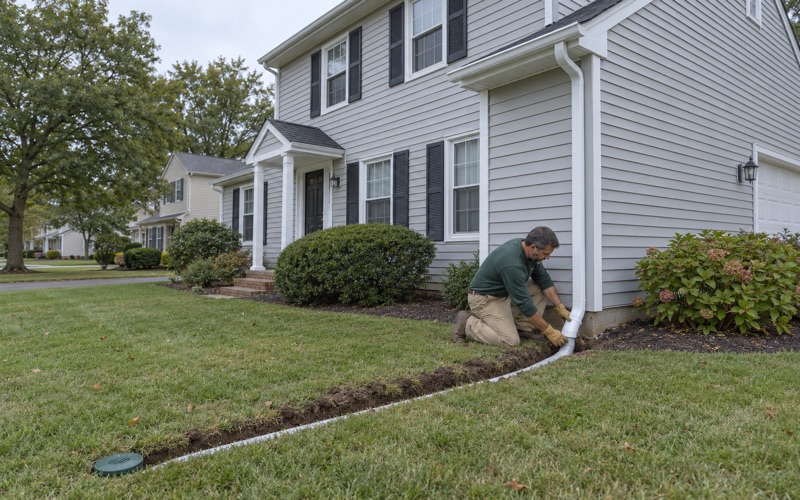
When we find a leader that disappears into the ground with no visible outlet, we flag it for the owner rather than guess where it goes. Any underground line we install carries roof water to a pop-up drainage emitter or another surface outlet, never into a sanitary connection.
Moving Water Off the Foundation
The 2021 New Jersey edition of the IRC, in R401.3, calls for the ground to fall 6 inches within the first 10 feet from a foundation. A downspout that empties at the wall works against that slope, and the usual result is a damp crawlspace or a stained basement wall that a tenant reports months later.
We propose an extension, a splash block or an underground line based on what sits beside each building, and we name the outlet on the estimate. On a building with tenants, we route discharge away from entrances and walks so the water does not end up as ice on a path in January.
Larger Outlets for Larger Roofs
Multi-unit roofs often drain long runs into only a few leaders. We size the system for the roof area behind each run, often with 6-inch K-style seamless gutters, 3x4 downspouts and wide-flange outlets, so the leader takes water as fast as the gutter delivers it.
Elbows matter too. We choose A and B elbows to keep turns as gentle as the wall allows, because every tight bend is a place where leaves catch and water backs up into the trough.
Scheduled Maintenance for Property Managers
A building held to a written maintenance standard does better on a schedule than on calls after a leak. We set up recurring visits for property managers and building owners who want leaders kept clear before a problem reaches a tenant.
Cleaning Visits That Leave Nothing Behind
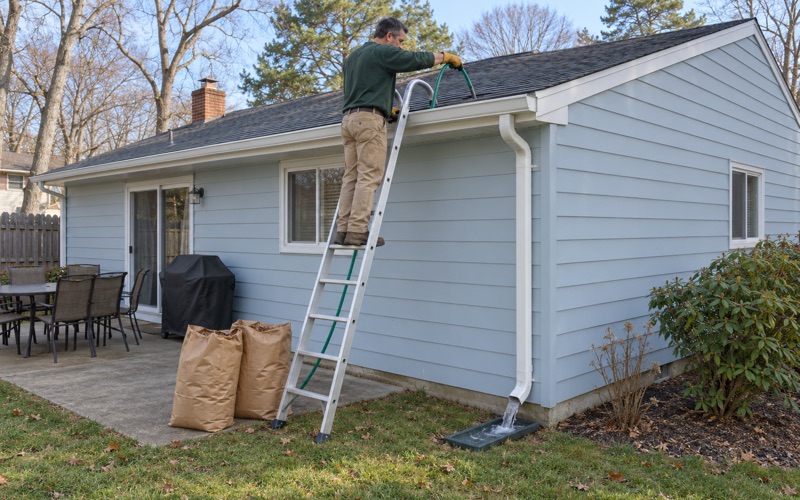
On each cleaning, we clear the troughs by hand, flush every downspout to confirm it runs freely and bag the debris. Nothing is left on the lawn, in the parking lot or in the street, which matters on a property where tenants and neighbors see the work as it happens.
Curb Canopy models the borough’s tree canopy at 26.1%, an estimate, so many buildings have trees close enough to drop leaves onto the roof. Where a lot sees heavy debris, we match guards to what falls, since pine needles and oak leaves call for different screens, and stainless steel micro-mesh suits fine needles.
Photos for the Building File
Every cleaning and repair comes with before-and-after photos. For a manager who handles several buildings, or an owner who lives elsewhere, the photos show the condition of each run and each leader without a trip to the site.
They also give the building’s maintenance file a dated record of the work. If a tenant reports water at a window, the photos show what the gutter looked like at the last visit and help narrow down where the water is coming from.
Salt Air and Material Choices
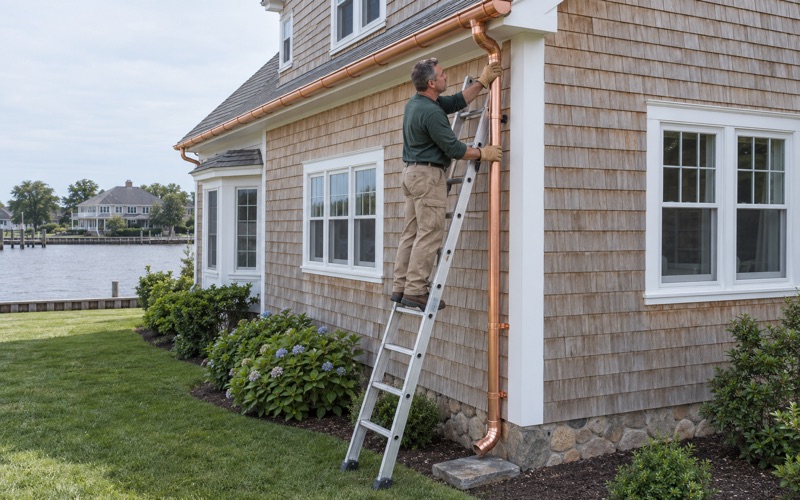
Spring Lake Heights sits in the southern coastal portion of Monmouth County, and salt air is hard on ordinary fasteners. We choose hangers, fasteners and sealants for the coast and name the material on the estimate, so the owner knows exactly what is holding the gutter to the building.
Coastal storms also test fastening. After a strong wind, we can walk the runs for pulled hangers and separated outlets, and a loose leader gets refastened before the next rain rather than after it.
- 20+ Years Experience
- Free Written Estimates
- Before-and-After Photos