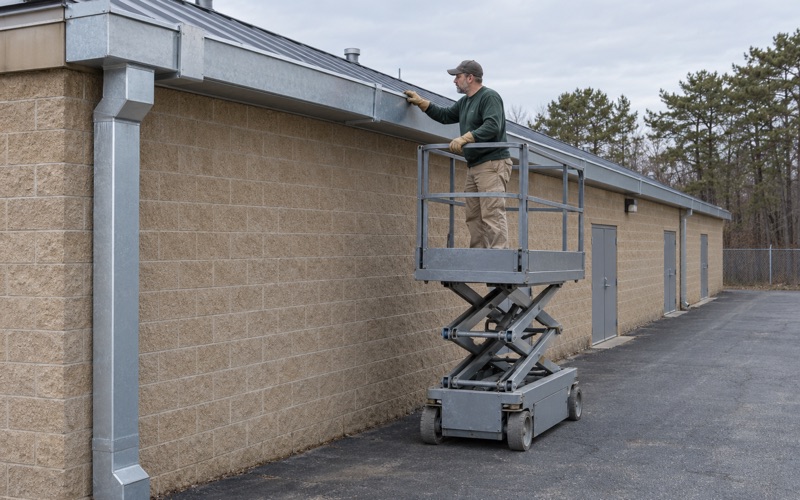
Brick Quality Gutters has spent more than 20 years cleaning, repairing and replacing gutters in Silver Ridge, and the question that shapes the work here is less about aluminum or downspout sizes than about who owns what. On many Silver Ridge lots the gutters belong to the homeowner while the trees shading them belong to someone else, and that split shapes how the work gets planned.
We handle the full range of residential gutter work: seamless runs formed on site from coil, downspout repairs and extensions, fascia checks, guards and cleaning visits. Before any of it starts, we look at the association documents with the owner so the scope fits what the community allows. That saves a homeowner from paying for work that a Board letter would have changed.
What follows is how gutter care actually plays out under the rules of the Silver Ridge Park Association, the East association. It covers what the declaration hands to owners, where the common ground begins, how a tree request goes to the Board, and what to ask before adding guards or changing a gutter profile.
Your Gutters, the Association’s Trees: How Silver Ridge Splits It
Silver Ridge is a census-designated place inside Berkeley Township in Ocean County, and many mailing addresses there read Toms River 08757. The East association is one of four associations in Silver Ridge Park, alongside West, Westerly Extension and North. The documents we describe on this page are the East association’s, so owners in the other sections should check their own papers.
What Article 9 puts on the owner
Article 9 of the East association’s declaration makes each owner solely responsible for exterior maintenance. The wording is specific: the owner is to paint, repair, replace and care for roofs, gutters, downspouts and the rest of the outside of the house. In practice, a sagging run, a split corner or a downspout that has pulled off the wall is the homeowner’s call and the homeowner’s bill.
That clarity is useful when you hire a contractor. There is no waiting on a management company to schedule a repair, and no question about whose crew is allowed on the roof edge. It also means a neglected gutter is not someone else’s problem, which matters for the enforcement rules covered further down.
Where the common ground begins
The trees are a different matter. The association’s rules, passed June 1, 2023, set the common area property line at 110 feet from the curb to the back of the home’s property. Trees on the far side of that line stand on common ground, and the owner of the house beside them does not control them.
A 2023 rule adds that, to maintain the common properties, only trees deemed dead, diseased or dangerous will be removed. The same rules note that the community is located in a forested area. For a gutter owner, that adds up to a canopy you live with rather than one you can thin on a whim.
Why we check the documents first
Checking the master deed or the management office before quoting is a habit we bring to adult communities and associations across the region. In Silver Ridge it tells the owner, in writing, that the gutters are theirs and the trees mostly are not. With that settled, the estimate can focus on keeping water moving under conditions the owner cannot change.
Looking for gutters closer to Leisure Village West? See Gutters in Leisure Village West.
Keeping Gutters Clear Under Common-Ground Trees
When the trees stay, the gutters have to cope with them. The houses here are one-story detached homes; the Census count for the CDP shows all 886 housing units as single-family detached. A low eave puts the gutter close to the ground, which makes cleaning simpler, but it also means an overflowing run soaks the soil right along the wall.
Cleaning visits that finish the job
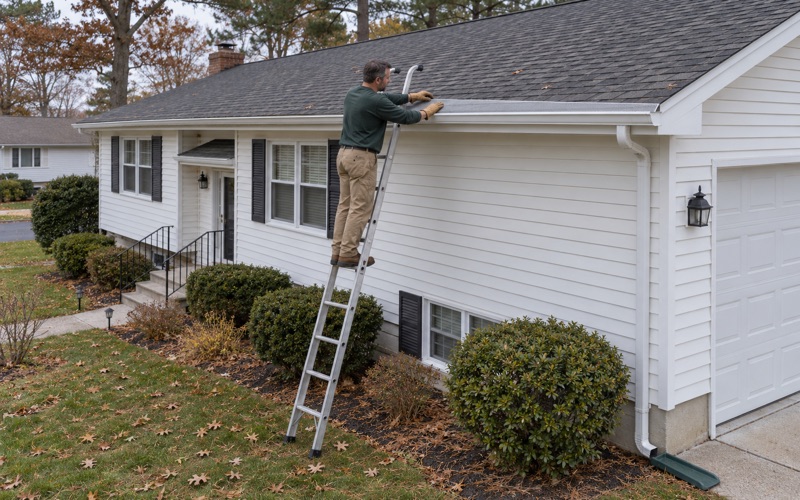
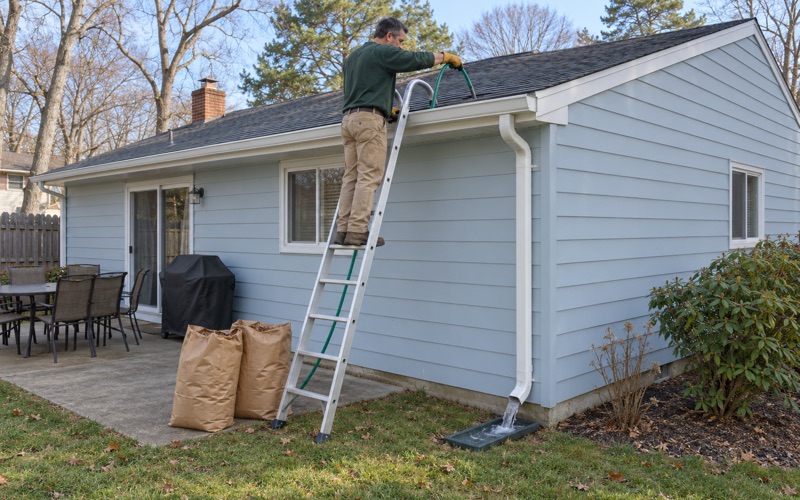
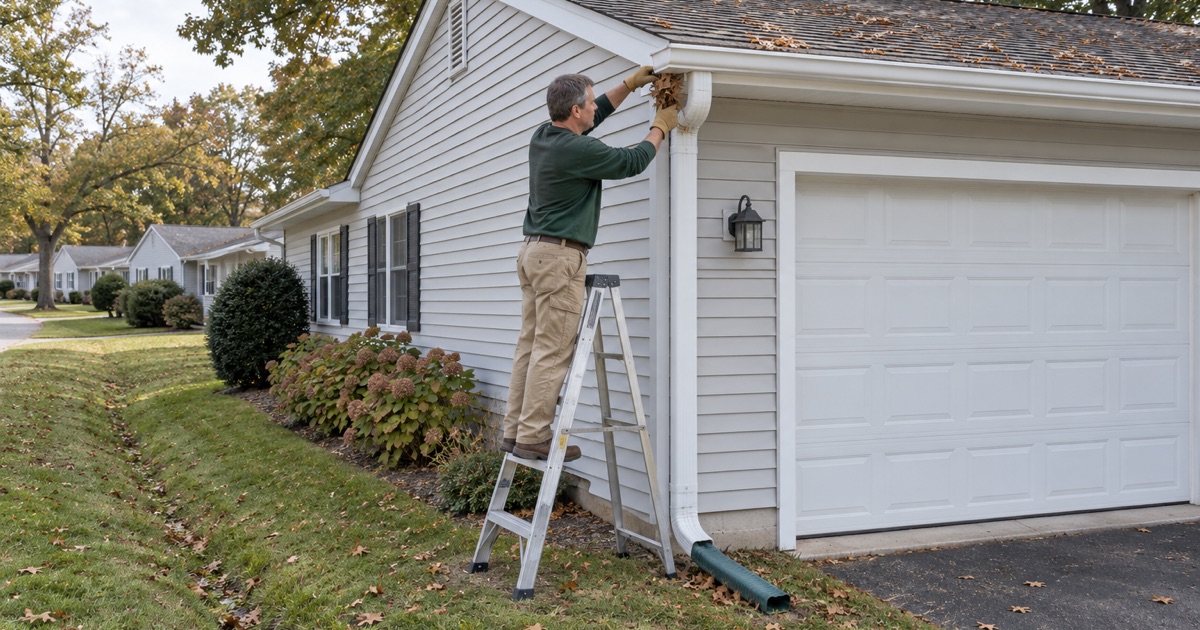
Our cleaning visits clear the troughs by hand and then flush each downspout so we know water runs through to the outlet. Whatever comes out is bagged and hauled away with us, so nothing is left on the lawn, on the walk or at the curb. For owners who spend part of the year elsewhere, before-and-after photos come with each visit as a record of what was done.
How often a house needs cleaning depends on how much of the roof sits under the common-ground canopy. A house with trees close behind it may need more visits than one facing open lawn. We suggest a schedule after seeing the lot, not from a standard calendar.
Following each downspout to where it lands
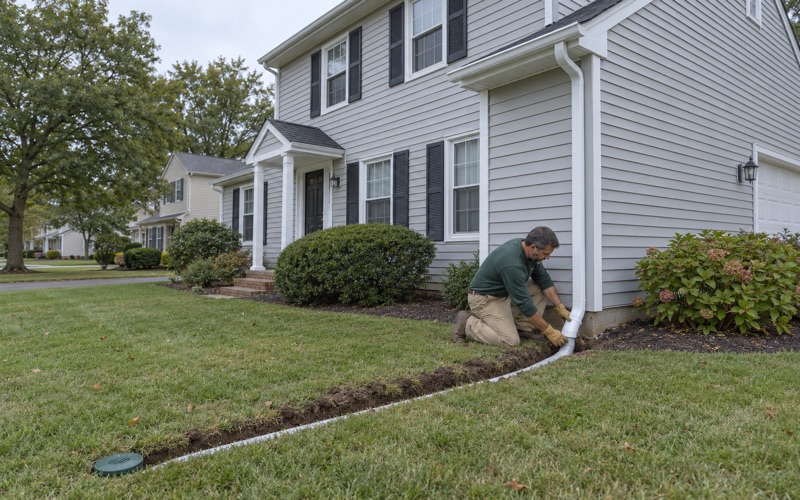
A clean gutter only helps if the downspout sends water somewhere useful. We follow each downspout to the spot where its water lands, and when it empties against the foundation we propose an extension or an underground line with a pop-up drainage emitter. The 2021 New Jersey edition of the residential code calls for grade that falls 6 inches within the first 10 feet from the foundation, and a downspout dumping at the wall works against that.
The soil at the CDP’s census point maps as Lakehurst sand on 0 to 5 percent slopes, rated moderately well drained. That is a single mapped point, not a survey of each yard, so we look at where water actually pools on your lot before recommending a line.
Sizing and seams for low eaves
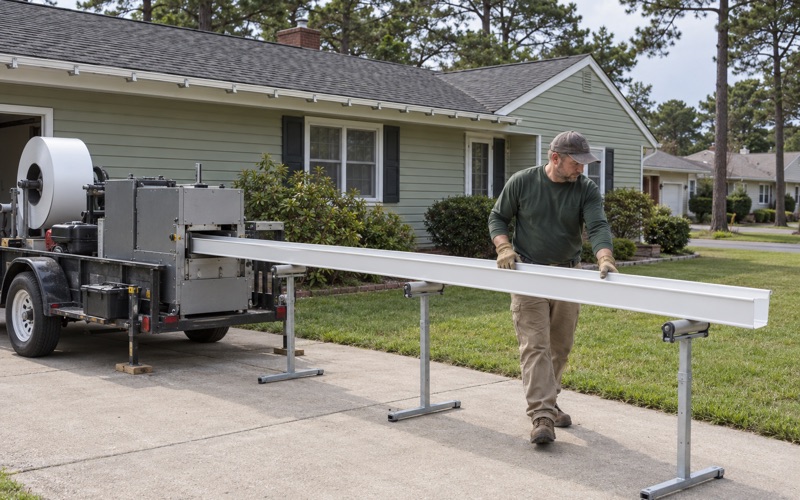
We size gutters and downspouts for the roof area that drains into each run instead of by habit. On many Silver Ridge houses that means 6-inch K-style seamless gutters with 3x4 downspouts, formed on site from .032 aluminum coil in one piece per run. Fewer seams mean fewer places for a clog to start a leak.
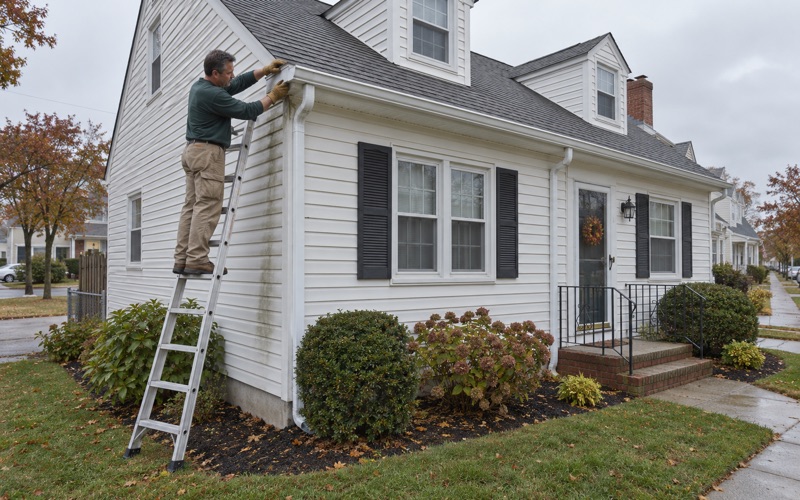
Before a new run goes up, we check the fascia behind it for rot. If the wood is soft, we show it to the owner first and only replace it with their go-ahead. On houses built before 1978, painted fascia and trim can fall under the EPA Renovation, Repair and Painting rule, which owners should keep in mind when that trim is disturbed.
Asking the Board, and When the Association Steps In
Sometimes a tree really is the problem, whether it drops so much onto the roof that the gutters cannot keep up or it leans toward the house. The East association has a written process for that, and it starts with the Board, not with a saw. Knowing the steps keeps an owner on the right side of the rules.
A written request comes first
The association’s Grounds, Trees and Board Policy for Common Grounds, adopted December 2, 1999, is direct. No homeowner shall remove or cause to be removed any living, dead or diseased tree from any common ground without expressed written permission from the Board of Trustees. Healthy trees are not to be removed solely for convenience or for appearance.
An owner who wants a common-ground tree taken down at their own expense must apply to the Board in writing with the contractor’s certificate of insurance. No work may be done until written permission is granted, and the policy adds that a Berkeley Township permit is needed if required. We are a gutter contractor, not a tree service, but we can describe the gutter conditions in writing if that helps an owner explain the request.
Hazard trees belong to the Board
The same policy says trees posing a danger to persons or to private property are the responsibility of the Board of Trustees. If a common-ground tree threatens the roof or the gutter line, the owner’s first call is to the association. That is a different path from a convenience request, and it does not leave the cost with the homeowner by default.
The association can correct and bill
Article 9 also lets the association correct a condition that could cause injury or damage, at the owner’s expense, with a lien on the lot. A gutter hanging off the eave or a downspout that has come loose could fall into that category. Keeping the system in repair is cheaper than paying for a correction someone else arranged.
Rule 13 of the 2023 rules adds that any violation of Architectural Control rules must be corrected at the time of sale to obtain a certificate of occupancy. Berkeley Township’s code, § 11-1.6A, also asks for evidence of the homeowners association’s written approval for permits and certificates of occupancy in a Planned Residential Retirement Community.
Approval Before Exterior Changes, and What to Ask About Gutter Guards
Replacing gutters is listed as ordinary maintenance under N.J.A.C. 5:23-2.7(c)1.xvi, the statewide construction rule. The association’s own approval rules are a separate question, and the East association takes exterior changes seriously. A short conversation with the committee before work begins avoids trouble later.
The 2015 resolution on exterior changes
A resolution effective August 6, 2015 says the Board or the Architectural Control Committee must review and approve in writing any addition, alteration or change to the exterior of a Living Unit. The list includes structural, cosmetic and decorative changes. Fines run up to $500 per violation and up to $100 per day while unapproved work continues.
The documents do not mention gutter guards or a change of gutter profile by name. Whether either counts as an exterior change is something the Architectural Control Committee can answer, so we suggest owners ask before ordering. We can supply product details and photos for that request.
Choosing guards for the debris on the lot
When guards are approved, we match them to the debris that actually lands in the gutters rather than pushing one product. Stainless steel micro-mesh guards suit fine material, while other screens handle larger leaves better. We look at what we pull out during a cleaning before suggesting either.
Matching the look matters here too. A guard that sits low under the shingle line keeps the gutter’s face unchanged, which may make the committee conversation easier. Hidden hangers rather than spike and ferrule keep the front of the run clean as well.
Estimates and contracts written for New Jersey
Our estimates put new gutters and repair work on separate lines, because New Jersey taxes them differently. Under the state’s guidance, new gutters are an exempt capital improvement documented on Form ST-8, while repairing gutters is a taxable repair. The split lets an owner see where the tax applies.
Contracts follow New Jersey’s home improvement rules, including the three-day cancellation notice. Combined with the association’s written approval when it is needed, that paperwork gives a Silver Ridge owner a clear record of what was agreed and when.
- 20+ Years Experience
- Free Written Estimates
- Before-and-After Photos