Brick Quality Gutters has spent more than 20 years on gutters in Ramtown and the rest of Howell Township, and most of what we see here comes back to one thing: leaves. We clean, repair, guard and replace gutters on the houses across this neighborhood. The work changes with the season more than it does in most towns we serve.
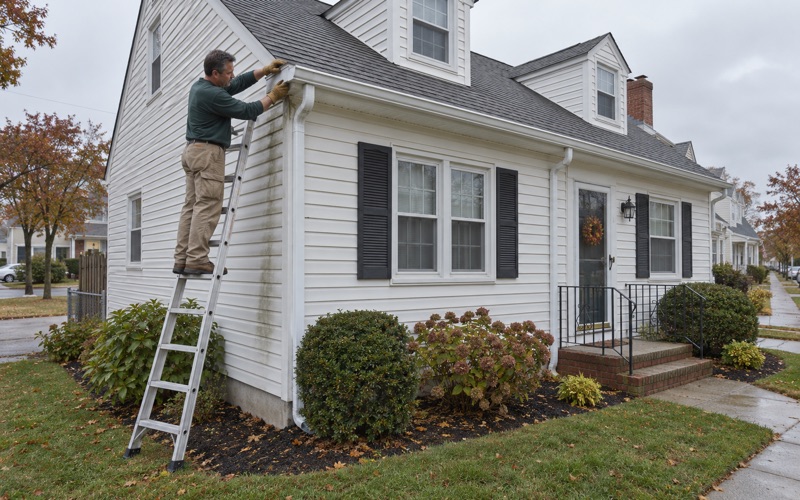
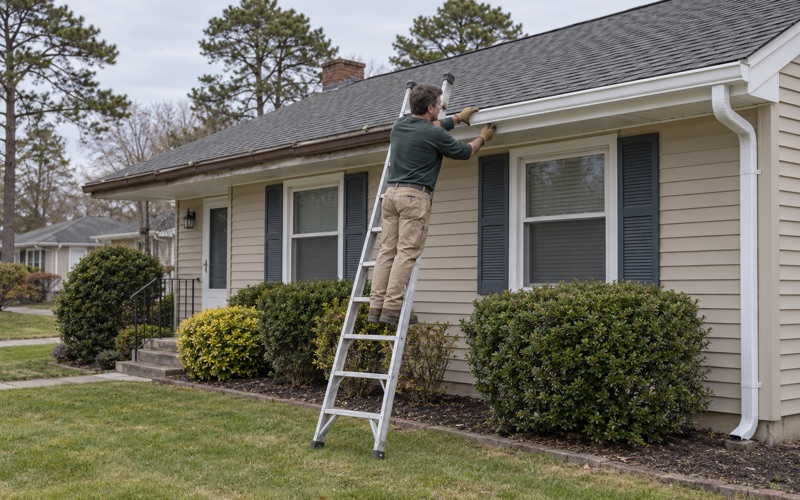
A typical visit starts on the ground. We walk the house, note where each downspout lets out, and look at the fascia board behind the gutter before anyone climbs a ladder. That walk tells us whether the house needs a cleaning, a repair, a set of guards, or new gutters, and the estimate says which.
We write the estimate to keep two kinds of work apart. New gutters and repairs sit on separate lines, because New Jersey taxes them differently, and any contract follows the state’s home improvement rules, including the three-day right to cancel. You get before-and-after photos of the finished work either way.
Oak Leaves and Ramtown Gutters
The leaves that fill Ramtown’s gutters come from the ground the neighborhood sits on. Knowing which trees that ground supports, and how old the houses under them are, explains why the gutters here behave the way they do.
Oak-woodland sands under the neighborhood
A 25-point sample of USDA soil survey data across Ramtown came back almost entirely sand: Evesboro at 8 points, Downer at 9, Lakehurst at 4 and Lakewood at 2. These are not neutral soils. The official NRCS description of Evesboro lists its dominant vegetation as black oak, white oak, red oak, yellow poplar and chestnut oak, and Downer’s native cover is white, red, scarlet and black oak.
That is an inference from the soil, not a tree count, and we do not claim to know Ramtown’s canopy share. What it does tell us is what grows well when a lot is left alone. On the roofs we work, the debris in the trough is mostly broad oak leaves, with stems, catkins and small twigs mixed in.
The same sands shape what happens below the gutter. Evesboro is rated excessively drained and Downer well drained, so water soaks in fast once it is spread out. Concentrated at one downspout, though, it can still wash out a bed or pool against a wall before it has time to sink in.
Houses old enough for the trees to catch up
Of Ramtown’s 2,303 housing units, 2,157 are detached houses, and 1,474 of them were built between 1980 and 1999. Trees planted or left standing at that build-out have now had 25 to 45 years to grow. On many lots the crowns have reached the roofline and spread over the eaves.
Ownership is steady too: 2,159 of the 2,211 occupied homes are owner-occupied. That shows up in the work we are asked for. Owners here tend to plan around the gutters for the long run, so the questions are about keeping a system working through every fall rather than patching it to sell.
Looking for gutters closer to Lakewood? See Gutters in Lakewood.
Why Ramtown’s Gutters Fill Again: Timing Cleaning to Howell’s Leaf Collection
The most common call we get from Ramtown in December is from someone whose gutters were cleaned in October and are full again. That is not a bad cleaning. It is the local leaf calendar, and the township’s own schedule shows how late it runs.
Leaves that hang on into December
Howell’s public works department set fall 2025 leaf collection to begin on or about November 3, with leaves at the curb by November 30 and the last round starting December 1. Oaks often hold a good share of their leaves well past the first frost, and many drop the rest in late November and early December.
In 2017 the township went further. Officials pushed the final leaf pass back a week, to December 4, because warm weather had left leaves on the trees. A gutter cleared in late October on one of those years would still have had most of an oak’s crown waiting to come down on it.
Planning a second fall cleaning
For many Ramtown homes under mature oaks, we suggest two fall visits. The first comes after the early drop, so the gutters run clear through November rain. The second comes once the oaks are mostly bare, usually close to the township’s final round, so the system goes into winter empty.
A single cleaning can work on a house with fewer trees or with guards already in place. We look at how much of the roof sits under a canopy before recommending either plan. You decide the schedule, and we tell you plainly when one visit will be enough.
What a full gutter does in a late storm
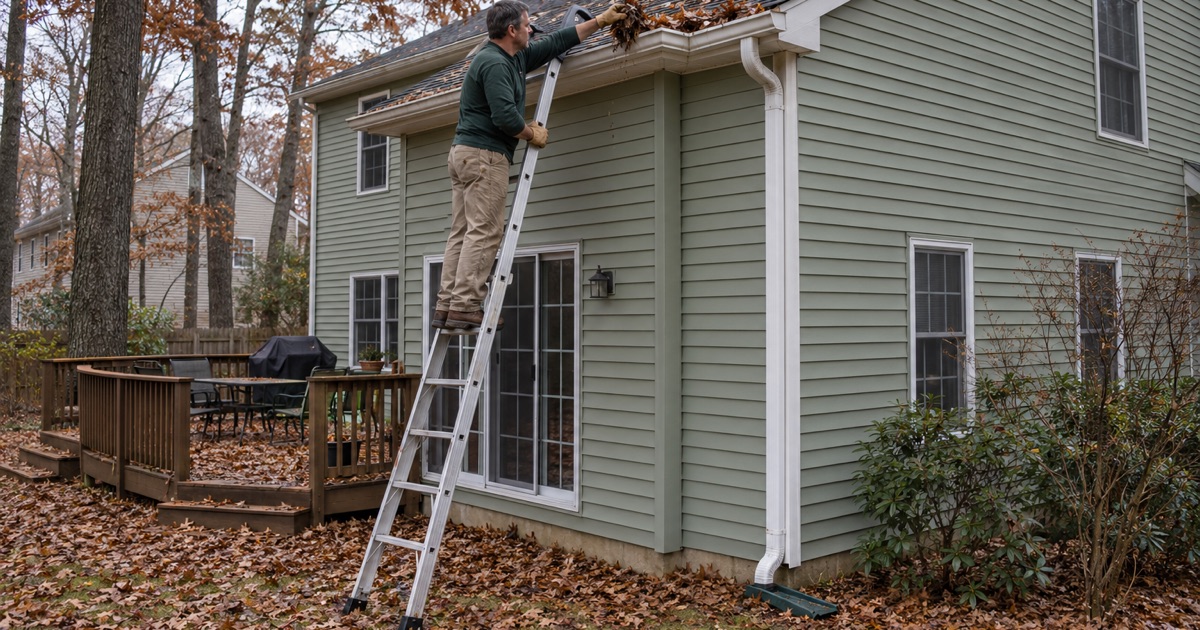
A gutter packed with wet oak leaves stops carrying water and starts holding it. The extra weight pulls on the hangers, and the overflow pours straight off the front edge, often onto walkways, steps and the soil right beside the foundation. In a cold snap, that standing water can freeze in the trough.
Late-season storms are when this shows up most, because the gutters are at their fullest just as the weather turns. Clearing them after the final drop, rather than only before it, is what keeps a December rain from spilling over the front of the house.
Where the debris goes
Howell collects leaves loose at the curb: the township asks residents not to bag them and to keep piles away from storm drains to prevent flooding. A gutter cleaning puts more leaves in one spot than raking does, so where they end up matters.
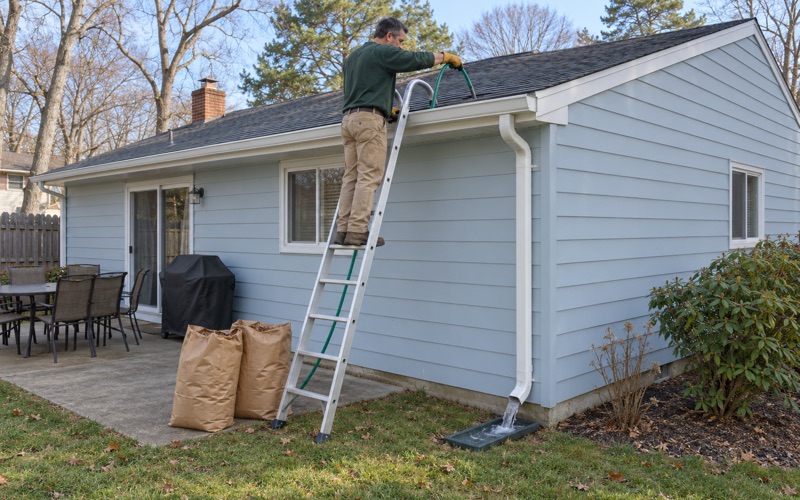
Our crews bag everything that comes out of the gutters and off the roof, so nothing is left on the lawn, the driveway or the street. On every visit we also run water through each downspout to make sure it drains end to end, because a clear trough over a packed downspout still overflows in the first storm.
Gutter Guards for Oak Leaves
Guards are the most direct answer to repeat cleanings, but the wrong guard can make an oak-leaf problem worse. We match the screen to what actually falls on the lot.
Matching the screen to broad leaves
Oak leaves are large and flat, and they tend to sit on top of a guard rather than slip through it. A stainless steel micro-mesh guard keeps out the leaves and the fine material that breaks off them, and its surface sheds dry leaves in the wind. Coarse plastic screens and foam inserts tend to trap stems and decaying leaf matter instead.
Lots that also carry pines call for a different screen than lots that are almost all oak. We look at the trees overhanging each side of the house before choosing, and on some homes the front and back runs get treated differently because the trees are different.
What guards still need
No guard ends maintenance under a heavy canopy. Leaves can mat on top of the mesh in a wet spell, and acorn caps and twigs can lodge at the edges. We tell owners to expect a light brushing of the guard surface after the late drop instead of a full cleaning.
Guards also change how we install around the roof edge. A guard that lifts shingles or sits behind the drip edge can let water behind the gutter. We fit them so the roof’s water still lands in the trough, and we check that the downspouts below are flowing before we put the guards on.
Adding guards to gutters already on the house
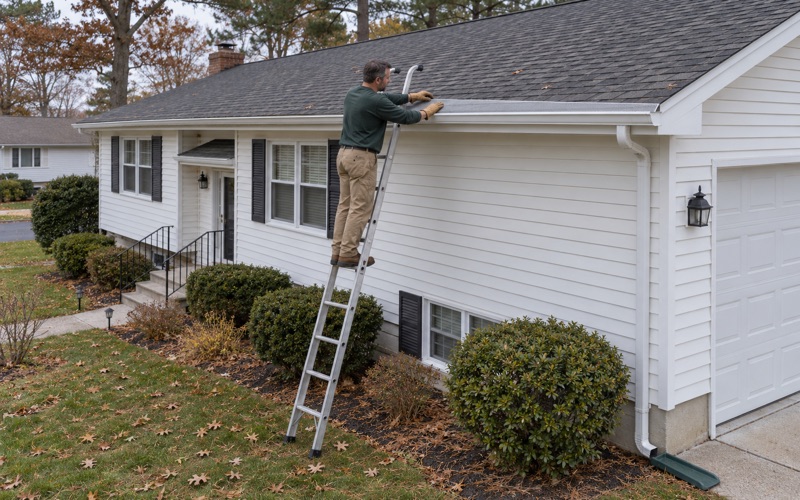
Guards can go on most existing gutters, but they only work as well as the gutter under them. Before fitting them, we clean the trough, flush the downspouts and check that the run still slopes toward its outlet. A sagging section that holds water should be rehung first, or the guard just hides the problem.
If the gutters are near the end of their life, we will say so before you pay for guards. In that case it usually makes more sense to put guards on with the new system, so both are sized and fastened together and the work is done once.
Gutter Replacement on Ramtown’s 1980s and 1990s Homes
Many houses in Ramtown went up in an era when sectional gutters hung on spikes were the norm. Thirty or forty years of leaf loads later, many of those systems are ready to be replaced rather than repaired.
Signs a gutter system has run its course
Sagging runs, spikes backing out of the fascia, leaking seams and corners that drip after every rain are the usual signs. Leaves sitting wet in a gutter year after year hold moisture against the metal and the board behind it, which speeds the wear.
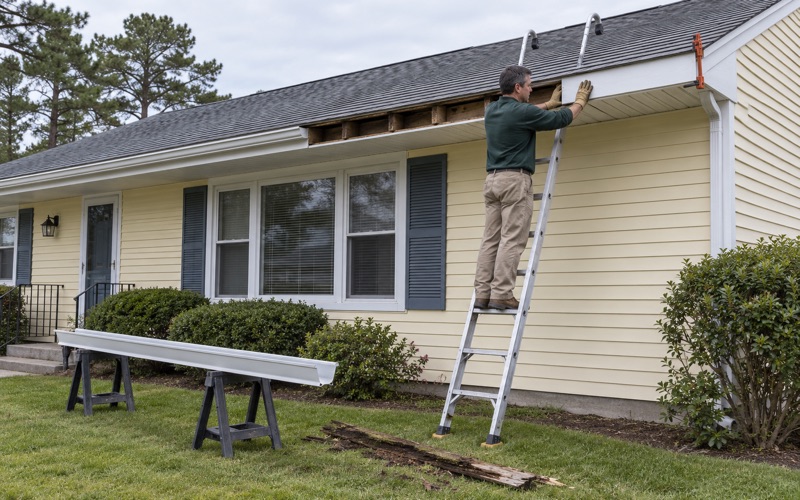
Before new gutters go up, we check that fascia board for rot. If any wood is soft, we show it to you before we replace it, so you can see why it is on the estimate. A new gutter fastened to soft wood will pull loose no matter how well it is made.
Seamless gutters sized for the roof
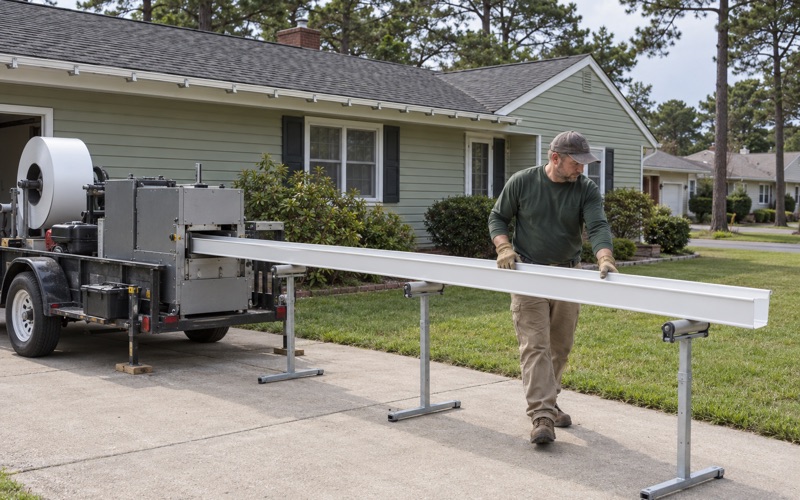
We form seamless gutters on site from aluminum coil, one piece for each run of the house, which removes the seams where older sectional systems leak. Hidden hangers replace the old spike and ferrule, and they hold the gutter far more firmly when it is loaded with wet leaves.
Gutter and downspout sizes are chosen for the roof area that drains into each run, not by habit. On a larger roof that sheds a heavy fall load, that can mean 6-inch K-style gutters and 3x4 downspouts, which pass leaf fragments more easily than smaller ones.
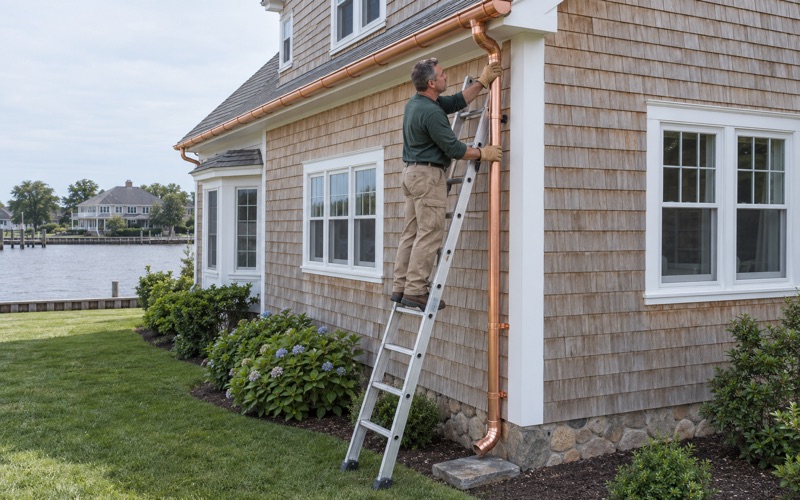
On an older or more traditional house, we can also match copper or half-round gutters to the age and style of the home. Half-round in a double-bead profile and 16-ounce copper weather to a patina over time, and we price them alongside aluminum so you can compare.
Following the water past the downspout
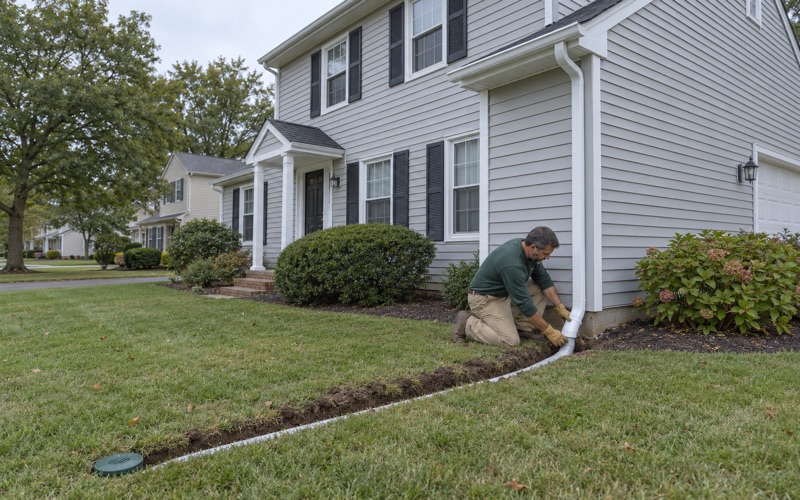
New gutters only help if the water ends up somewhere sensible. We trace each downspout to where it lets out, and when it lands against the foundation we propose an extension or an underground line with a pop-up emitter to carry it away.
On a corner lot or a house with a walkout, the right outlet is not always obvious, so we mark the options on the estimate. We show you where each downspout lands today and leave the choice of how far to carry it with you.
- 20+ Years Experience
- Free Written Estimates
- Before-and-After Photos