Brick Quality Gutters has spent more than 20 years installing, cleaning and repairing gutters in Point Pleasant, and the borough asks something of a gutter that most towns never put in writing. Here, a gutter is part of the lease cycle. Houses change hands between tenants on a monthly rhythm, and each change brings a county inspection and a fresh set of expectations about the property.
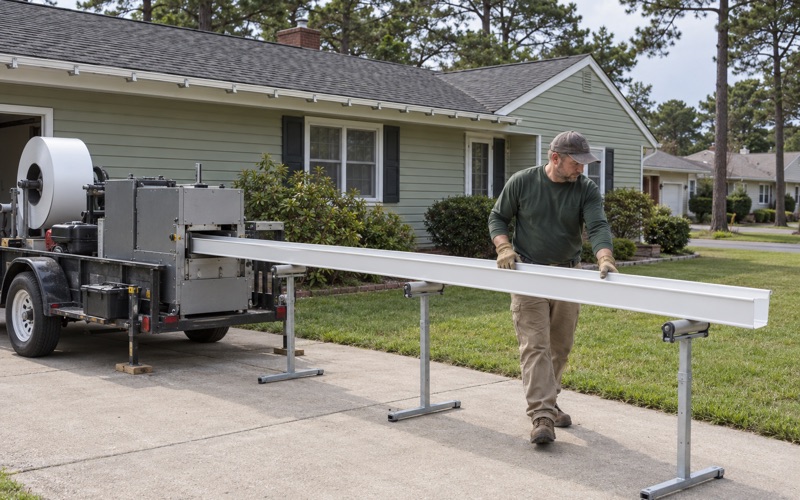
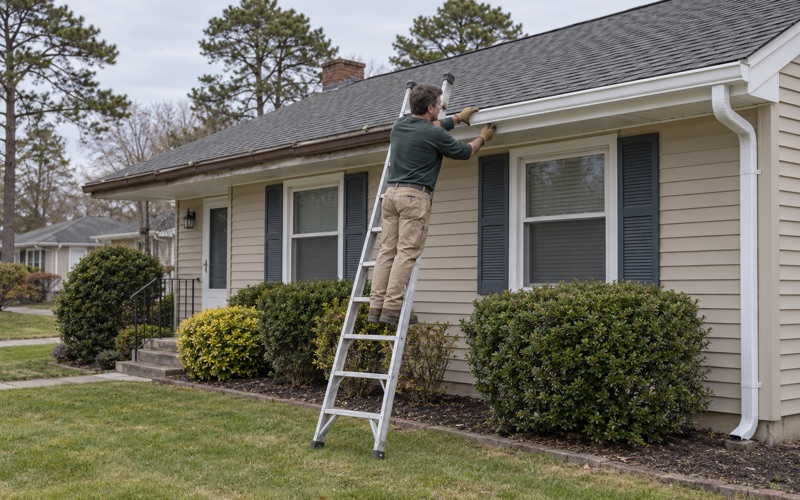
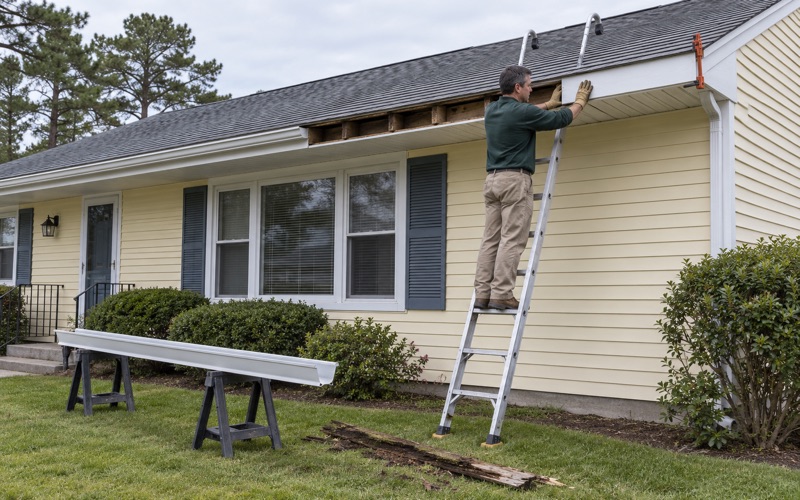
Our work starts with the house in front of us. We size each gutter and downspout for the roof area that actually drains into that run, then form seamless gutters on site from coil so every run is one continuous piece. Before anything is hung, we check the fascia board behind it for rot and show the owner any soft wood before we replace it.
Many of the owners we work for here are not in town most of the year. That is why every cleaning and repair visit ends with before-and-after photos, why our estimates split new gutters and repair work onto separate lines, and why our contracts follow New Jersey’s home improvement rules, including the three-day cancellation notice.
Gutter Cleaning on Point Pleasant’s Monthly Lease Calendar
Thirty Days Is the Shortest Stay
The borough settled the question of weekend rentals in November 2020. Section 8-10.3 of the borough code, added by Ordinance No. 2020-12, bars leasing a dwelling for a term of less than 30 days. A rented house here turns over by the month or the season, not by the weekend, and that rhythm sets the calendar for the gutters on it.
For an owner, a monthly tenancy means a small number of predictable handoffs instead of a constant churn. Each handoff is a natural point to have the gutters cleared and the downspouts flushed, because the house is between occupants, the yard is quiet and nobody is inconvenienced by a ladder against the eaves for an hour or two.
A Visit Timed to Each New Tenancy
The property maintenance code the borough adopted in 2023 added a change-of-occupancy rule, PM-104.7. Under it, every leased or rented building or unit in the borough is inspected by the Ocean County Fire Marshal’s Office on each initial occupancy or change of occupancy. That inspection is its own process, and we do not speak for what it covers.
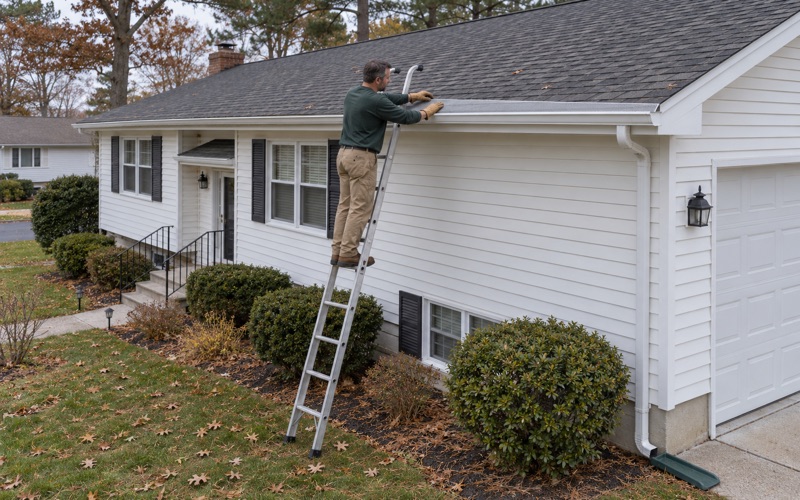
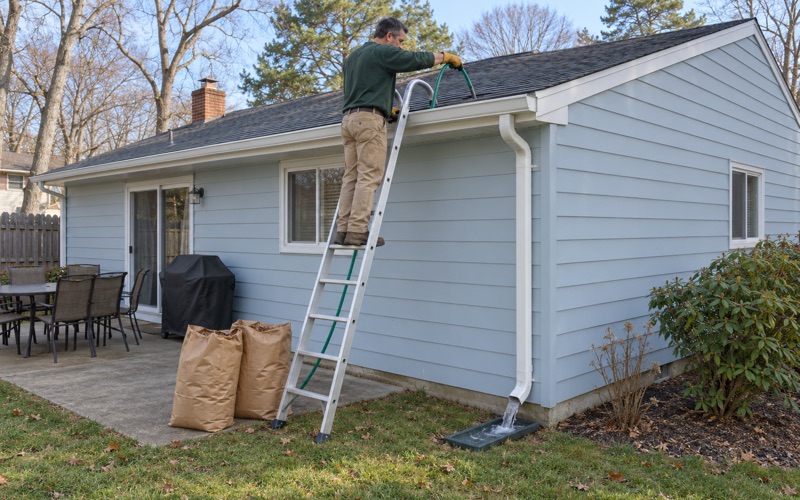
What we can do is make sure the gutters are not the loose end on move-in week. We book a cleaning for the gap between tenants, flush every downspout, bag the debris so nothing lands on the lawn or the street, and send the photos to the owner the same day. The tenant arrives to a house whose roof water already runs where it should.
Repairs Before the Next Lease Begins
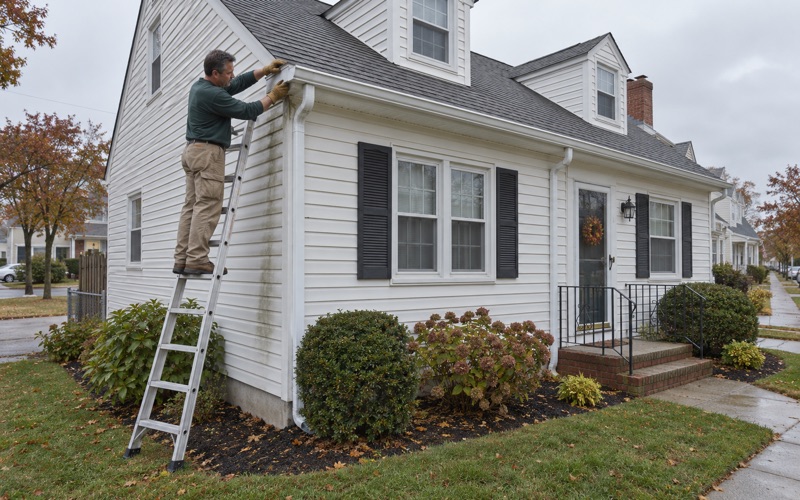
A cleaning often shows what a casual look from the driveway misses: a sagging run, a leaking end cap, a hanger pulled loose from soft wood. We would rather catch that between leases than in the middle of one. Spike and ferrule hangers that have backed out are a common find, and we replace them with hidden hangers screwed into sound fascia.
Our estimate lists any new gutter separately from the repair work. That is not paperwork for its own sake. New Jersey’s Division of Taxation treats new gutters as an exempt capital improvement documented on Form ST-8, while repairing a gutter is a taxable repair, so the split tells the owner exactly what each line will cost them.
Looking for gutters closer to Leisure Village East? See Gutters Services in Leisure Village East.
What the Borough’s Property Maintenance Code Asks of Gutters
Section 304.7 in Plain Words
Point Pleasant’s Chapter 8 adopts the 2012 International Property Maintenance Code. Its section on roofs and drainage, § 304.7, says roof drainage has to be adequate to prevent dampness or deterioration in the walls, and that roof drains, gutters and downspouts “shall be maintained in good repair and free from obstructions.” It also bars discharging roof water in a way that creates a public nuisance.
Notice what the code does not say. It does not require a house to have gutters at all. It says that where gutters and downspouts exist, they have to work. A run packed with leaves, an elbow choked shut or a leader dumping water across a neighbor’s walk is the condition the section is written against, and every one of those is something a cleaning visit fixes.
The Owner Carries the Duty
Section 301.2 of the same code places the obligation on the owner of the premises, not on whoever happens to be living there that month. A tenant on a summer lease has no reason to climb onto a porch roof, and most leases do not ask them to. The gutters stay the owner’s job whether the house is full or empty.
The borough backs its adopted code with penalties. Its amended PM 106.4 sets fines of not less than $300 and not more than $1,000 for a violation, and the Code Official who enforces it is the Construction Official or a designee, including the Code Enforcement Officer. A scheduled cleaning costs far less than an argument with the borough over a gutter that overflowed all fall.
Proof for an Owner Who Is Not Here
Owners who live elsewhere cannot walk out and look up at the eaves after a storm. Our before-and-after photos fill that gap: they show the trough as we found it, the debris we pulled, the flushed outlets and any repair we made, so the owner has a dated record without driving down.
Those photos also help when something does need fixing. If we find rot in the fascia, the owner sees the soft wood in the picture before we replace it. If a seam has opened, they see the gap and the tripolymer sealant we used to close it. Nothing on the invoice is a surprise.
Fall Cleanouts for the Borough’s Second Homes
Hundreds of Houses Held for the Season
The Census Bureau’s 2024 five-year American Community Survey counts 693 vacant housing units in Point Pleasant, and 571 of them, about 82 percent, are held for seasonal, recreational or occasional use. Those are the second homes and summer houses that fill in June and quiet down after Labor Day.
When a house empties for the fall, its gutters keep collecting. Our read, from the calendar rather than from any survey, is that many of those houses go uncleaned between the last summer week and the next spring. Leaves that land in October sit wet through the winter, and a gutter that holds water against the fascia for months is how rot starts.
Timing the Visit After the Leaves Drop
The useful fall cleaning comes after most of the leaves are down, not before. An early visit clears the first wave and leaves the gutter to fill again by Thanksgiving. For an owner who has already closed the house, we schedule late in the season, work from the outside, and send the photos so the owner knows the job was done without having to be there.
A spring visit then sets the house up for the next tenant. Between the two, a seasonal home gets its gutters cleared at the points that matter: once after the trees finish shedding, and once before the first monthly lease of summer begins and the change-of-occupancy process starts again.
Guards Matched to the Lot
Point Pleasant is mostly a town of single-family houses. The survey counts 6,933 detached homes out of 8,742 units, and 3,454 units were built between 1950 and 1969. Many of those postwar lots now sit under mature trees, and the borough’s modeled canopy cover is about 26.3 percent, according to an aggregator estimate updated in February 2026.
Not every tree drops the same thing, so we do not sell one guard for every house. Pine needles slip through coarse screens and call for stainless steel micro-mesh. Broad oak and maple leaves are handled well by a sturdier screen. We look at what is actually overhead before we recommend anything, and for some owners a scheduled cleaning is still the better answer than a guard.
Downspouts, the Sanitary Sewer and Where Roof Water Belongs
What Section 10-16.5c Rules Out
The borough’s sewer chapter is direct about roof water. Section 10-16.5c, added by Ordinance No. 14-2005, says no one may connect roof downspouts, exterior foundation drains, areaway drains or other sources of surface runoff to a building sewer or drain that connects to the public sanitary sewer. Rainwater from the roof cannot be sent down the house’s sewer line.
That matters on older houses, where a past owner may have tied a leader into a cleanout or a basement drain. When we find a downspout disappearing into the ground, we trace where it goes before we touch it. If the line leads somewhere it should not, we tell the owner and propose a lawful route for that water instead.
Following Every Leader to the Ground
A clean gutter only solves half the problem if the downspout empties against the foundation. We follow each leader to the spot where its water lands. The residential code New Jersey uses, IRC 2021 R401.3, calls for grade to fall 6 inches within the first 10 feet from the foundation, and a downspout dumping beside the wall works against that slope.
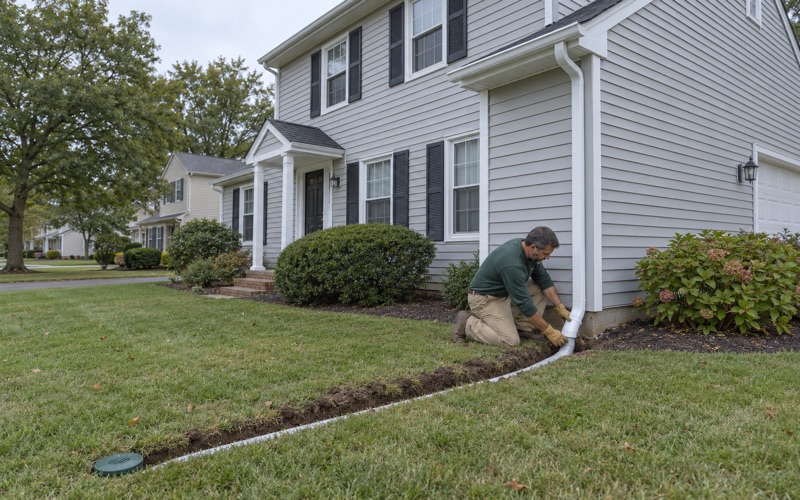
Where the water lands too close, we propose a fix that suits the yard: a longer extension, or an underground downspout line run out to a pop-up drainage emitter that opens only when water arrives. On a rental, an underground line also keeps the walk and the driveway clear of extension pipes that tenants trip over or mowers clip.
Salt Air, Two Waterways and a Canal
The borough sits between water on two sides. The Manasquan River forms its northern boundary and Beaver Dam Creek its southern one, and the Point Pleasant Canal, completed in 1925, divides the borough in half. Close to tidal water, salt air works on cheap fasteners and hangers until they streak, loosen and let a run sag.
We choose hangers, fasteners and sealants for that exposure and name the material on the estimate, so the owner knows what is holding the gutter up. Our standard run is 6-inch K-style seamless gutter in .032 aluminum coil with 3x4 downspouts, and for houses where it suits the age and style, we also install half-round and 16-ounce copper work.
- 20+ Years Experience
- Free Written Estimates
- Before-and-After Photos