Brick Quality Gutters installs, cleans and repairs gutters in Pine Lake Park, and after more than 20 years of gutter work we start almost every visit with one question: where does the roof water go once it leaves the house? On a lot near the lake, that question has a longer answer than it does in most neighborhoods. A downspout that empties onto the driveway is sending water toward the street, and the street drains somewhere.
We size each run and its downspouts for the roof area that drains into it, form seamless gutters on site from coil, and follow every leader to the spot where its water lands. When that spot is the foundation, or a paved slab that runs to the curb, we propose an extension or an underground line and show you exactly where it would go.
This page covers the parts of the job that change here: the lake at the center of the neighborhood, the storm drains that feed it, the sandy ground under the yards, and the age of the houses along the streets. It is written for owners deciding whether to clean, adjust or replace what is on the house now.
Gutters and Pine Lake: Where Pine Lake Park’s Roof Water Goes
A Neighborhood Built Around a Lake
Pine Lake Park is Manchester Township’s largest development, and it was laid out around Pine Lake, a man-made lake built in the 1970s. The community is an unincorporated census-designated place inside Manchester Township, so the township, not a separate borough, runs the streets, the storm sewers and the lake itself. The township code lists a Pine Lake pavilion and splash pad among its recreation facilities and bars swimming out to the island in the lake.
That arrangement matters to a gutter job because the lake is both the neighborhood’s centerpiece and one of the places its stormwater ends up. Water that runs off roofs, driveways and streets has to go somewhere. In a development built around a lake, the storm system was always going to have the lake as one of its destinations.
Two Township Outfalls Discharge to the Lake
The Manchester Township Watershed Inventory Report, published by the Rutgers Cooperative Extension Water Resources Program in July 2026, found that the township owns and operates 27 stormwater outfalls that drain directly into waterways. Two of those 27 discharge into Pine Lake. Under the township’s NJDEP MS4 permit, each outfall is inspected once every five years for erosion and illicit discharges.
The report does not trace water from individual rooftops, so we are careful about what it shows. It does show that part of the township’s storm sewer system ends at the lake. A downspout that dumps onto a driveway sloping to the curb can put roof water into those same street inlets, and that path is our inference rather than a finding in the report.
The Lake’s Water Quality History
Pine Lake’s water quality has been a township concern for years. A Patch report from August 2014 said the lake had been closed to swimming since 2008, the last summer the Ocean County Health Department ran fecal coliform tests there. That same report said NJDEP had approved the township’s request to lower the water level, which the council president called the first step in finding out what had contaminated the lake.
The report named no source, and we make no claim about what caused the problem. We bring it up because owners near the shoreline ask us whether redirecting a downspout makes any difference. The honest answer is that it keeps some roof water on the lot instead of sending it down the driveway into a storm system that empties into the lake.
Looking for gutters closer to Belmar? See Gutters Services in Belmar.
Turning Downspouts Toward the Lawn on Sandy Loam
What the Ground Under Pine Lake Park Does with Water
The federal soil survey maps the ground at a central point in Pine Lake Park as Downer gravelly sandy loam, a well-drained soil in hydrologic group A. Group A is the class that takes in water most readily. That is good news for a downspout, because water released onto grass over that kind of soil has a real chance to soak in before it travels anywhere else.
Well-drained soil still does not make the foundation a good place to empty a leader. A single downspout concentrates the water from a large section of roof onto a few square feet, and the footing is the last place that water should collect. We aim to discharge onto lawn that falls away from the house, the way the 2021 New Jersey edition of the residential code describes grade dropping 6 inches within the first 10 feet of the foundation.
Lawn, Not Driveway
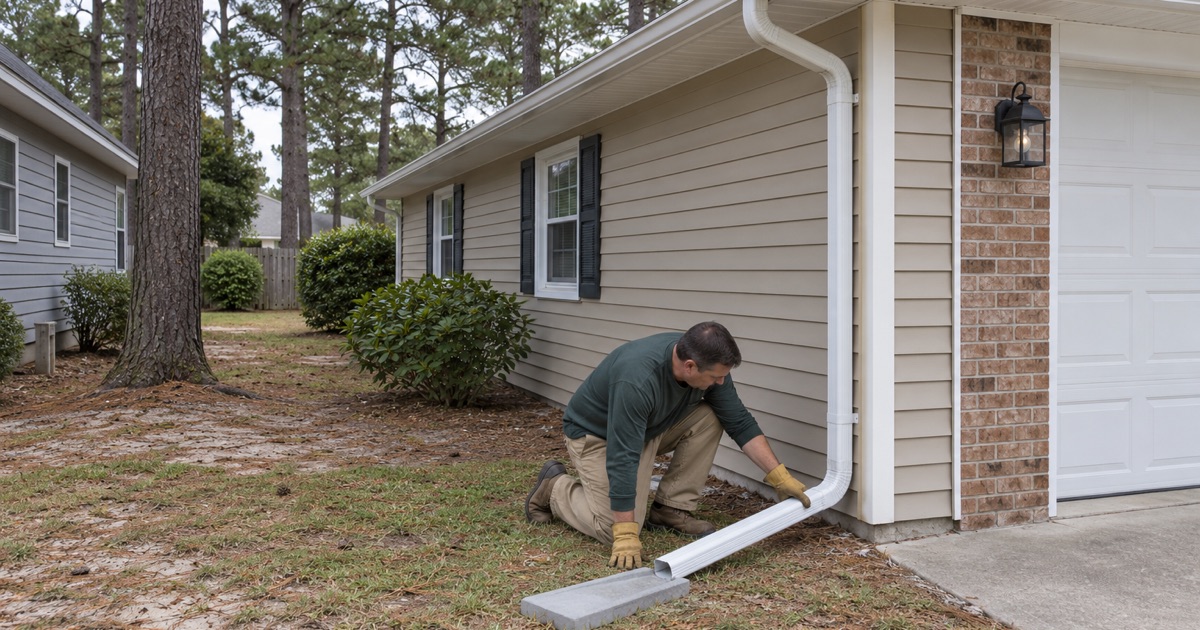
When a leader ends at the edge of the driveway, its water runs across concrete or asphalt to the curb. That puts the roof’s runoff on the quickest path to a street inlet, with nothing in between to slow it down. Swinging the leader a few feet so it lands on the lawn side, or adding a hinged or buried extension, sends the same water onto sandy ground instead.
We have not seen any township rule that tells owners where a downspout must discharge, so this is a choice rather than an obligation. It is still one we recommend on lots where the lawn can take the water. The same move that keeps runoff off the slab usually keeps it away from the foundation as well, and that protects the house no matter where the street drains.
Extensions, Pop-Up Emitters and Underground Lines
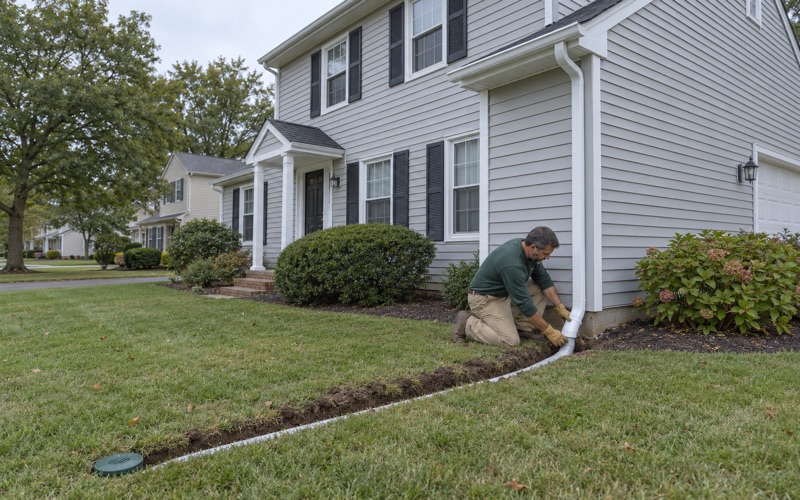
When the lawn sits on the far side of a walk or patio, an above-ground extension becomes a trip hazard, and that is where an underground downspout line earns its cost. We run a solid pipe from the base of the leader to a pop-up drainage emitter out in the yard. The emitter lid lifts when water flows and drops shut when the rain stops, so the line stays mostly free of leaves and mulch.
Before we propose any line, we walk the yard with you and mark where the water would come out. You see the route, the emitter location and the price on the estimate before anything is dug. If a simple extension will do the job, we say so and leave the shovel in the truck.
Gutter Cleaning Before Debris Reaches the Street
Why a Clogged Gutter Sends Water to the Wrong Place
A gutter packed with leaves and grit does not hold water; it spills over along its whole length. Overflow ignores where the downspout points, so a leader you redirected to the lawn does nothing while the trough is pouring off its front edge onto the driveway and walk. Regular cleaning is what keeps the downspout plan working.
Clogged leaders cause the same trouble one step lower. A downspout with a wad of debris stuck at the elbow backs water up into the trough until it overflows. An underground line fed by that leader can also fill with sediment over a few seasons if nobody flushes it, and a buried line that will not drain is harder to fix than an open one.
What Our Cleaning Visit Includes
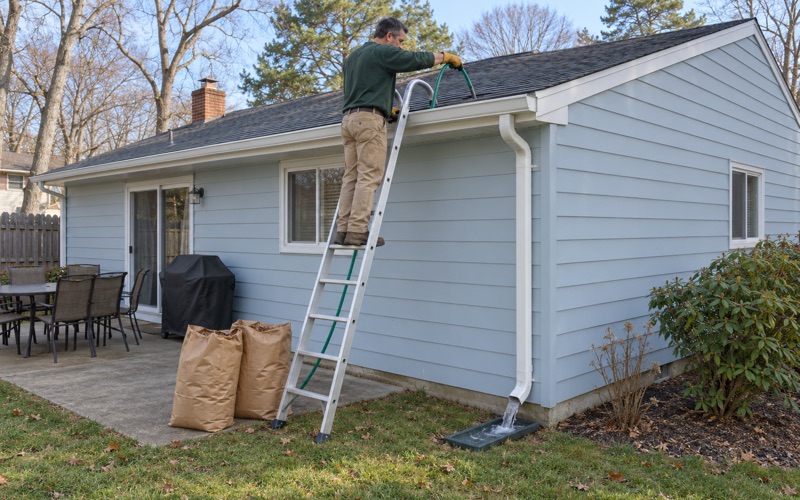
We clear the troughs by hand, flush every downspout with water to confirm it runs free, and bag the debris instead of leaving piles on the lawn or blowing it toward the curb. Leaves and grit left at the street wash into the same inlets the roof water does. For owners who are not home during the visit, we send before-and-after photos of each run.
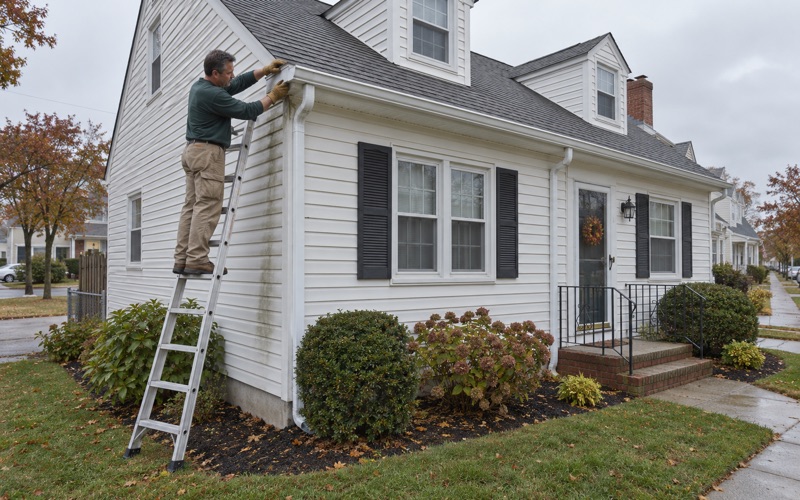
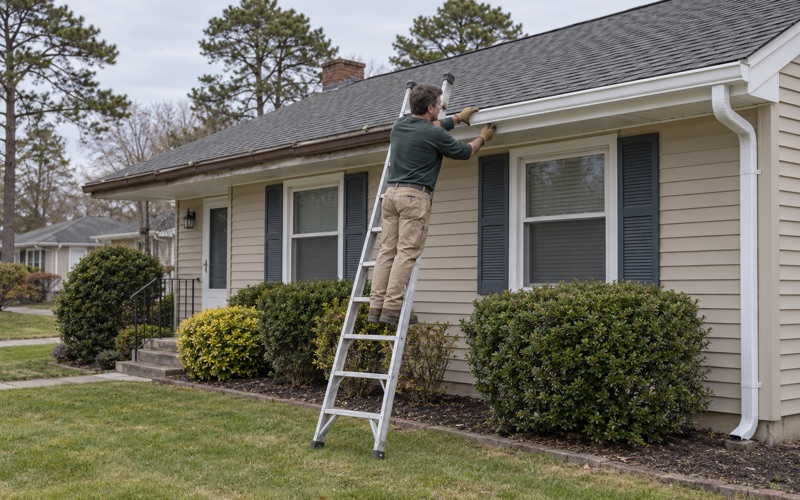
We also look at outlets and elbows while we are up on the ladder. A crushed A or B elbow, a wide-flange outlet that has pulled loose, or a seam weeping at a box miter goes on the cleaning report. Any repair we suggest is priced on its own line, so you can decide on it separately from the cleaning.
Guards Matched to the Lot
Gutter guards cut down on cleaning visits, but the right screen depends on what actually falls on the roof. Broad oak leaves and fine, gritty debris behave differently on a screen, and a guard that sheds one can trap the other. A stainless steel micro-mesh handles fine material well, while coarser screens suit lots with mostly large leaves.
We look at the trees over your house before recommending anything. If the debris load is light, we tell you plainly that a guard is not worth the money and a yearly cleaning will serve you better.
Gutter Replacement for Pine Lake Park’s 1970s and 1980s Homes
Houses of One Era, Decided One Owner at a Time
The Census Bureau’s American Community Survey counts 3,210 housing units in Pine Lake Park, and 2,908 of them, about 90.6%, are detached houses. More than half of all units, 1,845, were built between 1970 and 1989, and owners occupy 2,626 of the detached houses. Where each house’s leaders point is one owner’s choice, repeated house after house across the streets around the lake.
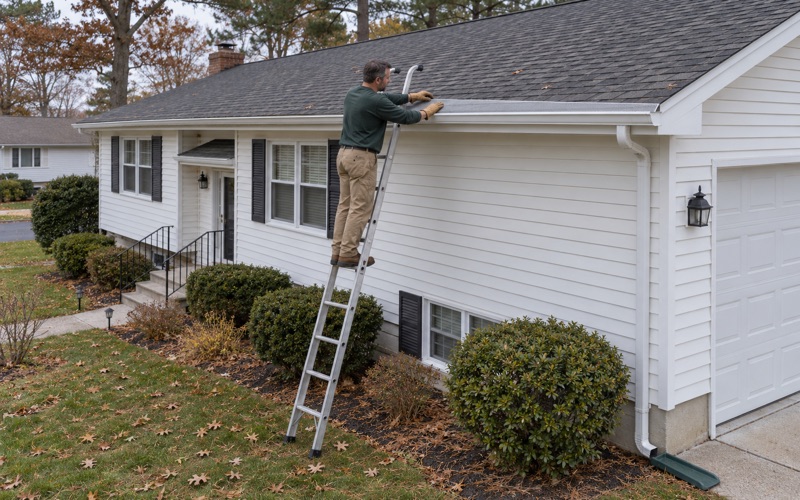
A house from the 1970s or 1980s may still carry gutters of unknown age, or a replacement set put up decades ago. It can show the usual signs: runs that sag between hangers, joints that drip at every seam, and spike-and-ferrule fasteners backing out of the fascia. Those signs tell us whether a repair will hold or whether the system has reached the end of its life.
Seamless Runs Sized to the Roof
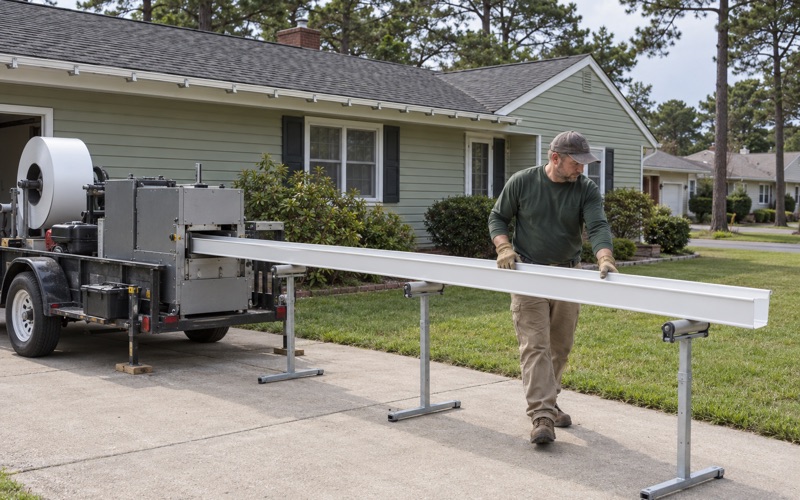
We form seamless gutters on site from .032 aluminum coil, one continuous piece for each run, so the only joints left are at corners and outlets. Each run and its downspouts are sized to the roof area that drains into it. On many houses that works out to a 6-inch K-style gutter with 3x4 downspouts, but we decide by measuring rather than by habit.
Hidden hangers screwed through the gutter into the fascia replace the old spike and ferrule, and corners are sealed with tripolymer sealant. Replacement is also the easiest moment to change where the water goes. When a new run is going up, moving an outlet a few feet so its leader lands on the lawn instead of the driveway is a small change to the layout.
Fascia, Paint and the Paperwork
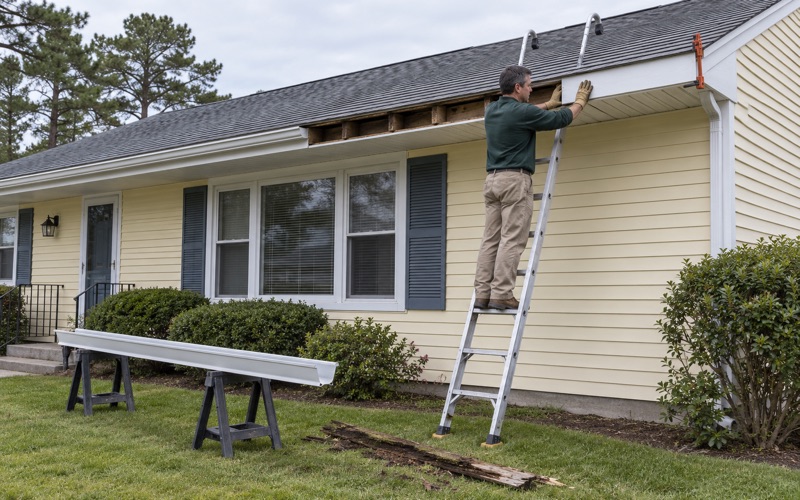
Before new gutters go up, we check the fascia behind them for rot and show you any soft wood before we replace it. On houses built before 1978, painted fascia and trim fall under the EPA’s Renovation, Repair and Painting rule. When our work will disturb that paint, we plan it around lead-safe practices from the start.
New Jersey’s Uniform Construction Code lists the repair, replacement or installation of exterior gutters and leaders as ordinary maintenance, which does not need a construction permit. Our estimates put new gutters and repair work on separate lines, because the state treats a new installation as an exempt capital improvement and a repair as taxable. Our contracts follow New Jersey’s home improvement rules, including the three-day cancellation notice.
- 20+ Years Experience
- Free Written Estimates
- Before-and-After Photos