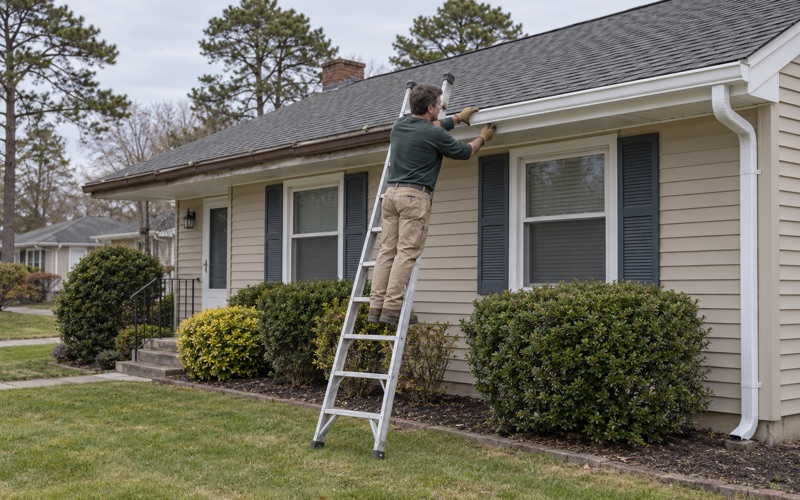
Brick Quality Gutters has spent more than 20 years installing gutters in Millstone Township and across Monmouth County, and on these properties the job starts somewhere other than the roof. Before we measure a single run, we walk the lot to find the well head and the septic field. Where the water leaves each downspout matters as much here as how well the gutter carries it.
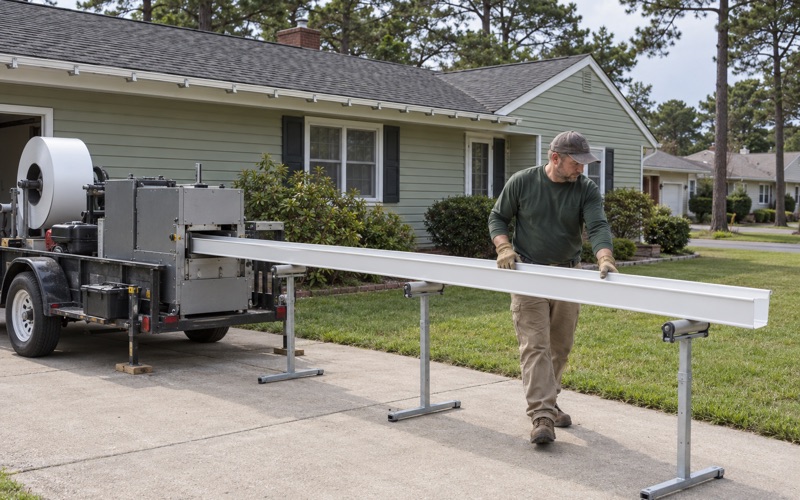
That walk shapes the whole estimate. A gutter system that collects water perfectly and then drops it in the wrong corner of the yard has only moved the problem. We size gutters and downspouts for the roof area that feeds each run, form seamless gutters on site from coil, and then plan the last few feet of every downspout with the same attention.
The result is a written plan that shows where the roof water goes and why. Owners see the discharge points marked against the features on their own lot, along with any extension or underground line we recommend. It is a simple step that keeps the conversation about the property you actually own rather than a generic layout.
Gutters and Downspouts on a Well-and-Septic Lot in Millstone
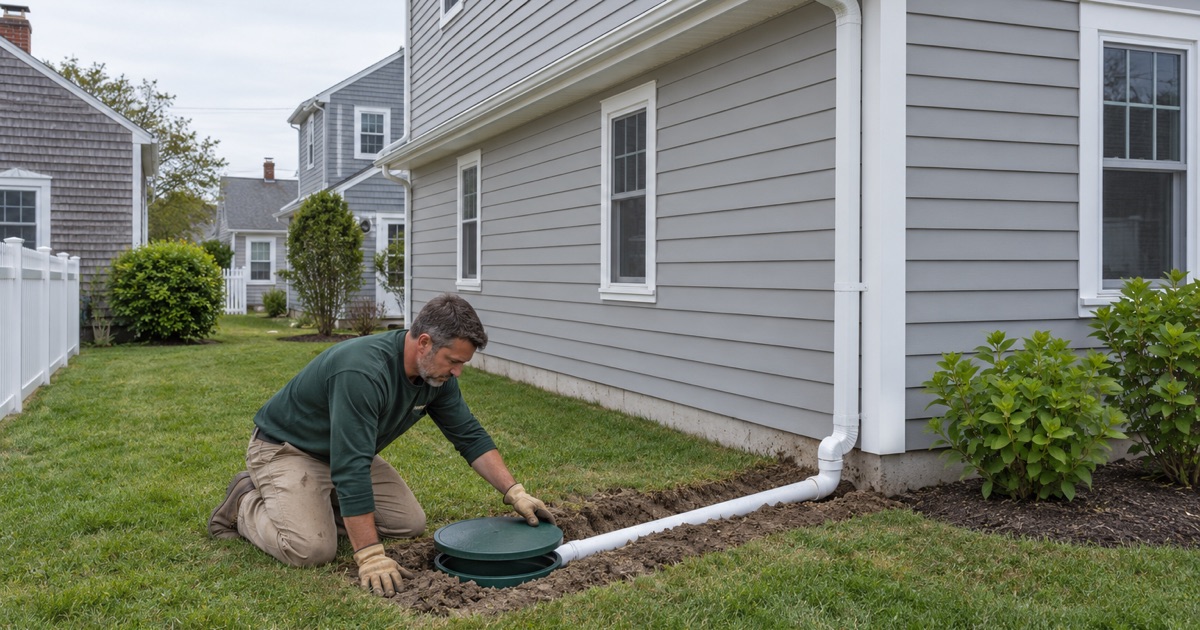
Millstone Township runs on private water and private wastewater. The township’s Ordinance 20-13, adopted May 20, 2020, describes Millstone as a township with no public water or sewer infrastructure available, and it removed the water main and sanitary sewer requirements from the subdivision code. In practice, the homes we work on draw from their own private well and send wastewater to their own septic disposal field.
Why the water setup changes gutter work
On a sewered street, the main question about a downspout is whether it keeps water off the foundation. In Millstone, the yard itself holds two features that do not want extra water poured on them. A downspout that empties toward the well head or across the disposal field is putting concentrated roof runoff exactly where nobody wants it.
New Jersey’s septic rules, N.J.A.C. 7:9A, show how seriously the state treats surface water around these systems. Section 7:9A-4.5 bars placing a disposal area in a depression or where runoff is likely to collect unless the approved design addresses it. It also allows swales that divert runoff away from a disposal field only as the engineering design prescribes.
How far apart the well and the septic field sit
The setback table in N.J.A.C. 7:9A-4.3 keeps a disposal field 100 feet from a well and 25 feet from an occupied building, and a septic tank 50 feet from a well. Those distances mean the well and the field are usually on different sides of the house or at opposite ends of the yard. That spacing is useful to us, because it often leaves a clear stretch of lawn between them for roof water.
None of these rules names roof leaders or downspouts, and we do not claim they do. Our practice of keeping downspout water off the disposal field and away from the well is a trade judgment drawn from what the rules protect. We explain that reasoning on site so the owner can weigh it alongside anything their septic designer has said.
Choosing where each downspout discharges
We follow each downspout to where its water lands and mark the spot on a sketch of the lot. If an outlet sits over the septic field, empties toward the well casing, or drops against the foundation, we propose a fix. That might be a longer extension, a turned elbow, or an underground line to open ground.
The target is a discharge location that slopes away from the house, stays clear of the well and the disposal field, and does not push water onto a neighbor’s land. Many Millstone lots give us room to do that, because the house usually sits well back from the property lines. When a property is tight or the grade works against us, we say so plainly and talk through the options.
Looking for gutters closer to Holmdel? See Holmdel Gutters.
Downspout Extensions, Underground Drains and Dry Wells on Large Millstone Lots
Lot sizes here change what is possible at the bottom of a downspout. The R-170 zone sets a minimum lot of 170,000 square feet, and R-170 subdivisions approved after June 21, 2000 need 4 acres. Outside the R-20 zone, a lot must also hold at least one contiguous acre of usable ground clear of wetlands, floodplains and steep slopes.
Extensions and splash blocks
For many houses, the simplest answer is an aboveground extension that carries water several feet farther out before it spills. We match extension length to where the grade starts falling away from the house. A splash block at the end spreads the flow so it soaks in rather than cutting a channel.
Extensions are easy to adjust and cost little, but they sit on the lawn and can be knocked loose by mowers. On a front walk or a play area, they may not be practical at all. In those spots, we usually recommend moving the water underground instead.
Underground downspout lines and pop-up emitters
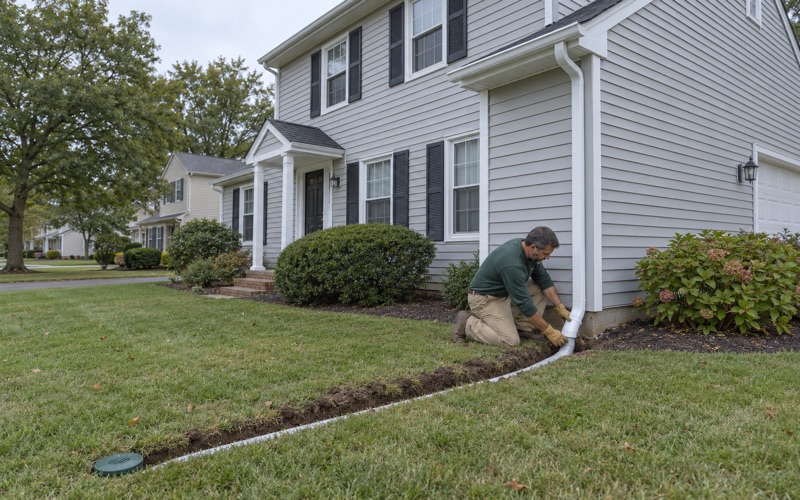
An underground downspout line runs from the base of the leader through buried pipe to a pop-up drainage emitter in open lawn. The emitter lifts when water arrives and settles flat when the flow stops, so the yard stays clear for mowing. On a large Millstone lot, a line can carry roof water a long way from the foundation and well clear of both the septic field and the well.
We route these lines around the disposal field rather than across it, and we confirm where the field sits before any digging starts. The septic plan for the property, or the owner’s knowledge of it, guides where the trench can go. If nobody is sure of the field’s edges, we stop and work that out first rather than guess.
Dry wells and the septic question
Some owners ask about a dry well, a buried chamber that lets roof water seep into the soil. Millstone’s stormwater rules in Section 35-4-14 list a dry well as a green infrastructure practice and cap its contributing drainage area at 1 acre. Section 35-4-14.4h also requires an engineer designing an infiltration system to avoid interference with the proper operation of subsurface sewage disposal systems.
Those sections govern development applications, not a homeowner replacing gutters. Still, they are the township’s own statement that water sent into the ground on a septic lot needs careful placement. When a dry well comes up, we look at where it would sit relative to the disposal field and the well before we recommend one, and we often point to a surface emitter as the simpler choice.
Gutters for Barns, Stables and Outbuildings
Millstone is farm country as well as a town of large homes. The township’s 2020 farmland preservation plan counts over 7,800 acres of assessed farmland and 1,446 acres preserved, with crop production, equine farms and nursery operations among the uses. A gutter job here can easily include a barn or stable eave along with the house.
Barn and stable eaves
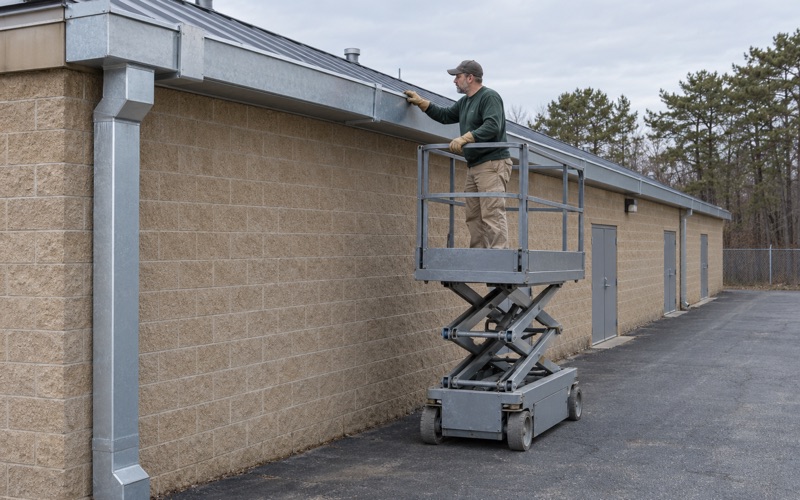
Barns and stables often have long, uninterrupted eaves, and the ground below them sees heavy use from animals, equipment and foot traffic. Water spilling off a roof with no gutters can turn a paddock entrance or a doorway into mud. We size these runs for the roof area they drain and place outlets where the water can leave the work area.
Outbuildings sit on the same lot as the well and the septic system, so the same discharge thinking applies. A stable downspout that drains toward the house well is no better than one on the house itself. Commercial farm buildings follow the Farm Building Code rather than the residential code, and we ask the owner how a building is classified before we plan the work.
Garages, pool houses and sheds
Detached garages, storage buildings and pool houses can benefit from gutters for the same reasons the house does. Millstone’s zoning requires accessory buildings over 200 square feet, and pool houses of any size, to match the principal residence’s siding and roofing materials and color. Farm buildings are exempt from that rule.
We have not seen the rule applied to gutters, so we do not tell owners it requires matching gutters. Many owners choose to match the house anyway, and seamless gutters formed on site make that straightforward. We can also carry copper or half-round work onto an outbuilding where it suits the style of the main house.
Gutter Cleaning and Guards for Millstone Homes
Clean gutters matter more on a lot where overflow lands near a septic field. A clogged gutter spills over its front edge in a sheet, dumping water exactly where the downspout was meant to keep it away. Regular cleaning keeps the discharge plan doing its job.
What a cleaning visit includes
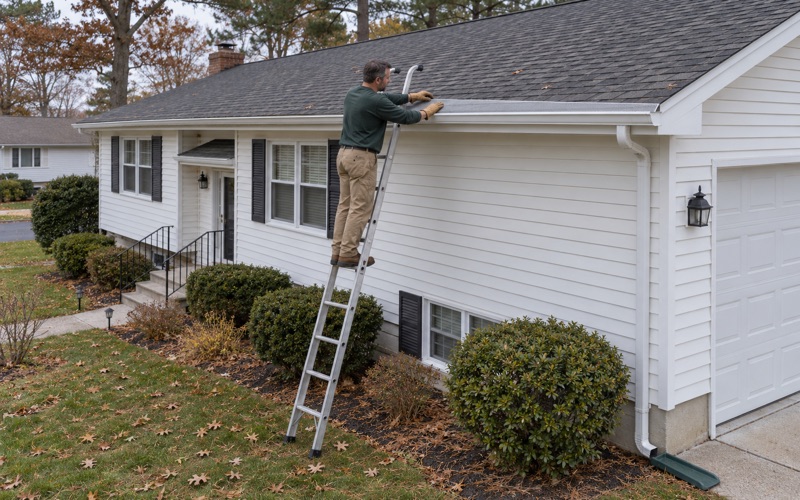
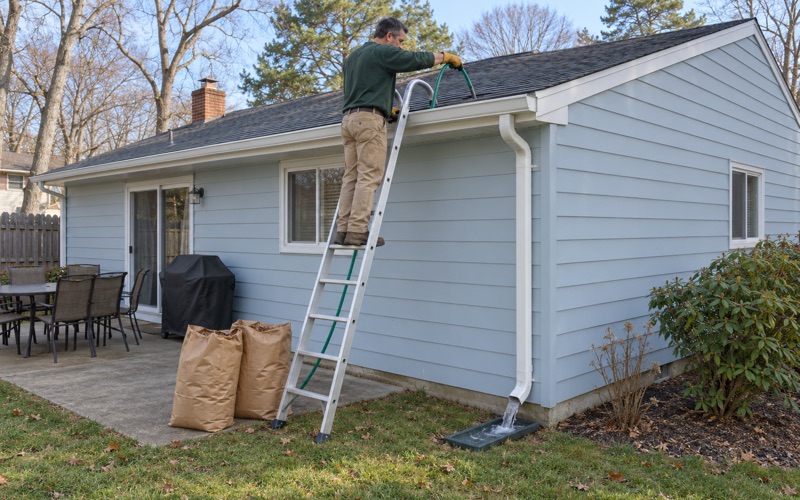
We clear the gutters by hand, flush each downspout to confirm it runs freely, and check that extensions and emitters are still in place. Debris is bagged and hauled away with us, so nothing is left on the lawn, in the driveway or by the road. Owners receive before-and-after photos, which helps when the house is a rental or the owner is away.
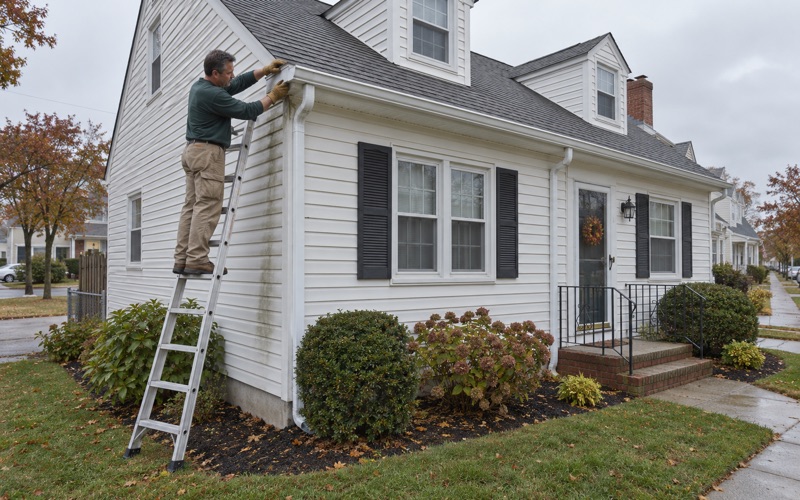
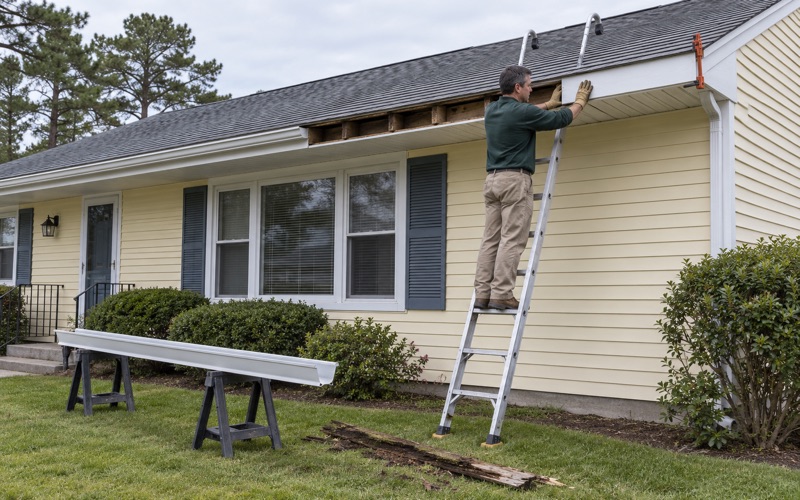
During the visit, we also look at the fascia behind the gutter. If the wood is soft or rotting, we show the owner before anything is replaced. Repairs and new gutters appear on separate lines of the estimate, because New Jersey taxes the two differently.
Guards matched to the trees on the lot
What falls on a roof depends on the trees closest to it, and that varies from one Millstone lot to the next. Oak leaves and pine needles behave differently in a gutter, and the screen that stops one may let the other through. We look at what actually falls on the roof before recommending a guard, often a stainless steel micro-mesh for fine needles.
A guard reduces how often gutters need attention, but it does not end maintenance. Debris can still collect on top, and downspouts still need an occasional check. We explain what each guard will and will not do so owners can decide if it is worth adding.
Contracts and estimates
Every contract we write follows New Jersey’s home improvement rules, including the three-day cancellation notice. Estimates spell out the gutter size, the material, each downspout’s discharge plan and any extension or underground line. For Millstone homes in forecast zone NJZ013, Western Monmouth, that written plan is the clearest way to see where the next heavy rain will go.
- 20+ Years Experience
- Free Written Estimates
- Before-and-After Photos