Brick Quality Gutters has spent more than 20 years on gutters in Leisure Village and the rest of the Ocean County shore, and the work here starts from a question most single-family jobs never raise. Before we set a ladder, we want to know who else lives under the roof we are about to touch, because on many homes in this community that answer is a second household.
Most of the village is attached housing, so a gutter run is rarely a private matter between one owner and one contractor. A clog over your kitchen window can back water up toward the unit next door, and a sagging section can pull at fascia that two families share. We plan the visit around the whole building, then sort out who signs off before any work is quoted.
That approach changes the order of a normal service call. We look first, photograph what we find on both sides of the shared wall, and help you take a clear report to the people who manage the exterior. When the repair is approved, we size the gutters and downspouts to the roof area that actually drains into them, which on a long duplex eave can differ from one end to the other.
One roofline, two households: gutters on Leisure Village duplexes
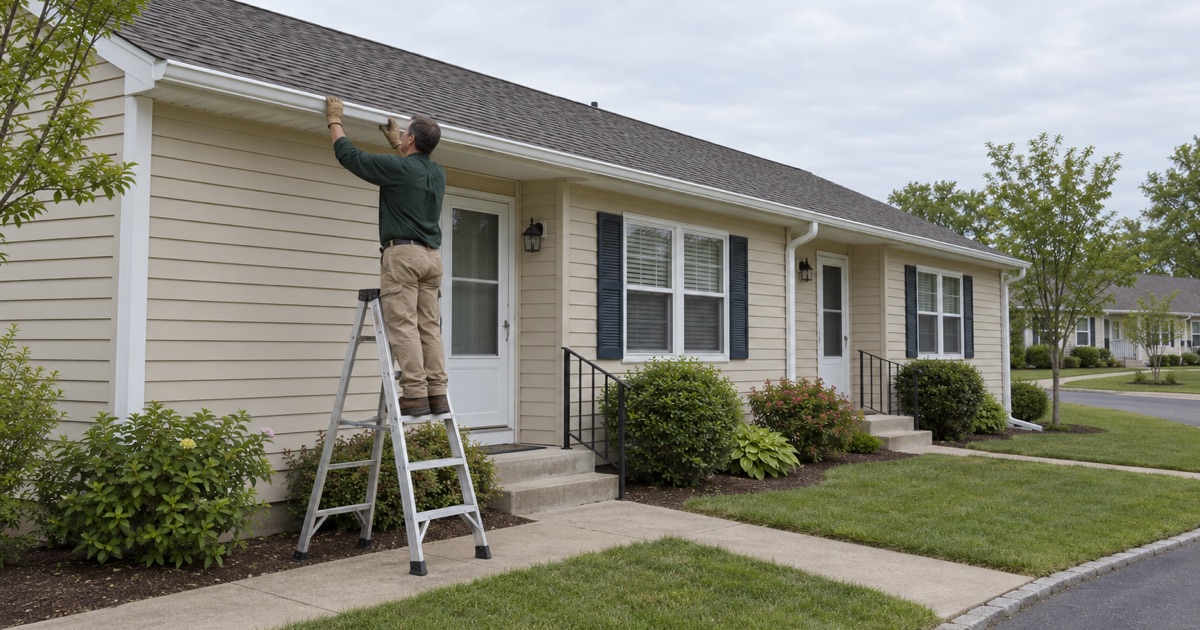
The village was built by Leisure Technology between 1960 and 1970, and the Census Bureau’s 2024 five-year estimates count 1,754 one-unit attached homes in the Leisure Village CDP. Listings describe these homes plainly: 598B Lake Point Drive is a ranch, attached duplex built in 1970, and 168B Huntington Drive is unit B at its address, built in 1967. One street number, two units, one building.
How a shared eave line carries water
On an attached duplex, the roof slopes to a single eave along the front or back, and a gutter there can serve both the A unit and the B unit. Whether a particular run is shared depends on how that building was framed and guttered, so we confirm it on site rather than assume it. When it is shared, the outlet placement decides whose side the water leaves from.
That matters because each downspout drains a defined share of the roof. If the only outlet sits at the far end of the B unit, the A unit’s half of the roof sends its water through the B side before it ever reaches the ground. We trace each downspout to where its water lands and note when one unit is carrying more than its share of the load.
When the overflow lands on your neighbor’s side
A blockage rarely stays where it starts. Leaves packed into an outlet over one unit make the trough fill back toward the low point, and on a long shared run that can mean water spilling over the edge beside the neighbor’s front door or patio. The owner whose gutter clogged may never see the overflow at all.
A pulled hanger works the same way. When one section drops an inch, the slope reverses, and water that should run toward one corner stalls or flows the other direction instead. On a duplex that reversal can send runoff toward the other household’s foundation, which is why we check the pitch along the entire eave, not only the part over the unit that called us.
What we look at on the first visit
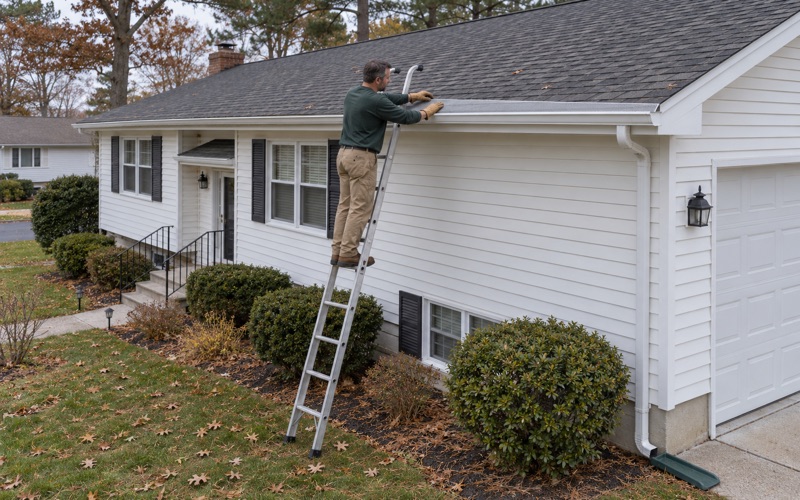
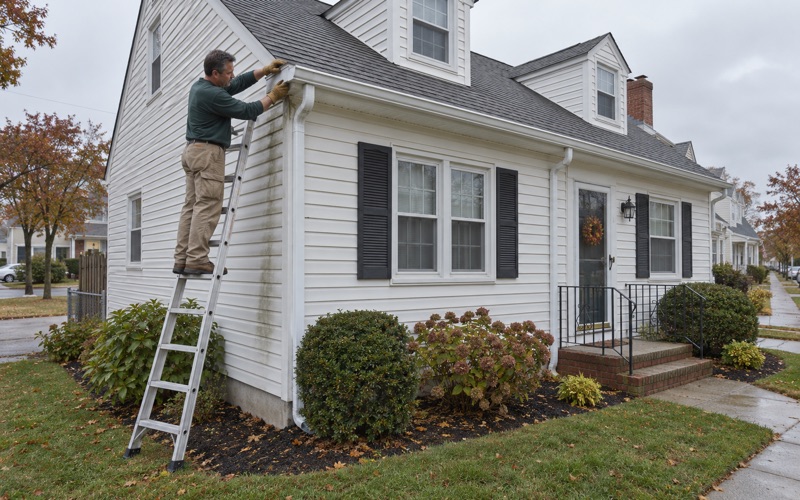
We walk both sides of the building, check the outlets, hangers and seams, and press on the fascia behind the gutter to find soft wood. Any rot we find is shown to the owner before we suggest replacing it. On homes built in the 1960s, painted trim can predate 1978, and we keep that in mind when planning work on fascia.
We also photograph every finding, including anything we notice on the adjoining unit. Those pictures give both households and the on-site management office the same view of the problem, which makes the next conversation shorter. It also means nobody has to climb a ladder to confirm what we saw.
Looking for gutters closer to Ramtown? See Ramtown Gutters.
Reporting a gutter problem to on-site management
Listings for village homes put exterior upkeep in the association fee. The 598B Lake Point Drive listing includes “Exterior Maintenance” among its fees with professional, on-site management, and the 168B Huntington Drive listing names “Exterior Maint” among its fee items. Neither listing mentions gutters, so where the association’s exterior work ends and an owner’s starts is something we ask about rather than guess.
Why the call starts with the office
On a typical detached house, the homeowner calls us and we fix the gutter. In an attached community with exterior maintenance in the fee, a repair to a shared roofline may need the management office’s involvement first. We help the owner make that call before any quote is written, so nobody pays for work the association may already handle.
This step protects both households. A gutter that serves the A and B units affects two owners, and a change made for one side alone can leave the other side with a new problem. Starting with the office keeps the decision with the people who manage the building as a whole, and it keeps neighbors from finding out about the work after it is done.
What to bring when you report it
The most useful report names the building address, both unit letters, the section of gutter involved and what the water is doing during rain. Our dated photos show the clog, the sag or the gap, and where the overflow lands. A clear picture of water spilling beside the neighbor’s door tells the office more than a description ever could.
Note also when the problem started and whether it gets worse in heavy storms. Leisure Village sits in the National Weather Service’s Ocean forecast zone, and a gutter that copes with light rain can fail in a downpour. Timing details help the office decide whether a cleaning, a hanger repair or a larger fix is needed.
When the office asks for an estimate
If the management office or the owner asks us to price the work, our estimate separates new gutters from repairs on different lines, because New Jersey taxes those two kinds of work differently. Hangers, fasteners and sealants are named on the estimate, so everyone reviewing it knows what will be installed and can compare it with past work on the building.
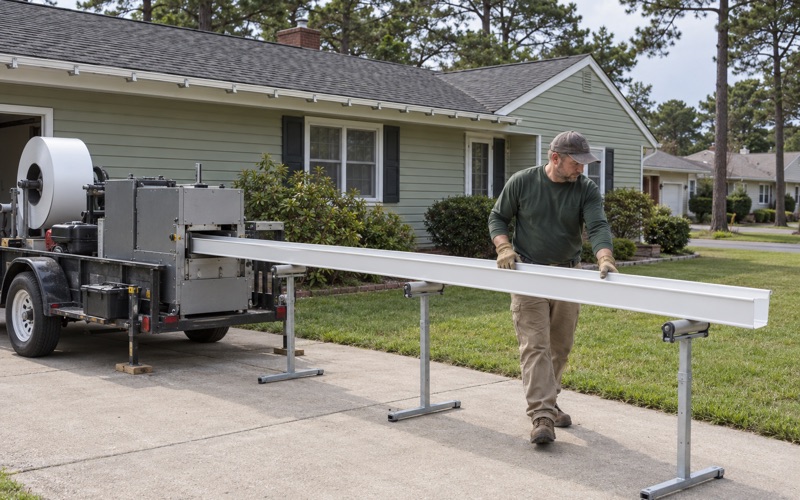
Our contracts follow New Jersey’s home improvement rules, including the three-day cancellation notice. When new gutters are approved, we form them seamless on site from coil, one piece for each run, which means a shared duplex eave can get a continuous trough without a seam sitting over the line between the two units.
What the unit owner still watches: ceilings, walls and the ground by the door
Even when exterior care is part of the fee, the people living inside are often the first to notice that something outside has gone wrong. A stain or a soft spot rarely announces which gutter caused it, so a few habits after a heavy rain help catch a shared-run problem early. Reporting what you see is your best tool.
Signs inside the unit
Look at the ceiling near exterior walls, especially below the eave, and at the tops of window frames. Brown rings, peeling paint or a musty smell after a storm can point to water backing up behind a gutter and getting past the fascia. The same signs on both sides of a shared wall suggest the cause sits on the common run.
Interior walls can show it too. Bubbling paint or a baseboard that stays damp after rain often traces back to water running down the outside of the wall instead of through the downspout. Take a photo, note the date and the weather, and include it in your report to the office alongside anything we documented outside.
Signs at the foundation and the door
Walk past your entry after a heavy rain. Water pooling against the step, mulch washed out of a bed or a muddy trench along the wall are signs that a downspout is dumping too close to the house or that a gutter is overflowing above it. On a duplex, check whether the water seems to come from your side of the roof or the neighbor’s.
The soil at the community’s census point maps as Downer loamy sand, a well-drained soil, though that single reading does not describe every yard. Even fast-draining ground can be overwhelmed when one outlet carries water from two units onto one spot. Where that happens, we can propose an extension or an underground line to carry the water away from the foundation.
The township’s rainproof standard
Lakewood Township’s Board of Health code, in section BH13-2.1(b), asks dwelling owners to keep roofs, sidewalls and other outside surfaces in a rainproof and weathertight condition. It also sets a limit of 30 days to repair broken exterior surfaces. Who handles that work in an attached community is a question for the association and its residents.
For a unit owner, the practical takeaway is simple: report exterior damage promptly and keep a record of when you did. Dated photos of an overflowing gutter or a wet wall make it easy to show the problem was flagged, and they give the management office what it needs to schedule a repair.
Gutter guards and changes on an attached home: ask before you buy
A guard, a bigger downspout or a new outlet can solve a lot of overflow problems, but on an attached building those changes touch a shared roofline. The best time to ask about them is before money changes hands, while there is still room to plan the work around both units.
Matching a guard to the trees and the roof
We pick guards based on the debris that actually lands on the roof. Pine needles slip through coarse screens that stop oak leaves, while stainless steel micro-mesh holds back fine needles but still needs an occasional rinse. A shared eave should get one guard along its full length, so one unit’s half does not clog while the other stays clear.
Guards also change how a gutter is cleaned and inspected, which matters to whoever handles exterior care. We explain how each option is maintained, what it does in heavy leaf fall and how it fastens to the gutter. That information goes to the owner and the office together, so the choice is made with the whole building in mind.
Changes that affect both units
Moving an outlet, adding a downspout or switching to 6-inch K-style gutters with 3x4 downspouts can fix a run that overflows. On a duplex, each of those changes alters where water leaves the roof and which side of the building it lands on. We sketch the drainage before and after so both households can see the result.
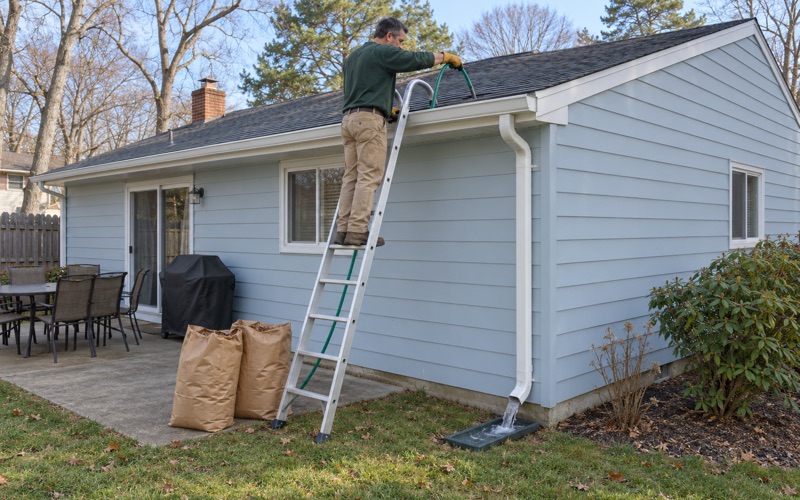
Cleaning visits follow the same care for the neighbor’s side. We flush every downspout on the run and bag the debris, so nothing is left on either lawn or in the street. Every cleaning and repair comes with before-and-after photos, which helps owners who split their year between homes or rent a unit out.
Who approves the work
Because exterior maintenance appears in the association fee, changes to a shared gutter run should be cleared with the on-site management office before an order is placed. We check with the office first so the owner knows who is responsible for the gutters on that building, and we share our photos and the proposed layout to make that review quick.
Once the work is approved, the job itself is familiar: seamless runs formed on site, hangers spaced for the load and fascia checked before anything is fastened. The difference in the Village of Seven Lakes is the conversation that comes first, and we make sure it happens before anyone buys a guard or schedules an install.
- 20+ Years Experience
- Free Written Estimates
- Before-and-After Photos