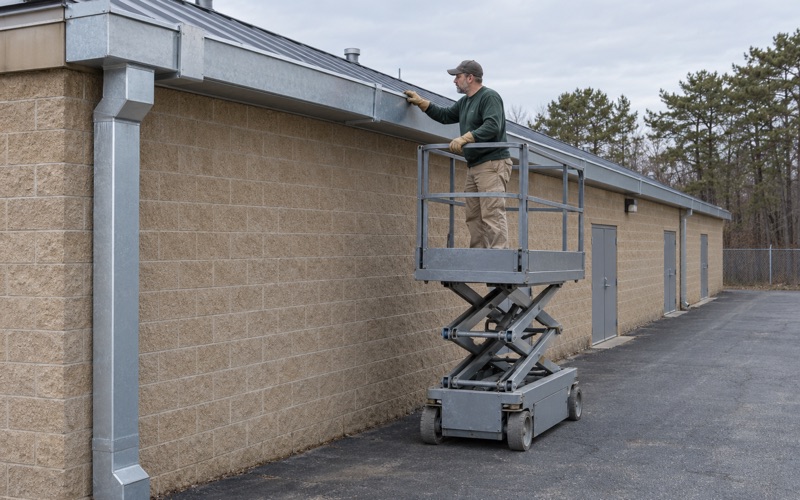
Brick Quality Gutters has spent more than 20 years working on gutters in Lakewood and across Ocean County, and the work here has its own shape. A large share of the township’s homes share a wall, a roofline or a driveway with a neighbor, so the gutter on one house is often one section of a longer run. We plan, install, repair and clean those systems with that in mind from the first visit.
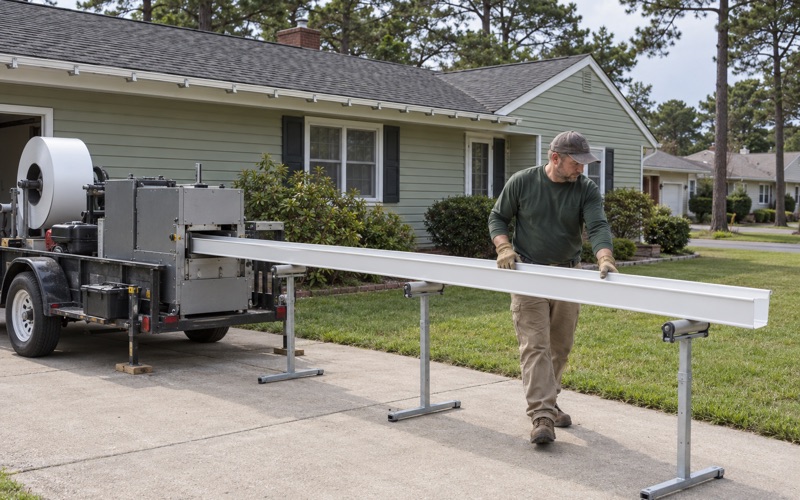
Every run we hang is sized for the roof area that actually drains into it, and the seamless sections are formed on site from coil so one piece covers each stretch of eave. Before anything goes up, we check the fascia board behind it. If the wood is soft, we show it to you first and only then replace it.
Our estimates put new gutters and repair work on separate lines, because New Jersey taxes the two differently, and our contracts follow the state’s home improvement rules, including the three-day cancellation notice. Repairing, replacing or installing gutters and leaders counts as ordinary maintenance under N.J.A.C. 5:23-2.7(c)1.xvi, so the work itself does not need a construction permit.
Gutters on Lakewood Townhouses, Duplexes and Attached Rows
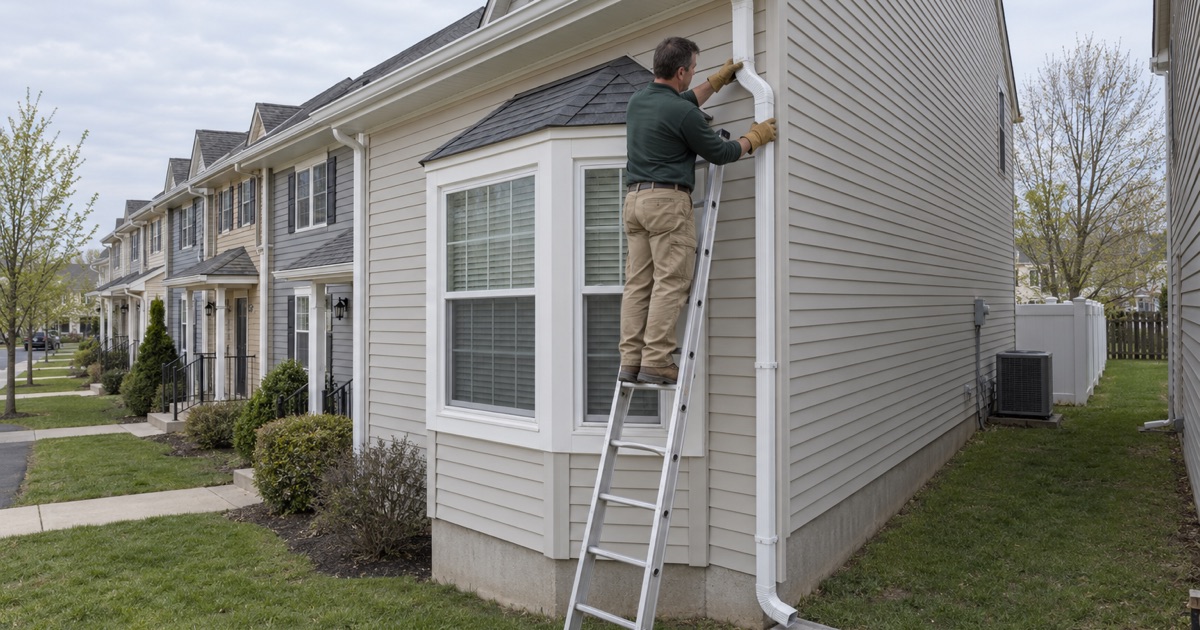
Lakewood’s housing stock leans toward shared walls. The Census Bureau’s 2024 five-year American Community Survey counts 12,203 one-unit attached homes in the township against 11,990 detached ones, out of 33,812 housing units in all, with another 1,968 units in two-unit buildings. That mix shapes most of the gutter conversations we have on this side of the county.
One Roofline, More Than One Owner
On a townhouse row or a side-by-side duplex, the eave often runs unbroken across two or more households. Rain that lands on a neighbor’s half of the roof can travel along a shared gutter before it reaches a downspout on your side, or the other way around. A sag, a clogged outlet or a failed end cap in one section affects every home downstream of it.
That is why we look at the whole run before quoting a single section of it. We note where each household’s roof drains, which outlet carries the heaviest load, and whether the existing pitch sends water toward the downspout it should. When the full run needs replacing, both owners can see on one estimate exactly what the job covers and where it starts and stops.
Who Decides When Nearly Half the Homes Are Rented
Lakewood splits almost evenly between owners and renters. Of 31,407 occupied homes, 16,159 are owner-occupied and 15,248 are rented, and 4,443 of the rented homes are attached units. The person who notices water spilling over the gutter during a storm is often not the person who approves the repair or pays for it.
We build our process around that gap. Before-and-after photos come with every cleaning and repair, so a landlord who rarely visits the property can see what was found and what was done. For homes inside an association, we check the master deed or call the management office first, so everyone knows who is responsible for the gutters before any work begins.
Looking for gutters closer to Allenwood? See Gutters Services in Allenwood.
One Eave Line, Several Households: Planning Downspouts on Narrow Lots
Attached homes usually sit on narrow lots with tight side yards and small rear yards. Where a downspout can go, and where its water ends up, matters more on those lots than on a wide detached parcel. That drainage picture is a reading of the housing mix rather than a measured survey, but it is the pattern we plan around on many Lakewood blocks.
Sizing Gutters for Shared Roof Area
A gutter that serves two or three households’ worth of roof has to be sized for that load. We work out the roof area that drains to each run and pick the gutter and downspout size from that figure, often 6-inch K-style seamless gutters with 3x4 downspouts where a long, shared eave collects a lot of water. Habit is not a sizing method.
Outlet placement matters as much as gutter size. On a long attached run we would rather add an outlet than force water to travel the full length of the eave to reach one downspout. Wide-flange outlets, box and strip miters at the corners, and hidden hangers instead of spike and ferrule keep the run straight, pitched and draining the way it was designed.
Where the Downspout Water Lands
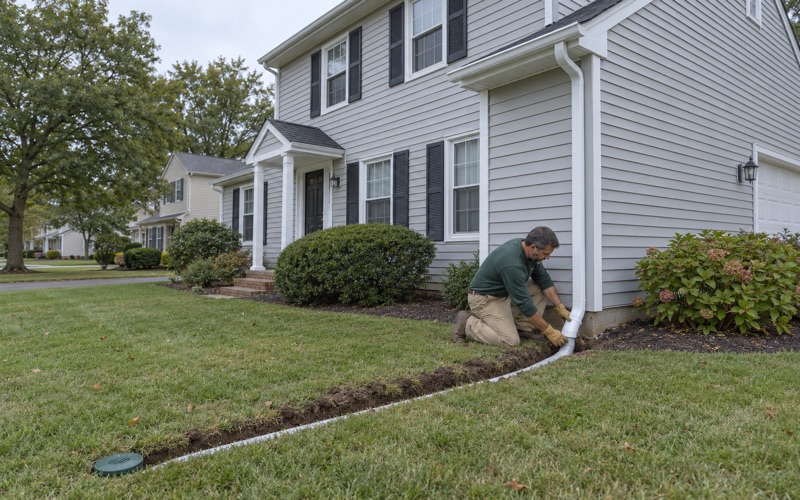
We follow every downspout to the spot where its water meets the ground. On a narrow lot that spot is often a few feet from the foundation, beside a shared walkway, or against the neighboring unit’s wall. When the water lands against a foundation, we propose an extension or an underground downspout line ending in a pop-up drainage emitter.
The residential code’s grading provision, IRC 2021 New Jersey edition R401.3, has the ground falling 6 inches within the first 10 feet from the foundation, and a narrow side yard often cannot offer that much room. A downspout that discharges into a shared side yard affects two households at once, so we talk the route through with both before anything is buried.
Drainage Fees Priced by Dwelling Type
The township’s own drainage planning treats housing type as something that matters. Ordinance O2017-42, introduced October 18, 2017, proposed amending Unified Development Ordinance Section 18-815 so the township would maintain drainage basins serving residential communities, funded by one-time per-unit fees of $750 for detached homes, $500 for attached homes and $300 for multi-family dwellings.
The basin maintenance it lists includes leaf removal, debris removal, inspection and desilting, the same kinds of debris a gutter collects on its way down. Final passage was scheduled for December 7, 2017, and we have not confirmed that it was adopted. Read those numbers as the ordinance as introduced, not as a fee in force today.
New Construction in Lakewood: When a Leaking Gutter Is a Warranty Claim
Lakewood is still building at volume. The Census Building Permits Survey recorded 1,481 housing units authorized in the township in 2024, including 1,254 single-unit buildings, 42 two-unit buildings and 140 units in buildings of five or more. Many of those homes will go through their first full year of rain, wind and snow with gutters nobody has looked at since closing.
What New Jersey’s New-Home Standard Says
New Jersey’s new-home warranty regulations set performance standards for a home’s early years. N.J.A.C. 5:25-3.5(f)7 states it plainly: “Gutters and downspouts which leak is a deficiency.” Under N.J.A.C. 5:25-3.2(a)1, each new home is to be free from performance-standard defects for one year from the warranty date.
In practice, a gutter that drips at a corner or an outlet on a first-year Lakewood house is a question for the builder and the home’s warranty plan before it is a repair job. We have not read which warranty plan covers any given house, and we are not the builder, so that first call belongs to the owner and the builder.
Our Role on a Newer House
Where it helps, we can look over a newer gutter system and photograph what we find: leaking corners, outlets pulling loose, gutters pitched the wrong way, or downspouts dumping water at the foundation. That record gives an owner something concrete to bring to the builder instead of a description of a drip during last week’s storm.
Once the first year has passed, or once the builder’s response is settled, we can repair or replace the system. If the original gutters were undersized for a long attached eave, we resize the run rather than reinstalling the same profile. The estimate still lists new gutters and repair items on separate lines, so the tax treatment of each is clear.
Fascia, Flashing and Roof-Edge Details
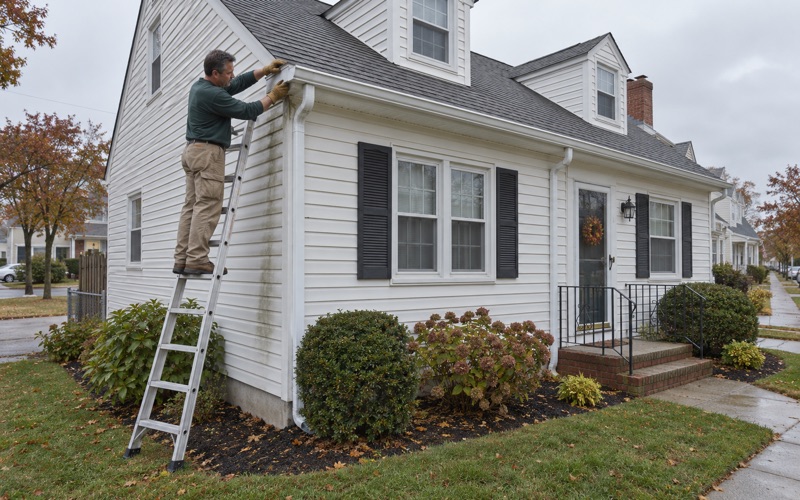
On any house, new or old, the roof edge is where small omissions show up first. We check for gutter apron and drip edge behind the gutter and for kickout flashing where a roof meets a sidewall, a junction that comes up often on attached rows. Missing flashing sends water behind the gutter and down the face of the fascia.
Even on a young house, we check the fascia for soft spots before new gutters go up. If any of the wood is rotting, you see it before it is replaced, and the new run is hung on solid backing using .032 aluminum gutter coil, with tripolymer gutter sealant at the miters and end caps.
Cleaning, Guards and Where Lakewood’s Roof Water Goes
Cleaning Visits on Dense Blocks
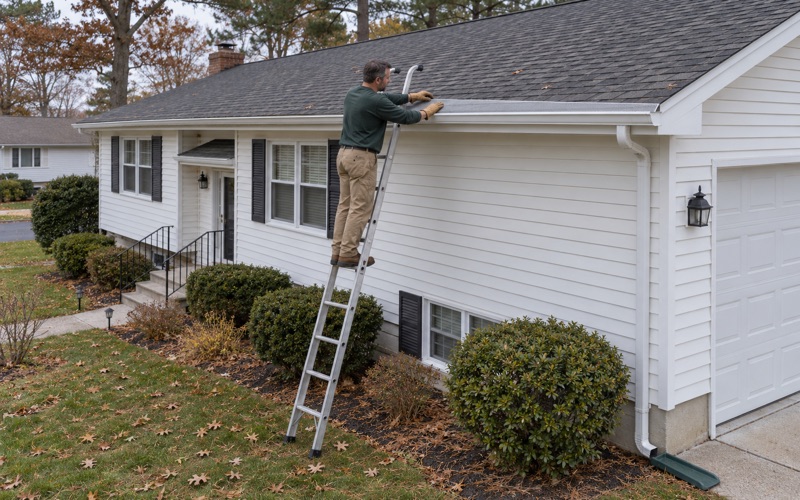
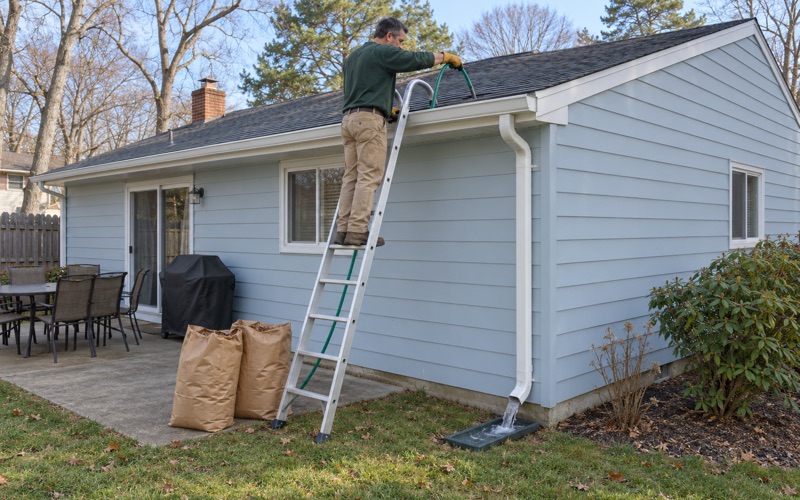
On a block of attached homes, debris in one clogged section can back water up into the neighbor’s run. Our cleaning visits clear the troughs, flush every downspout to confirm it runs freely, and bag the debris, so nothing is left on the lawn, the sidewalk or the street when we drive away.
Photos before and after each visit show the owner or landlord what came out and what shape the gutters are in. That record is especially useful where the owner lives elsewhere and the tenant is the only person who looks at the roofline from one season to the next.
Choosing Guards for the Lot
Guards should match the debris that actually falls on the property. Pine needles slip through screens sized for broad leaves, while oak leaves can mat over a fine mesh and sit there. We look at the trees around the house before recommending a guard, and stainless steel micro-mesh is often the answer where needles are the main problem.
On a shared eave, guards work best when the whole run gets them. Guarding one household’s section while the neighbor’s stays open tends to move the clog to the unguarded stretch. We point that out at the estimate so both owners can decide together rather than finding out after the first fall.
Lake Carasaljo and the Storm Drains
Water from many of Lakewood’s denser neighborhoods eventually reaches Lake Carasaljo, part of the South Branch Metedeconk River, which drains to the Metedeconk River and Barnegat Bay. Engineers working on Lake Carasaljo Park found dozens of outfalls discharging directly into the river and lake with no water quality treatment.
A project completed in fall 2018 with the Brick Township MUA and Lakewood Township retrofitted six direct outfalls along North Lake Drive and South Lake Drive with bioretention and infiltration systems. The Metedeconk is also a water-supply source for the Brick Township MUA. Keeping downspout water on the lot where it can soak in, and bagging cleaning debris instead of leaving it at the curb, is one small way a household fits into that system.
- 20+ Years Experience
- Free Written Estimates
- Before-and-After Photos