Brick Quality Gutters has handled gutters in Howell for more than 20 years, and the work here starts with a question most homeowners never think to ask: where does the roof water go once it leaves the leader? We install, repair, replace and clean gutter systems on Howell houses, and we size each run for the roof area that actually drains into it.
A gutter is only the first few feet of a longer path. On many Howell lots that path was drawn on paper before the house was framed, and changing it later can mean more than swapping aluminum. We plan our work so the new system fits the drainage the lot was designed around, and we tell you plainly when a change reaches past what a gutter crew should decide.
This page covers what the township looks at on a lot, how regrading and leader outlets connect to that review, what the sewer and stormwater rules say about drainage lines, and what a seamless installation looks like on the homes built here in the 1980s. If you are weighing new gutters, an addition or a yard project, it should help you sort out which parts are ours and which belong to someone else.
Howell’s Plot Plan and the Water Around a House
Howell treats water as a lot-level question before a new house goes up. That is unusual enough to be worth understanding, because it shapes how gutter work fits into a property that has already been through township review.
What Section 188-31 asks for
Code of the Township of Howell Section 188-31 requires an individual plot plan with any permit application for new residential or commercial construction, and with major renovations or regrading of existing property. Three copies of the plot plan, the architectural drawings where they apply, and a plot plan checklist go to the Howell Department of Community Development. The plan is where the township sees the ground before anyone moves it.
Among the required items, the plan must show existing contours that reveal the natural drainage of the land, with any high or low points marked for drainage review. It must also show existing and proposed drainage swales, structures, basins and pipes, including pipe size, type and slope. Every drainage system within 50 feet of the property has to appear on the drawing as well.
The seasonal high water table boring
Item (13) of the same section calls for a soil boring demonstrating that the basement sits at least two feet above the seasonal high water table. In plain terms, the township wants proof that a new basement will not be built down into the wettest level the ground reaches during the year. That is a builder’s and engineer’s question, settled on paper long before gutters arrive.
It still matters to a gutter job, because that two-foot margin assumes the water around the house keeps behaving the way the plan expected. Roof runoff released in the wrong spot can add water near a foundation that the drawing never counted on. We keep that in mind when a homeowner asks us to change where leaders come down.
What the code does not say
Section 188-31 does not mention gutters, leaders or roof drains, and we will not tell you otherwise. The link between a downspout and the reviewed drainage plan is a practical one: the water from your roof joins the same swales and contours the township looked at. We treat the plan as the map our work has to respect rather than as a rule written about gutters.
Looking for gutters closer to Shark River Hills? See Gutters Services in Shark River Hills.
Gutters, Leaders and Regrading in Howell
Most gutter replacements in Howell leave the drainage exactly where it was. The questions start when a project moves the ground, adds a wing or relocates the leader outlets that feed a swale.
When a regrade becomes plot-plan work
Section 188-31 names major renovations and regrading of existing property alongside new construction. A project that reshapes the yard around a house can therefore bring the plot plan back into play on its own. If you are planning a regrade and want the leader outlets moved as part of it, the outlet locations become part of that larger drainage picture rather than a simple gutter decision.
We have not established that a gutter or leader change by itself triggers a plot plan, and we do not claim it does. New Jersey’s construction code lists the repair, replacement or installation of exterior gutters and leaders as ordinary maintenance. The distinction we draw is simple: a like-for-like gutter job is ours to plan, while a regrade or addition that reroutes water belongs to the people handling that project.
Keeping leader outlets in step with the drainage plan
When we replace a system, we put leaders where the existing outlets already tie into the lot’s drainage unless you have a reason to change them. If a project calls for new outlet locations, we ask whether a plot plan or a grading drawing already exists for the property. Matching our layout to that drawing keeps the gutters from quietly undoing the swales and basins the lot was built around.
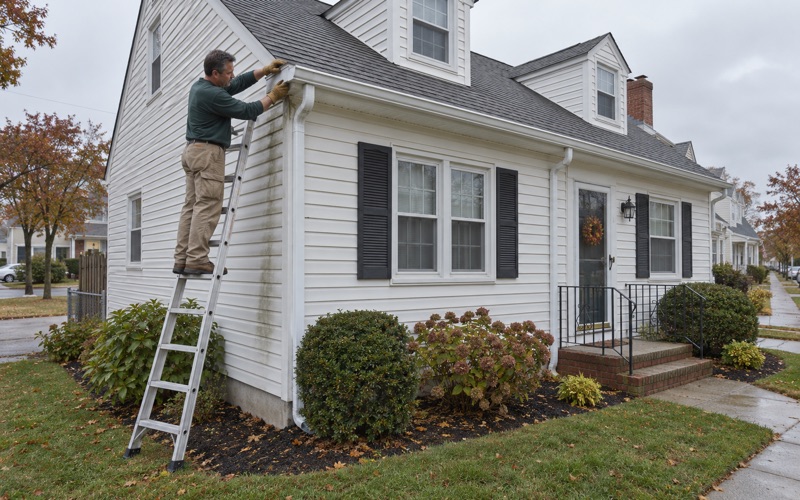
We follow each downspout to where its water lands as part of every estimate. If the water is collecting against the foundation, we point it out and propose an extension or an underground line, and we tell you when that change touches grading that someone else designed. You get the observation either way, along with a clear line between gutter work and site work.
What we do and do not do
We are a gutter contractor, not an engineer, and we do not draw, sign or submit plot plans. When a project needs one, that work goes through your builder, designer or engineer and the Department of Community Development. Our part is to supply the gutter and leader layout they need, and to install it the way the approved drawing shows.
That division keeps a project moving without surprises. Homeowners who bring us in early, while a regrade or addition is still being drawn, usually end up with leader outlets that land where the plan expects. Bringing us in after the yard is finished often means adjusting outlets to fit grading that is already set.
What Howell’s Sewer and Stormwater Rules Mean for Drainage Lines
Underground leader lines are where Howell’s two drainage rules come closest to gutter work. One rule governs the sanitary sewer and the other governs the township’s storm sewer system, and they say different things.
Section 252-21 and the sanitary sewer
Section 252-21, amended on March 15, 2011 by Ordinance O-11-05, makes it a violation to connect or discharge into the township sewer system any materials, chemicals or drainage other than sanitary sewerage. The Howell Township Sewer Utility’s Director or Code Enforcement Officer serves notice on a prohibited discharge and requires its removal immediately. The section is titled for sump pumps and broken service lines, but its wording covers drainage of any kind.
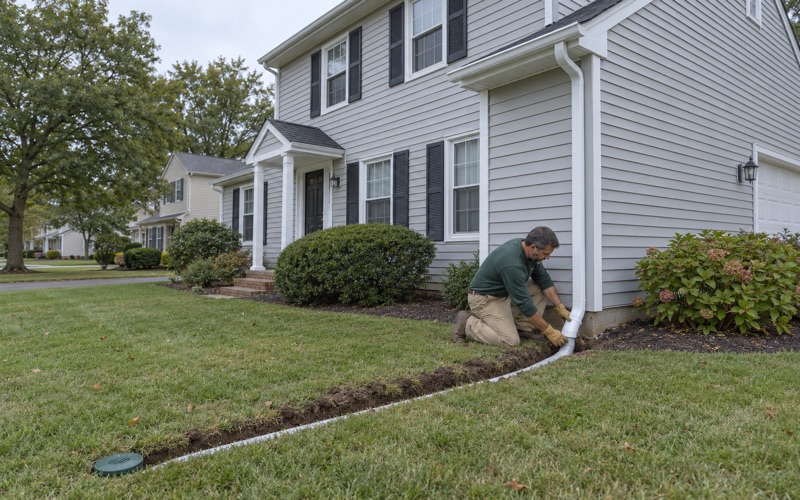
For gutter work, the takeaway is direct: a leader line never ties into a sanitary sewer cleanout or lateral. When we propose an underground downspout line, it carries roof water away from the house without touching the sewer system. If we find an older line that appears to run toward a sewer connection, we show it to you rather than reconnect it.
Chapter 275 and the storm sewer system
Chapter 275, Stormwater Management, was adopted on September 20, 2005 by Ordinance O-05-32. Section 275-3 prohibits spilling, dumping or disposing of materials other than stormwater into the municipal separate storm sewer system the township operates. Section 275-4 lists exceptions, including uncontaminated groundwater from crawl space or basement sump pumps and foundation or footing drains.
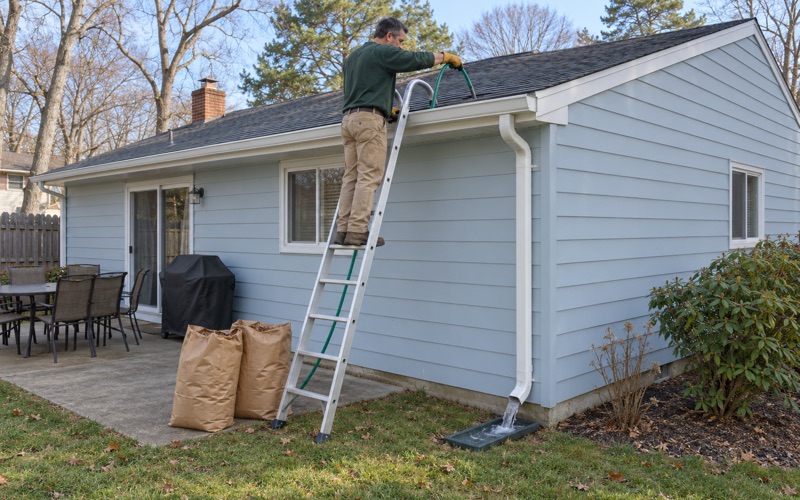
Roof rainwater is stormwater, so the chapter is concerned with what else ends up in the system. That is one more reason our cleaning crews bag every scoop of leaves, shingle grit and debris and haul it away. Nothing we pull out of a gutter is left in the street, on the lawn or near a storm inlet.
Seamless Gutter Installation for Howell’s 1980s Homes
Howell Township, incorporated on February 23, 1801, covers about 61.21 square miles and is the largest municipality in Monmouth County by total area. Its housing grew steadily as a bedroom community of New York City, and the 2020 census counted 53,537 residents. The houses we see most often reflect that growth.
The houses we work on most
The 1980s were the township’s biggest building decade, with 5,318 of its 19,613 housing units built then, according to the 2024 American Community Survey five-year estimates. About 79.4 percent of Howell homes are detached, and most occupied homes are owner-occupied. Many of those 1980s houses are now on their second or third gutter system, often with sectional gutters and leaky seams.
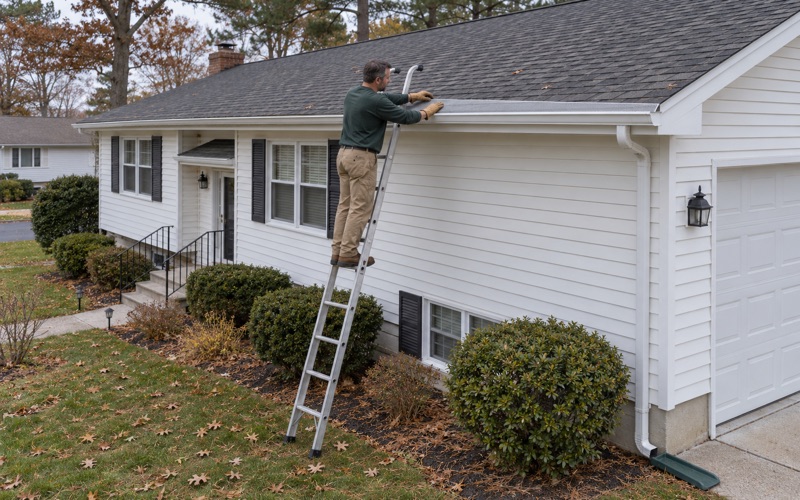
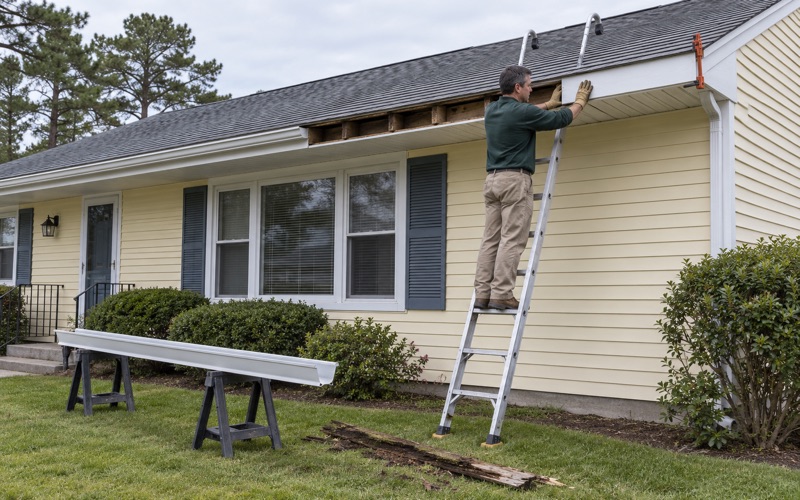
Houses of that age also tend to carry original fascia boards behind the gutters. Before any new gutter goes up, we check the fascia for rot, and if we find soft wood we show it to you before replacing it. Hanging a new system on a rotten board only moves the failure a few years down the road.
Sized and formed on site
We do not pick gutter and downspout sizes by habit. Each run is sized for the roof area that drains into it, which on many Howell colonials and split-levels means 6-inch K-style seamless gutters with 3x4 downspouts on the larger roof planes. The goal is a system that carries a heavy summer downpour to the outlets instead of spilling over the front edge.
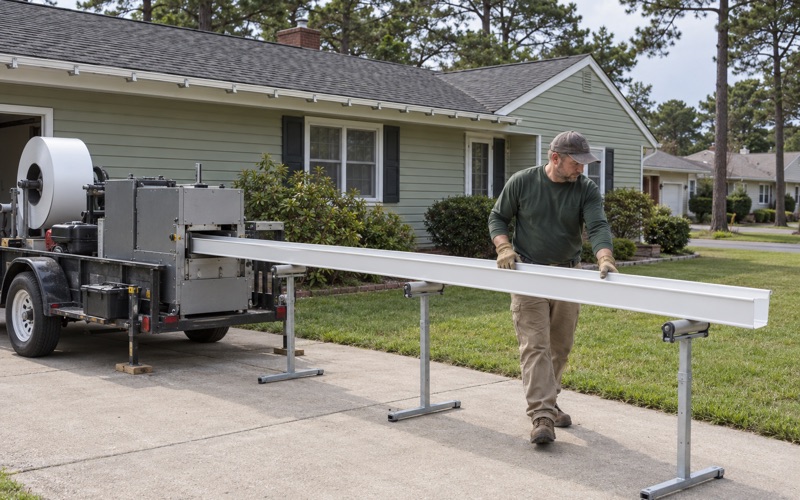
Our seamless gutters are formed on site from .032 aluminum coil, one continuous piece for each run of the house. Corners get box or strip miters sealed with tripolymer sealant, and we install hidden hangers rather than spike and ferrule so the gutter holds its pitch. Where a roof meets a sidewall, kickout flashing keeps water off the siding below.
Estimates and contracts
Our estimates list new gutters and repair work on separate lines, because New Jersey taxes them differently. A new gutter system is an exempt capital improvement documented on Form ST-8, while a repair is a taxable service. Seeing the two apart tells you exactly what you are paying for.
Every contract is written to New Jersey’s home improvement rules, including the three-day cancellation notice. Cleaning and repair visits come with before-and-after photos, which helps owners who rent out a Howell house or are not home during the work. If you are planning new gutters, a repair or a project that touches the yard, call us and we will walk the lot with you.
- 20+ Years Experience
- Free Written Estimates
- Before-and-After Photos