Brick Quality Gutters has spent more than 20 years hanging, repairing and cleaning gutters in Holmdel, and our work here starts with a tape measure on the roof rather than a stock size pulled off the truck. A large house sheds a lot of water into a small number of gutter runs. A trough chosen out of habit can spill over its front edge in the first hard storm, so we size the gutter, the downspouts and the outlets to the roof area that drains into each run.
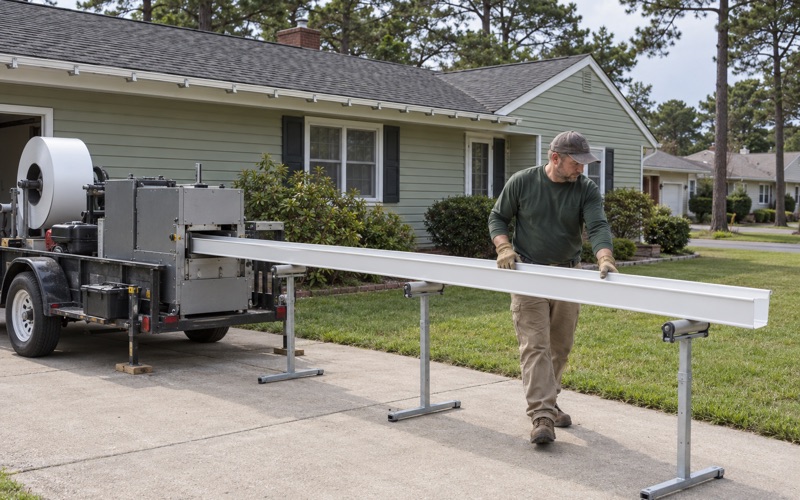
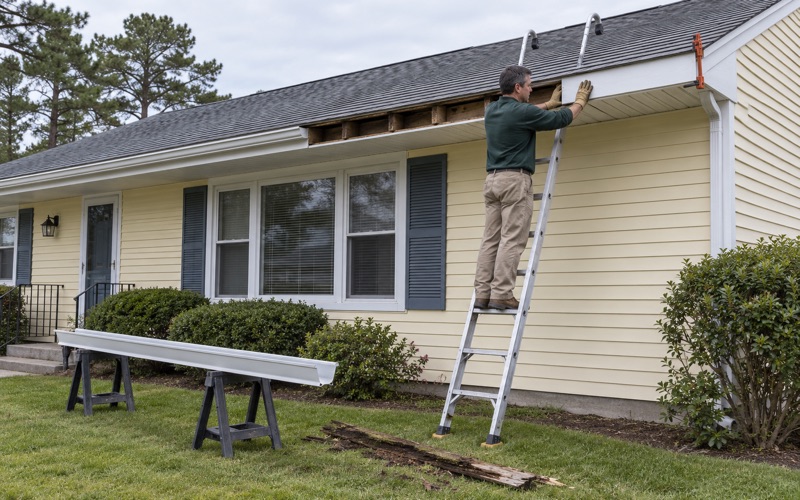
Our seamless gutters are formed on site from coil, which gives each side of the house a single piece with no joints along its length. Before a new run goes up, we check the fascia board behind it for rot and show you any soft wood before we replace it. Once the gutters are planned, we trace every downspout to the spot where its water actually lands.
That last step matters more on a hilly lot than a flat one. When a downspout empties against the foundation or straight down a slope toward the driveway, we propose an extension or an underground line and price it as its own item. New gutters and repair work also sit on separate lines of the estimate, because New Jersey taxes the two differently.
Sizing Gutters and Downspouts for Large Holmdel Roofs
Holmdel’s housing runs large. The 2024 American Community Survey counts 3,330 of the township’s 6,528 homes, just over half, with nine or more rooms, and the median room count is top-coded at 10.0, the highest figure the survey reports. The lots are generous as well: the R-40A zoning district calls for 43,000-square-foot lots and the R-40B district for 108,900 square feet.
Room Counts Point to the Roof, but Don’t Measure It
A room count measures living space, not shingles, so we never size gutters from a census table. What the figures do suggest is that many of our Holmdel jobs involve big houses, and big houses tend to come with long eaves and wide roof planes. The actual numbers come from the house itself, measured on our first visit.
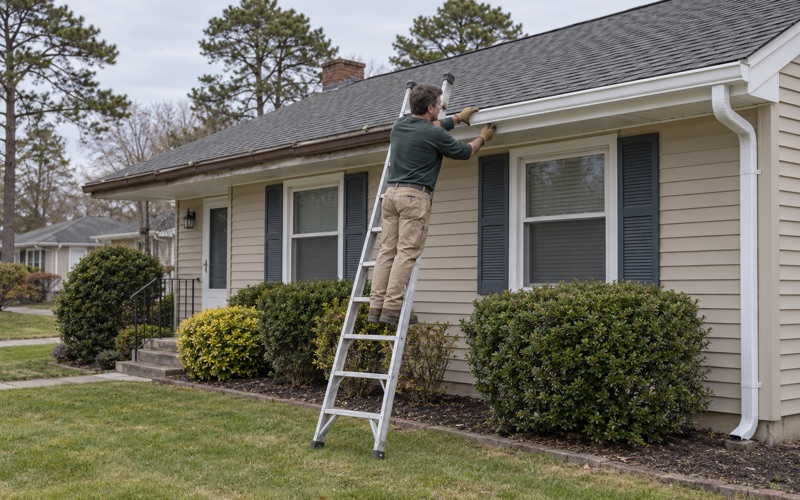
On that visit we walk the whole house, note each roof plane, and mark which gutter run catches it. Upper roofs that drain onto lower roofs count twice, because the lower gutter carries both. Copying the gutter size from a smaller house down the road is the most common reason a new system overflows.
Choosing the Gutter Profile
The gutter profile has to carry whatever the roof behind it sends. On many larger houses that points toward 6-inch K-style seamless gutters in .032 aluminum coil, but the choice follows the measured roof area behind each run, not a blanket rule. Where a smaller profile would handle the water, we tell you so.
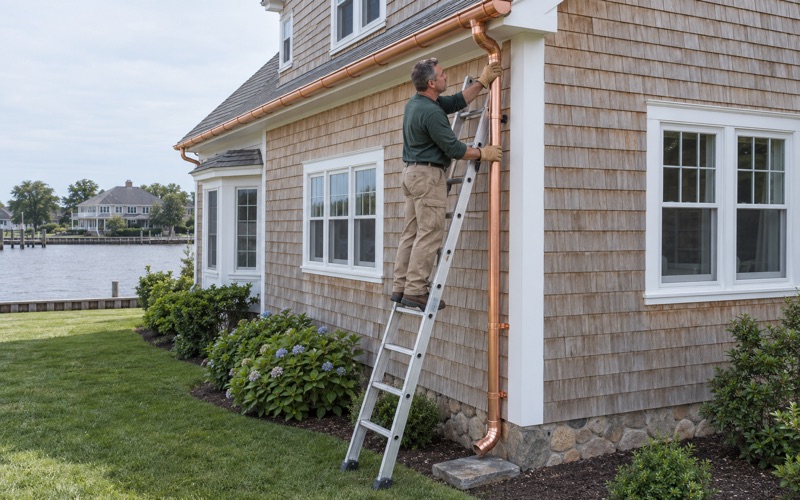
Some houses call for a different look altogether. We match copper and half-round work to the age and style of the house, including half-round gutters with a double-bead profile and 16-ounce copper that weathers to a patina over time. Each option is priced separately with the material named on the estimate.
Downspouts and Outlets on Two-Story Eaves
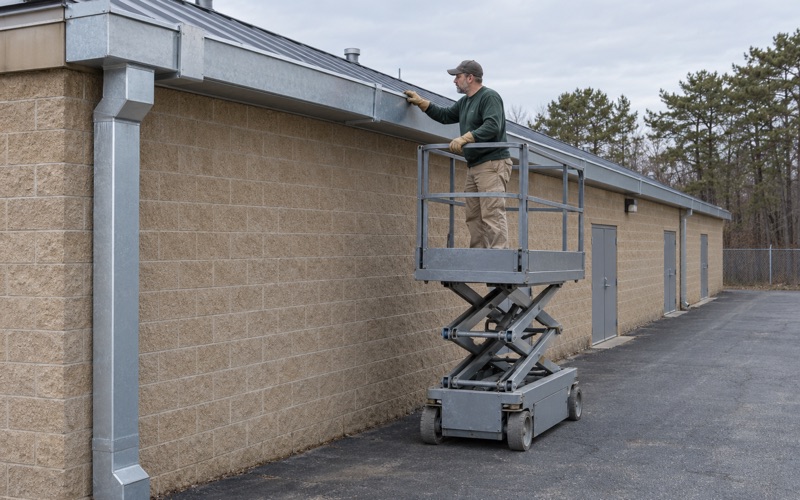
A long two-story eave can collect water from a large stretch of roof, and a single downspout at one end may not keep up with it. We set the number of outlets and the downspout size, often 3x4 downspouts on the bigger runs, to the roof area feeding that run. Wide-flange outlets let water drop out of the trough with less backup at the opening.
Downspouts on a tall wall also have to come down cleanly. We bend them around trim and lower roofs with A and B elbows, and we add kickout flashing where a roof edge meets a sidewall so the water lands in the gutter instead of behind the siding. Every seam and end cap is sealed with tripolymer gutter sealant.
Looking for gutters closer to Aberdeen? See Gutters in Aberdeen.
Moving Roof Water Away on Sloped Holmdel Lots
Holmdel is hilly by Monmouth County standards. Crawford Hill, at about 391 feet, is the highest point in the township and in the county, and the township’s zoning code requires at least two extra parking spaces near the street wherever a driveway exceeds an 8 percent slope. On ground like that, a gutter job does not end at the bottom of the downspout.
Where the Downspout Lets Go
On a sloped lot, the place where a downspout empties decides where the water travels next. Let it out on the uphill side and it can run back along the foundation, while a downspout on the downhill side may send it across the driveway or toward the neighbor’s yard below. We follow each downspout on the house and note where its water ends up.
The 2021 New Jersey edition of the residential code, in section R401.3, calls for the grade to fall 6 inches within the first 10 feet from the foundation. A downspout that empties inside that zone on a slope can work against the grading around the house. When we find one dumping against the foundation, we show you the spot and propose a fix.
Extensions, Underground Lines and Emitters
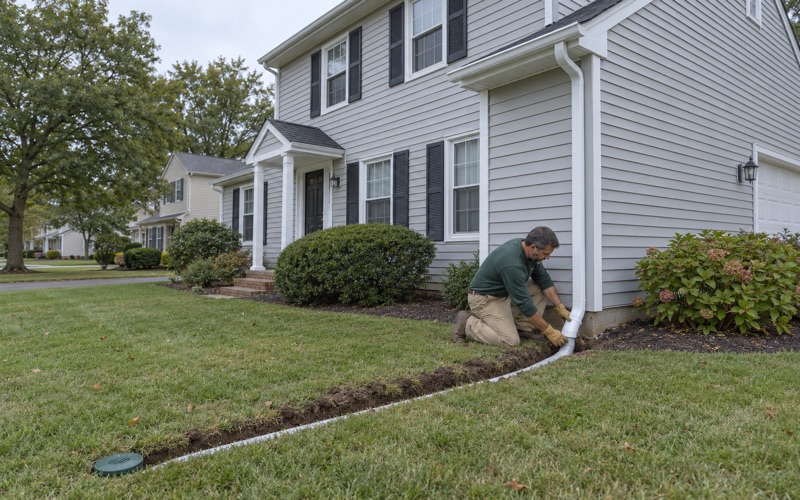
The simplest fix is a downspout extension that carries the water a few feet clear of the wall. Larger lots often leave room to go further, with an underground downspout line running out to a pop-up drainage emitter in the lawn where the water can spread and soak in. We lay out the route with the grade in mind so the line keeps falling the whole way.
Holmdel’s township code permits HDPE piping for roof drain systems in Section 30-137(k)(4), and buried lines are a common way to move roof water on a slope. We talk through where the water can go on your own property and keep it pointed away from the house next door. Any underground work is listed on its own line, so you can decide on it apart from the gutters.
Seamless Gutter Replacement for 1980s and 1990s Holmdel Homes
Much of Holmdel went up in a single 30-year wave. Census estimates count 3,522 of its 6,528 homes, or 54.0 percent, built between 1980 and 2009, with 1,781 of those built in the 1990s alone. Over the same stretch, the township’s population nearly doubled, from 8,447 in 1980 to 15,781 in 2000.
Gutters Left From the Building Boom
Where the original gutters are still hanging, they are now roughly 17 to 46 years old, going by build dates alone. That is arithmetic rather than an inspection, so we look closely before recommending anything. Some original runs only need resealed seams and new hangers, while others sag, pull away from the house or drip at every joint.
When replacement makes sense, we roll seamless gutters on site from coil, one piece for each run. Sectional gutters have joints spaced along every run, and each joint is a place where a leak can start. A seamless run keeps its seams to the corners, where we form box, strip and bay miters to fit the shape of the house.
Fascia, Hangers and Drip Edge
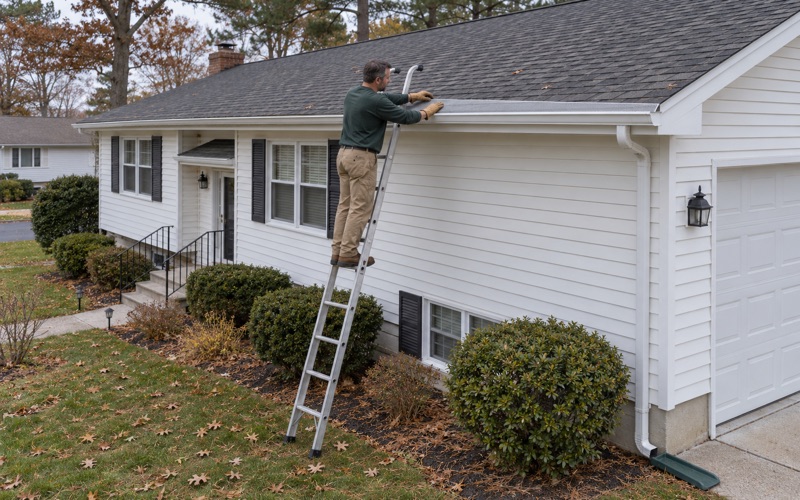
Gutters that have hung for decades often hide fascia boards that are just as old. Before the new run goes up, we check that board for rot and walk you through any soft wood before replacing it. On houses built before 1978, painted fascia and trim are handled under the EPA Renovation, Repair and Painting rule.
The new gutter hangs on hidden hangers rather than the spike and ferrule fastening many older installations used. We add a gutter apron or check the existing drip edge so roof water clears the back of the trough instead of running down the fascia. Under N.J.A.C. 5:23-2.7(c)1.xvi, the state treats the repair, replacement or installation of exterior gutters and leaders as ordinary maintenance.
Second-Story Gutter Cleaning and Guards
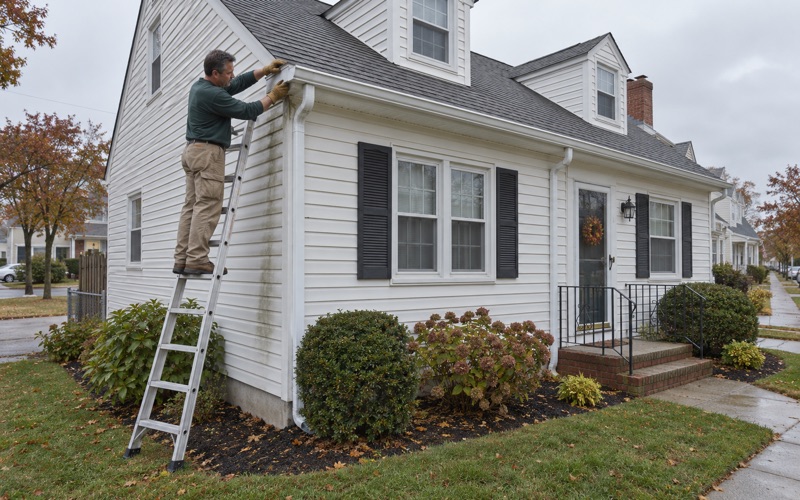
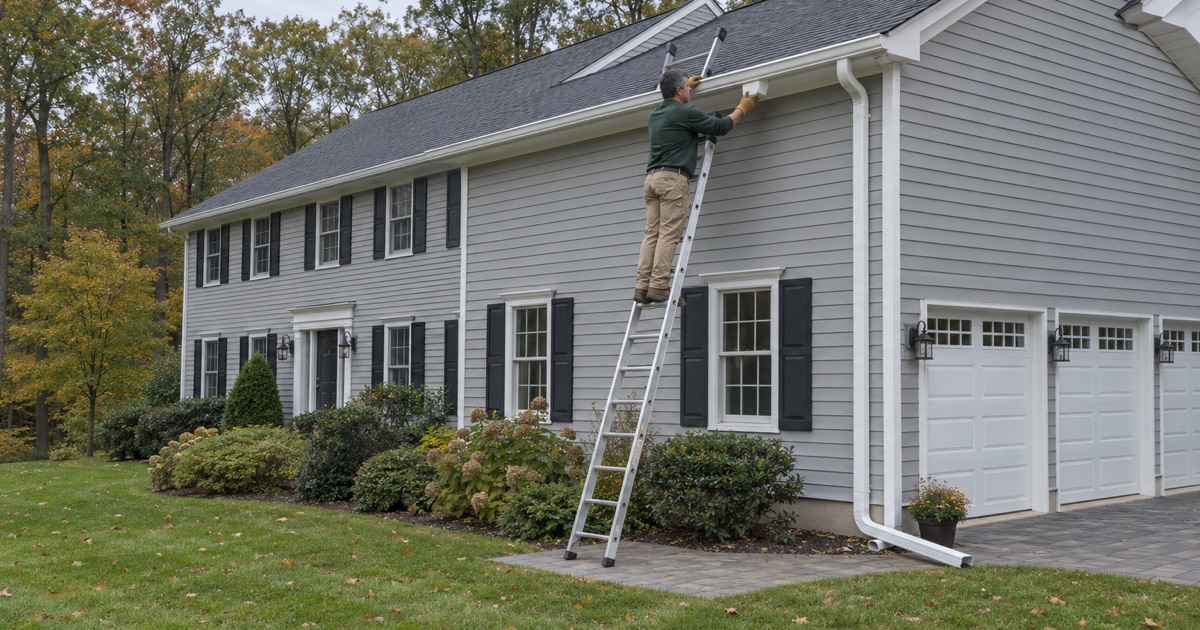
On a two-story Holmdel house, cleaning the gutters is ladder work at second-story height. Census figures count 1,981 of the township’s 5,890 owner households, about a third, headed by someone 65 or older. Plenty of owners of any age would rather not stand on a tall ladder above a sloping yard.
Cleaning at Second-Story Height
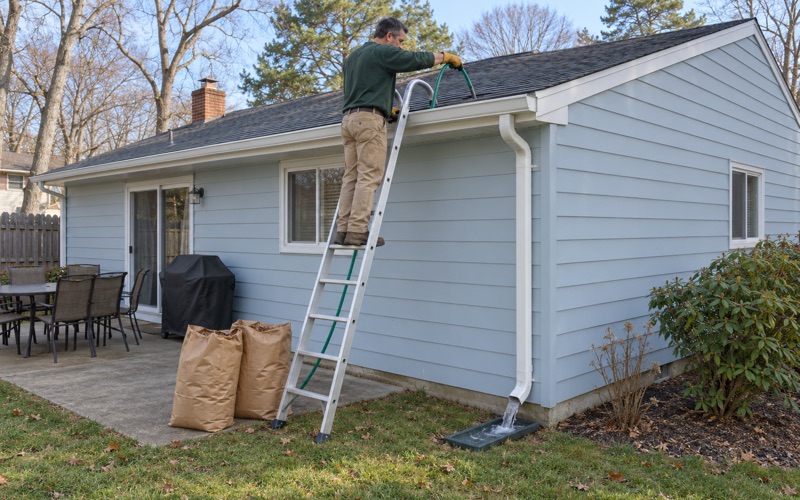
We clean the troughs by hand, then flush every downspout to confirm it runs clear from the outlet to the spot where it lets out. A clogged elbow on a tall downspout can back water up into the gutter even when the trough itself looks clean. All the debris is bagged and hauled away, so nothing is left on the lawn or in the street.
Every cleaning and repair comes with before-and-after photos. They help owners who travel, anyone managing a rental house, and anyone who simply cannot see the top of a second-story gutter from the ground. The photos also show any loose hangers or open seams we spotted along the way.
Guards Matched to the Trees on the Lot
Larger lots often hold mature trees close to the house, and those trees decide which guard will work. Pine needles slip through screens that stop oak leaves, while broad leaves can mat on top of a fine mesh. We look at what is actually growing over the roof before recommending any guard.
For many lots with mixed trees, stainless steel micro-mesh gutter guards keep out needles and seed pods along with leaves. A guard does not end maintenance, so we still check it on a cleaning visit and clear whatever settles on top. On a second-story eave, fewer trips up the ladder is the real payoff.
- 20+ Years Experience
- Free Written Estimates
- Before-and-After Photos