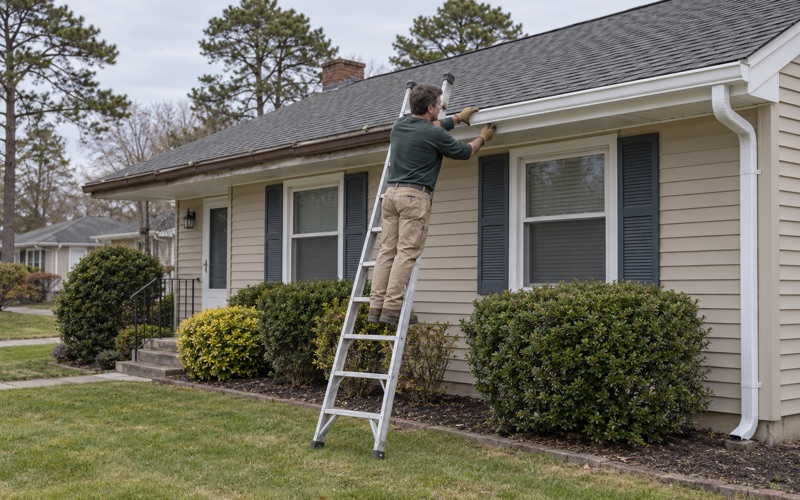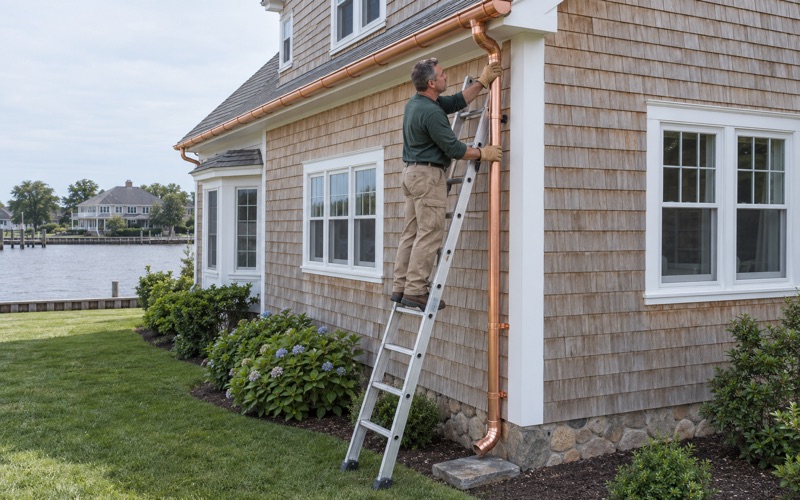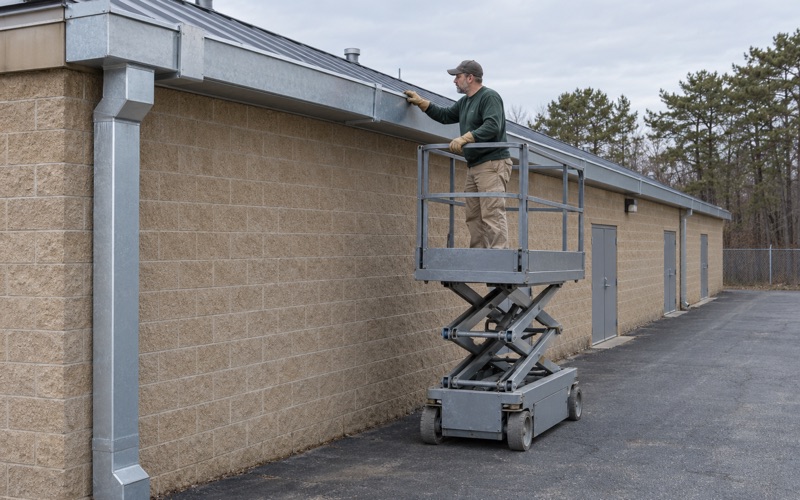
Brick Quality Gutters has spent more than 20 years installing, repairing and cleaning gutters in Holiday City South, and the work here starts with a question most homeowners never have to ask: where is the water allowed to go? Hanging a straight, tight gutter is only half the job on these lots. The other half is making sure the downspouts deliver that water somewhere the community’s own rules expect it to land.
That is because the paperwork behind this neighborhood treats roof runoff as a shared concern. Owners carry the gutters, and they also carry the duty not to disturb the way water moves across their yard and the yards beside it. We read that duty before we price anything, so the system we propose fits both the roof and the rules.
Our crews form seamless runs on site, size each gutter and downspout to the roof area it serves, and trace every outlet to the spot where it empties. When a downspout dumps against a foundation, we suggest a fix that respects the drainage layout already in place rather than inventing a new one.
Gutters and downspouts are the owner’s job in Holiday City South
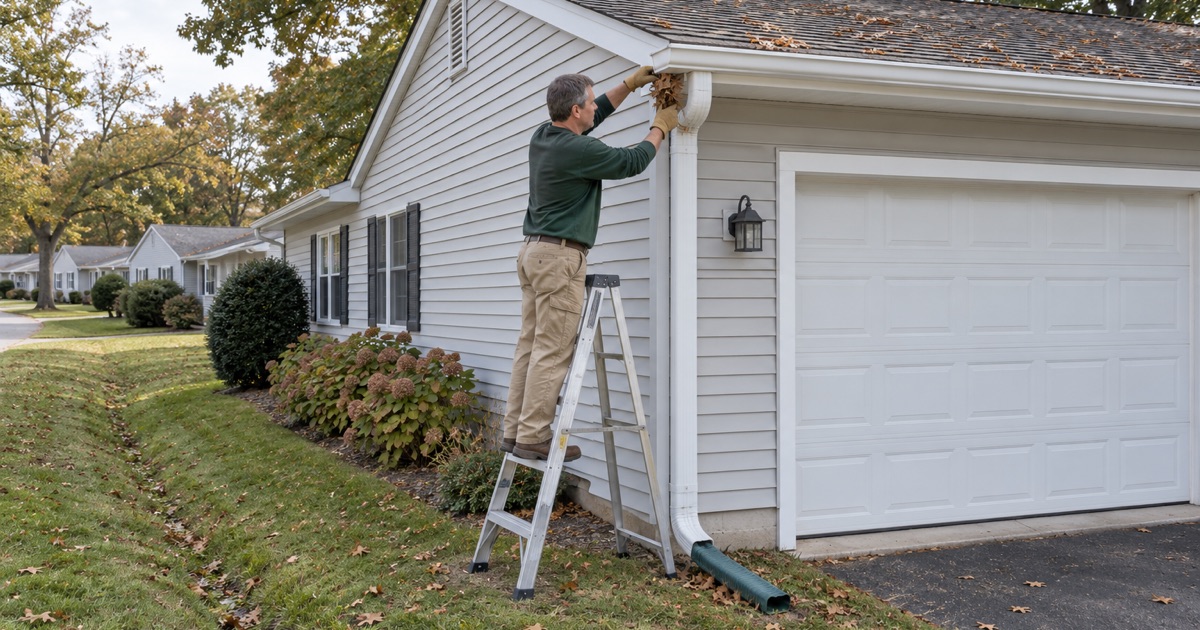
Holiday City South is a census-designated place inside Berkeley Township, in Ocean County, and its homes sit under a Declaration of Covenants and Restrictions made on March 13, 1984 by the developer, Hovsons, Inc. The declaration was recorded with the Ocean County Clerk in Book 4188, Page 807. It is the document that decides who pays for what on the outside of a house, and it answers the gutter question plainly.
What Article VI puts on the owner
Article VI, Section 1 makes each owner solely responsible for the exterior maintenance of the lot and the living unit, including the “paint, repair, replacement and care of roofs, gutters, downspouts, exterior building surfaces.” In other words, the association does not clean or replace gutters for you. If a seam is leaking over the garage or a downspout has pulled loose from the wall, the repair and its cost belong to the household.
That matters when you are comparing quotes or deciding whether to wait. Owners here pay a quarterly assessment to the Holiday City South Homeowners Corporation, set at $150.00 per quarter on the 2026 coupons, but that money does not buy gutter service on your own house. We say this on the first visit so nobody assumes the corporation will step in for routine work.
Why we read the declaration before we quote
In adult communities and other associations, we check the governing documents first so the owner knows exactly who is responsible for the gutters. Holiday City South is one of several neighboring adult communities that each run their own homeowners association, and their rules are not interchangeable. A quick look at the right declaration prevents a homeowner from paying for work the association owns, or skipping work the association expects.
Most houses here are detached, owner-occupied homes, and Census figures show the large majority of the housing was built in the 1980s. Many of those homes are now on their second or third set of gutters, and some listings mention roofs replaced in 2023 or late 2025. A new roof is a natural moment to replace gutters, check the drip edge and confirm that every outlet still drains where it should.
Looking for gutters closer to Beachwood? See Beachwood Gutters.
Where your downspouts discharge, and the established drainage pattern
The same Article VI section that hands owners their gutters also hands them the water those gutters collect. Each owner agrees to maintain slopes, banks, “swales and drainageways” on the lot “for the preservation of designated drainage patterns over his LOT, surrounding LOTS and COMMON PROPERTIES.” The owner also agrees not to “in any way interfere with any established drainage patterns.”
Swales, drainageways and the lot you own
Article IX, Section 7 repeats the point with sharper wording: “No OWNER shall alter or change the established drainage pattern over his LOT from adjoining or surrounding LOTS or COMMON PROPERTIES.” The developer also reserved the right to correct an owner-created drainage problem at the owner’s expense. Read together, those lines make a downspout outlet more than a lawn detail on a Holiday City South lot.
Our reading, which is an application of the covenant text and not a Board ruling, is simple. A downspout extension, a buried line or a reshaped garden bed should keep water moving along the pattern the lot was built with. It should not push runoff toward a neighbor’s foundation, into a shared walkway or across common ground that used to stay dry.
Neighbors, common property and the Article V easement
Article V gives the developer and the corporation a perpetual easement across each lot for utility, drainage and other service facilities. Owners are also barred from planting or building improvements inside the mapped “General Easement Reserved to Hovsons, Inc.” So before we route a discharge line along a side yard, we ask the owner whether that strip falls inside the easement area.
On lots set close together, the choice of outlet location can affect the house next door as much as your own. That is why we walk the property line with you and look at where water flows during a hard rain. A good answer keeps your foundation dry without handing the problem to the neighbor.
Sandy ground at the census point
At the CDP’s census point, the federal soil survey maps the ground as Lakewood sand, 0 to 5 percent slopes, an excessively drained soil. That is a single point read, not a lot-by-lot survey, so we do not assume your yard matches it. Still, sandy ground that drinks water quickly can wash out under a concentrated downspout stream.
When we see a bare, scoured patch below an outlet, it usually means the water is landing too hard in one spot. Spreading that flow along the existing swale, rather than pooling it, tends to protect both the bed and the pattern the covenant asks you to keep.
Extensions, underground lines and splash blocks on a covenant lot
The declaration does not name downspout extensions, underground drains or splash blocks, and we have not read any Board ruling about them. What it does say is that the established drainage pattern stays put. So our job is to pick the outlet option that moves water away from the house while staying faithful to the way the lot already drains.
Choosing an outlet that follows the pattern
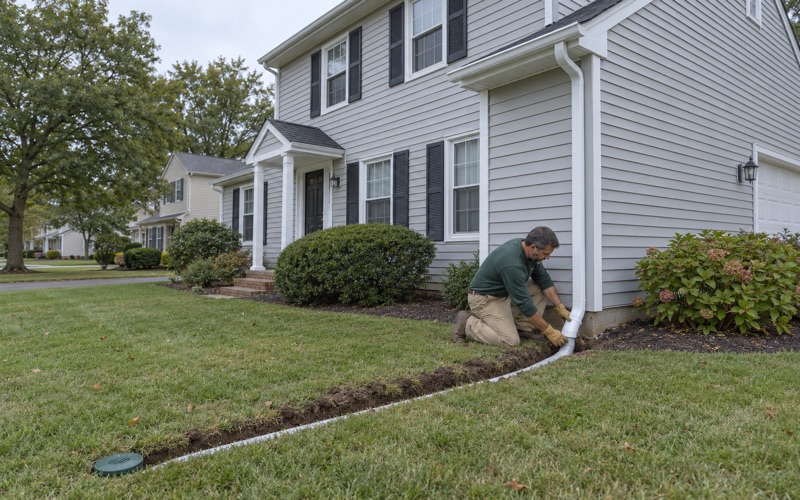
Every downspout we touch gets followed to where its water lands. If it empties right against the foundation, we propose a fix: a longer extension, a splash block that spreads the flow, or an underground line ending at a pop-up drainage emitter. The building code’s guide for new grading calls for the ground to fall 6 inches within the first 10 feet of the foundation, and we use that as a reference when we judge whether water is draining away.
For any option that changes the ground or adds a buried run, we sketch where the water starts and where it ends. You can bring that sketch to the Board along with your request. It shows the outlet joins the existing swale instead of creating a new path toward someone else’s lot.
Sizing, seamless runs and the fascia behind them
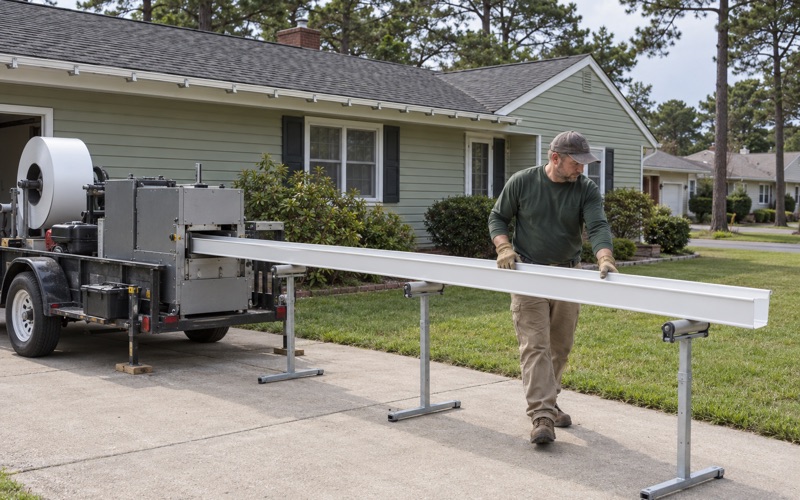
On a ranch roof, a gutter that is too small for the area draining into it overflows at the corners and dumps water right where the outlet plan was meant to prevent it. We size each run and its downspouts to the roof area that feeds it, often with 6-inch K-style seamless gutters and 3x4 downspouts formed from .032 aluminum coil. Each run comes off our machine as one piece, which removes the seams where leaks tend to start.
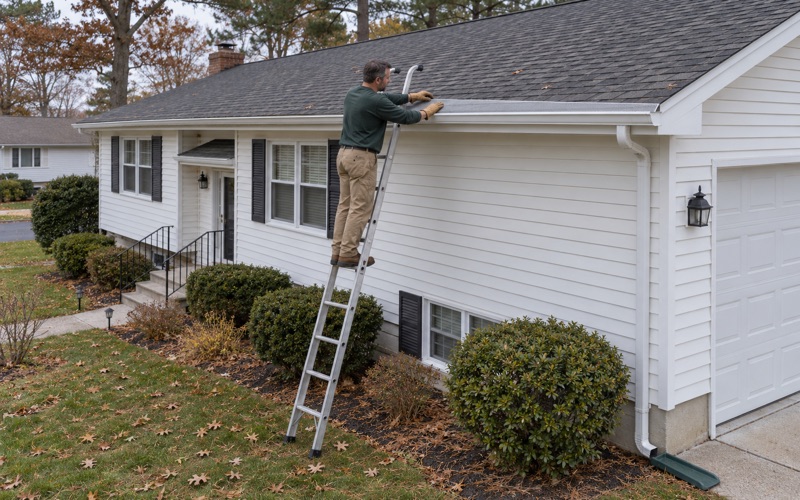
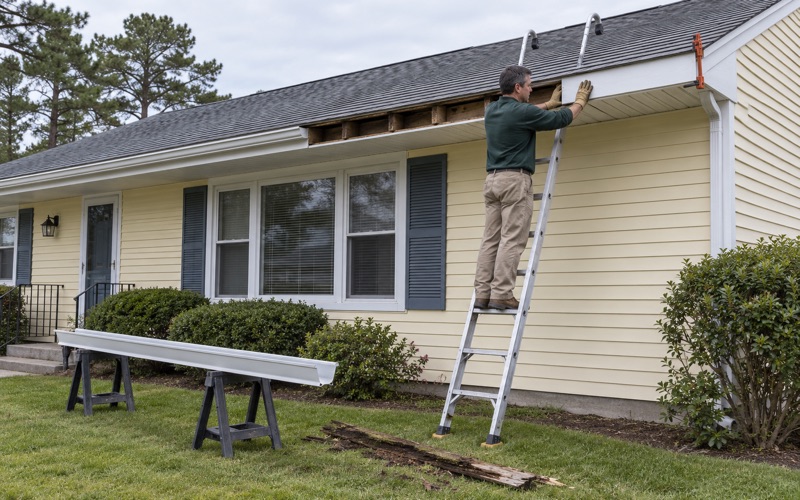
Before anything new goes up, we check the fascia board behind the old gutter for rot. If we find soft wood, we show it to you before replacing it, so you can see the damage instead of taking our word for it. Hidden hangers then tie the new gutter back into sound wood rather than relying on spike and ferrule.
Guards and cleaning where trees overhang
Where the developer left existing trees on a lot, the declaration puts their care and removal on the owner. We match guards to the debris that actually falls on your roof, because pine needles and oak leaves need different screens. Stainless steel micro-mesh suits fine needles, while a broader leaf may call for a different design.
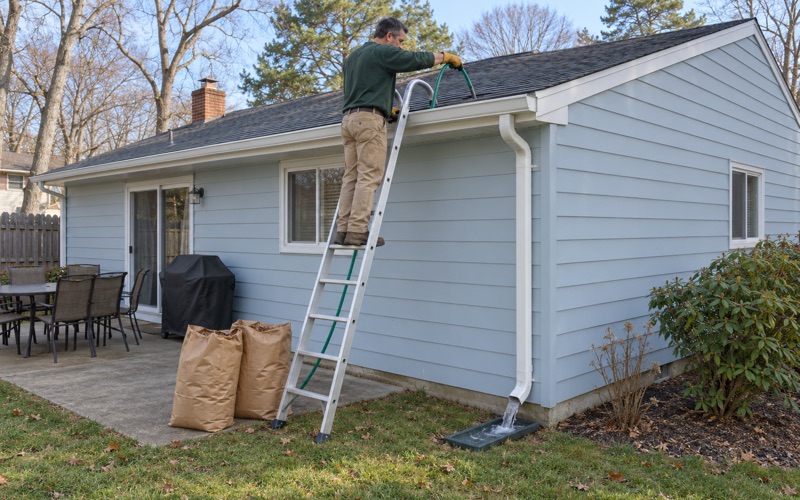
On cleaning visits, we flush each downspout to confirm water runs freely to its outlet. We bag the debris and haul it away with us, so none of it stays behind on your property. Before-and-after photos come with each cleaning and repair, which helps when a family member manages the house from a distance.
Getting Board approval before you change the outside
Gutter replacement in kind is one thing, but a new color, a different profile or a buried drain line is an exterior change. Article IX, Section 1 bars any “exterior addition, change, or alteration” until plans “are submitted to and approved in writing by the BOARD, in their sole discretion.” We build that step into the schedule rather than treating it as an afterthought.
What to bring to the Board
We give you a written scope that the Board can read without a site visit: the gutter size and material, the downspout locations, and where each outlet will empty. If the plan includes a buried line or a regraded bed, the drainage sketch shows how the water stays on the established pattern. The Holiday City South Homeowners Corporation keeps its covenants, bylaws and Code Committee details on its website, and the office is at 139 Santiago Drive.
Once the Board has approved the work in writing, we schedule the install. Our estimate lists new gutters and repairs on separate lines, because New Jersey taxes a new installation and a repair differently. Our contracts follow the state’s home improvement rules, including the three-day cancellation notice.
When the Board can correct a problem and add it to the assessment
Under Article VI, if the Board finds an owner has not kept up exterior maintenance, it can send written notice and then have the condition corrected and charge the owner. That cost can be added to the annual assessment and treated as a lien on the lot. A sagging gutter or a downspout that has been dumping water toward a neighbor is the kind of item worth fixing before it reaches that stage.
We cannot tell you how the Board will judge any particular house, and we do not speak for it. What we can do is leave the gutters and outlets in a condition that is easy to defend: sized, sealed, cleaned and draining along the pattern the lot was built to follow.
The township and state side of the job
In New Jersey, the repair, replacement or installation of exterior gutters and leaders counts as ordinary maintenance under N.J.A.C. 5:23-2.7(c)1.xvi. Berkeley Township’s code covers larger construction separately, and for permits in a Planned Residential Retirement Community the township asks for evidence of the homeowners association’s written approval. If your gutter work is part of a bigger addition, we can talk through how those pieces fit before you file anything.
- 20+ Years Experience
- Free Written Estimates
- Before-and-After Photos