
Brick Quality Gutters handles gutter installation in Brick, NJ, serving surrounding cities including Point Pleasant, Leisure Village East, Brielle, Point Pleasant Beach and Leisure Village. After 20+ years on rooflines from the bay to the inland pine lots, we install seamless gutters that are formed in the driveway, sized to the roof that drains into them, and hung on sound fascia.
A new gutter system is more than a trough along the eave. It is the gutter, the hangers that carry it, the outlets and downspouts that empty it, the flashing that feeds it, and the ground where the water ends up. We plan all of those pieces together, because a well-hung gutter that dumps its water against the foundation has only moved the problem a few feet.
Every installation starts with a measured, written estimate that names the gutter size, coil thickness, hanger type, sealant and downspout layout. Owners know before the crew arrives exactly what is going on the house and why each choice fits that roof.
Residential Gutter Installation
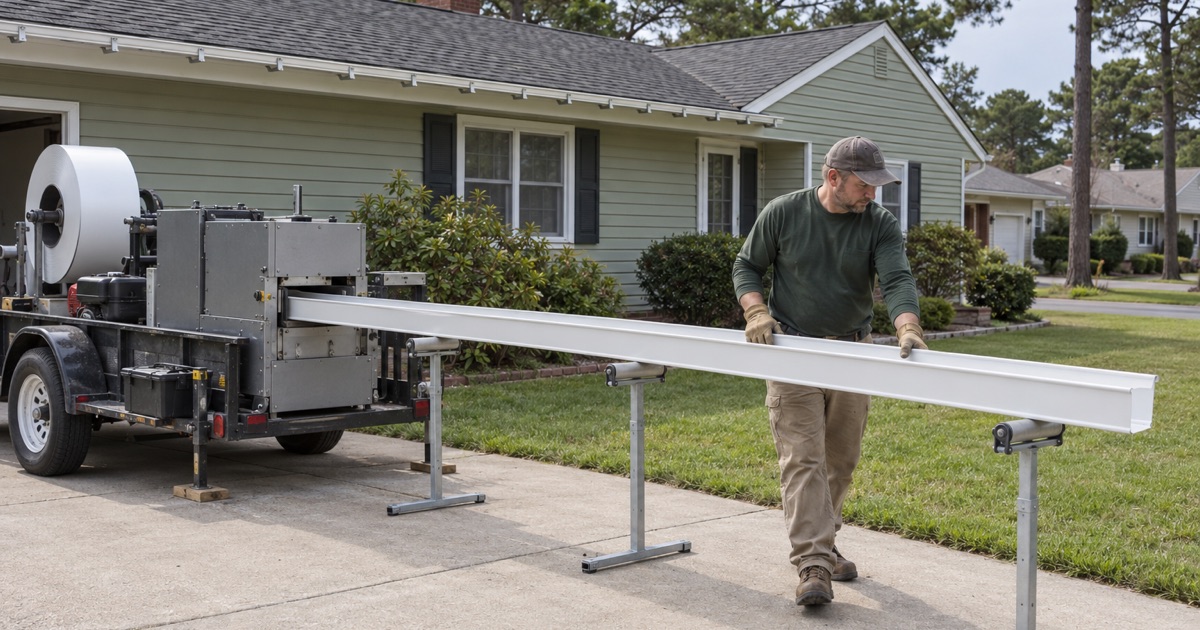
Seamless Gutters Rolled to Length on Site
Our crews bring a forming machine to the job and roll each gutter from a coil of painted aluminum, cutting it to the exact length of the wall it will hang on. A single piece runs from corner to corner with no lap joints along its length. Joints appear only where they must, at the miters, end caps and outlets, which is where they are easiest to seal well and to inspect later.
Sectional gutters from a home center come in short lengths that are riveted and caulked together every few feet. Each of those joints is a future drip once the sealant hardens through a few hot summers and cold winters. A seamless run removes them entirely, which is why it is the standard on nearly every house we work on.
Gutter and Downspout Sizing for the Roof Above
We start by looking at how much roof area drains toward each run and how steep that roof is, since a steep slope sends water faster than a shallow one. Valleys matter too, because two slopes meeting at a corner can pour a concentrated stream into one short stretch of gutter. Those observations decide the gutter width, the outlet size and how many downspouts each run needs.
Many houses near Brick do well with a 5-inch K-style gutter. Large two-story colonials, homes with long rear slopes and roofs with deep valleys often need 6-inch K-style seamless gutters and 3x4 downspouts to keep up with a summer thunderstorm. Sizing up only where the roof calls for it keeps the cost reasonable while ending the overflow at the problem corners.
Profiles, Colors and Metals
K-style gutters, with their flat back and molded front, suit most homes built since the middle of the last century. Half-round gutters with a double-bead profile sit on round brackets and fit older houses and copper work. We match the profile to the house, since a modern ranch and an 1890s Victorian call for different looks even when both drain the same amount of rain.
Aluminum coil comes in dozens of colors, and our default is to match the gutters to the trim so they read as part of the roof edge. Owners who want the metal to show can choose copper, galvalume or zinc. We explain how each weathers over time and what fasteners it needs, since copper and aluminum must never touch.
Commercial Gutter Installation
Gutters for Stores, Offices and Churches
Commercial buildings, churches and multi-family properties often have large roofs that empty into a few long gutter runs. Those runs need wider troughs, heavier hangers and bigger downspouts than a house, and they must handle water from a flat or low-slope roof that drains through scuppers. We size each system from the roof it serves and coordinate the work around business hours.
On storefronts and offices, downspouts often discharge onto sidewalks, parking lots or into storm lines. We plan where that water goes so it does not freeze on a walkway or flood an entrance. Brick Township’s illicit connection ordinance in Chapter 396 governs what may enter the storm sewer, and we keep downspout tie-ins within those rules.
Box Gutters and Built-In Systems
Older churches, commercial blocks and some historic homes have box gutters built into the roof structure, lined with metal or membrane. When the lining fails, water leaks straight into the walls or ceiling below. We reline or rebuild box gutters, or replace them with an external system when the owner and any review board agree, and we make sure the outlets and leaders can carry the volume.
Hangers, Flashing and the Fascia Behind the Gutter
Hidden Hangers Over Spikes and Ferrules
Gutters installed decades ago were held up by long spikes driven through ferrules into the fascia. As the wood swells and shrinks with the seasons, those spikes back out and the gutter sags. We hang every new gutter on hidden hangers screwed through the back of the gutter into the fascia, which hold far better and leave a clean front edge.
Hanger spacing is set to the gutter size, the roof and the snow and ice the house can expect, rather than a one-size number. On houses close to the ocean, Barnegat Bay or the rivers, we use hangers and screws chosen for salt air and name them on the estimate.
Gutter Apron, Drip Edge and Kickout Flashing
A gutter can only collect water that reaches it. We check that the drip edge or gutter apron carries roof water past the fascia and into the trough rather than letting it run down behind the gutter. Where a roof meets a sidewall above a gutter end, we add kickout flashing so water is turned into the gutter instead of running down the siding.
Missing flashing is one of the most common reasons a new gutter still leaves stains on the fascia. Fixing it during the installation costs far less than coming back later to replace rotted boards.
Fascia Inspected Before Hanging
Before any new gutter goes up, we probe the fascia along each run for soft spots. If we find rot, we show it to the owner, replace the damaged boards and wrap or paint them before fastening the new gutter. Hangers driven into sound wood hold the gutter level for years, while hangers in rotted wood pull loose in the first heavy storm.
On houses built before 1978, painted fascia and trim may contain lead. That work follows the EPA Renovation, Repair and Painting rule, with the containment and cleanup it requires.
Our Step-by-Step Gutter Installation Process
Step 1: Measure and Inspect
We measure every run, look at the roof slopes and valleys, probe the fascia and follow each existing downspout to where its water lands. The estimate lists the gutter size, coil, hangers, sealant and downspout plan, with any fascia repair on its own line.
Step 2: Remove the Old System
The old gutters and downspouts come down carefully, and the fascia is checked again once it is exposed. Old gutters are hauled away rather than left at the curb.
Step 3: Form, Hang and Pitch
Each run is formed on site, fitted with outlets and end caps, sealed with tripolymer gutter sealant and hung on hidden hangers with a steady pitch toward the downspouts. Miters are formed and sealed at every corner.
Step 4: Downspouts and Water Test
Downspouts are strapped to the wall with A or B elbows as the layout needs and run to extensions, splash blocks or underground lines. We run water through every gutter to confirm it drains, then clean up and photograph the finished work.
- 20+ Years Experience
- Free Written Estimates
- Before-and-After Photos