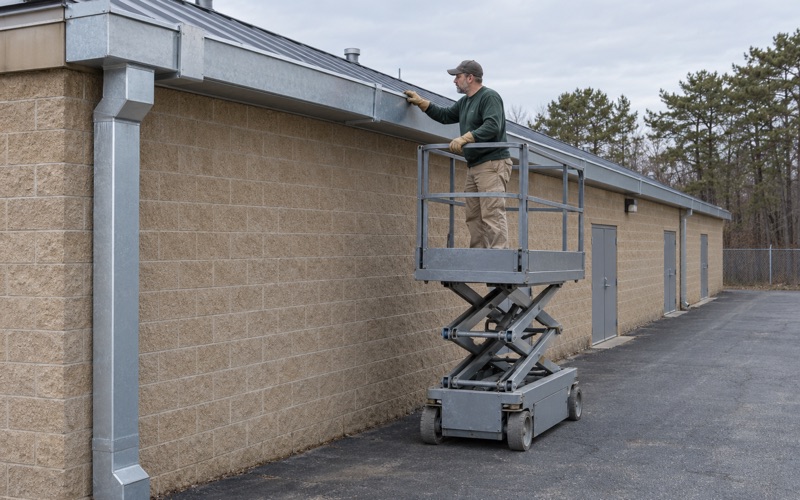
Brick Quality Gutters has spent more than 20 years on gutters in Eatontown and the rest of Monmouth County, and the work here asks a different question than it does on a quiet residential street. Some of the biggest roofs in town belong to stores and offices, and the water coming off them has to go somewhere a borough already struggles to hold it. We plan each job around where that water ends up, not only around the trough that catches it.
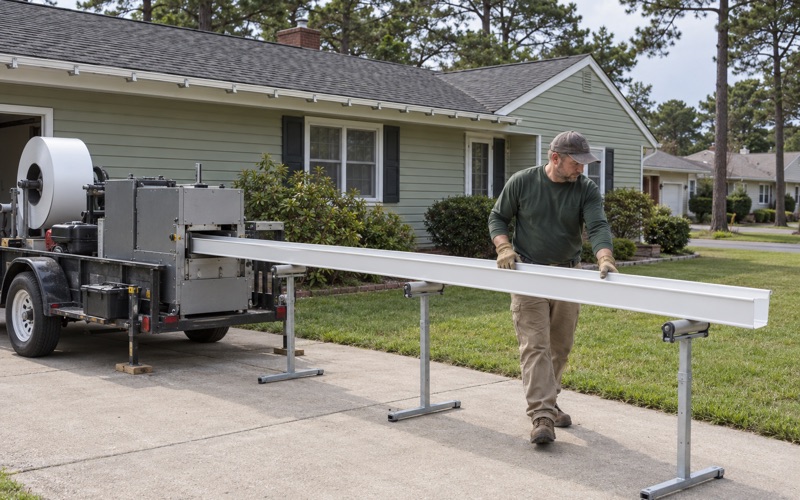
On a flat commercial roof, that means scuppers, conductor heads and leaders sized for the roof area feeding each outlet. On a house or townhome, it means seamless runs formed on site from coil, one piece per run, with downspouts that carry water away from the foundation. Either way, we name the hangers, fasteners and sealants on the estimate, so an owner or property manager can see what is going up.
Estimates put new gutters and repair work on separate lines, because New Jersey taxes the two differently. Contracts follow the state’s home improvement rules, including the three-day cancellation notice. The sections below cover the commercial corridor, the drainage hardware on flat roofs, the watershed that roof water joins, and the houses that make up most of the borough’s neighborhoods.
Commercial gutters along Routes 35 and 36
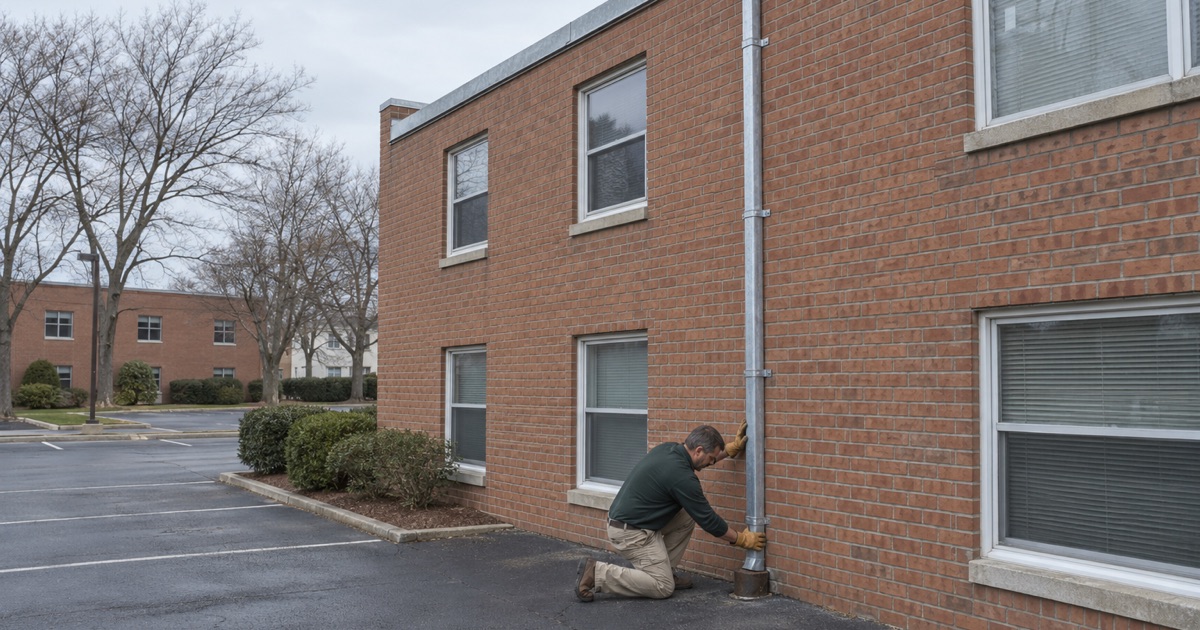
Eatontown’s commercial roofs cluster along the Route 35 corridor and around its meeting with Route 36. Strip centers, pad buildings, offices and service shops line those roads, and many of them carry low-slope roofs that shed water to the edge or to a single wall. That is a different drainage problem than a pitched house roof, and it is sized differently from the start.
Storefronts, offices and pad buildings
A typical retail building on the corridor drains a wide, nearly flat field toward one or two walls. The water reaches the edge in volume, often at a few points rather than spread along a long eave. A residential K-style gutter hung across that wall can overflow in a hard rain even if it looks generous on paper.
We start by measuring the roof area that feeds each outlet and then pick the gutter, collector box or leader that can carry it. Where an existing system overflows, the cause is often an undersized leader or an outlet that has been patched shut. Fixing the outlet and the pipe below it usually does more than adding gutter length.
From Monmouth Shopping Center to Monmouth Square
The largest roof in town has been the Monmouth Mall at Routes 35 and 36 and Wyckoff Road. It opened on March 1, 1960 as the open-air Monmouth Shopping Center and later grew into an enclosed mall. Eatontown agreed to plans to turn it into an improved commercial area called Monmouth Square, and the interior closed to the public in mid-August 2024.
A rebuild of that kind changes how roofs along the corridor drain, because new buildings bring new roof edges, outlets and leaders. We have not worked on Monmouth Square, and we mention it because it shows where commercial drainage in Eatontown is heading. Owners of nearby buildings that are being refitted face the same questions at a smaller scale.
Looking for gutters closer to Red Bank? See Gutters in Red Bank.
Scuppers, conductor heads and leaders on flat roofs
Low-slope roofs rarely use house gutters as their main drainage. They push water through openings in the parapet or roof edge, catch it in a box on the wall, and drop it through a leader to grade or to a storm line. Each of those parts has to be sized to the others, or the weakest one sets the limit.
How water leaves a flat roof
A scupper is an opening through a parapet or roof edge that lets water spill off the roof. A conductor head, sometimes called a collector box, catches that water on the outside of the wall and feeds it into a leader. Some buildings also use internal roof drains that run down through the structure.
Internal roof drains and the storm piping inside a building are plumbing work, a separate trade and a separate review. Our work sits on the outside of the wall: the scupper liner, the conductor head, the leader and where its water lands. We tell a building owner plainly when a problem traces back to an interior drain instead.
Sizing the leader to the roof that feeds it
An oversized leader on a commercial wall is usually there for a reason, and replacing it with a smaller stock pipe invites overflow at the conductor head. We measure the roof area that drains to each scupper before choosing the box and leader size. Elbows, offsets and long horizontal runs slow water down, so we keep them to the fewest the wall allows.
Seams and joints on wide boxes and leaders are sealed with a tripolymer sealant made for metal. Fasteners and straps are matched to the wall, whether that is masonry, metal panel or block. On buildings near the rivers and the shore, we pick hardware for salt air and write the material on the estimate.
Replacement versus new work on the estimate
A conductor head that has rusted through at the seams is a repair line; a full new leader run is a new installation line. Keeping them apart on the estimate matters for tax treatment under New Jersey rules and makes the scope easy to compare. It also lets a property manager approve the urgent repair now and schedule the rest.
Under N.J.A.C. 5:23-2.7(c)1.xvi, the repair, replacement or installation of exterior gutters and leaders is listed as ordinary building maintenance. That covers the outside hardware, not interior drains or storm piping. If a job crosses into that plumbing work, the owner hears that before anything is scheduled.
Roof water in a watershed short on storage
Where a leader discharges is not only a sizing choice in Eatontown. The borough’s own 2024 request for federal flood funding describes a watershed that fills quickly, and its sewer code limits where roof water can be piped. Both shape how we route a downspout or leader.
Wampum Lake and short-term runoff storage
The 2024 funding request for the Eatontown Community Flood Mitigation Project says the Wampum Lake watershed experiences repetitive, significant flooding because of a lack of short-term runoff storage. It describes Wampum Lake runoff backing up into various properties during high-intensity rain, most notably the 412-unit Eatoncrest Apartment Homes. It also reports that the sluice gates at the 1937 dam are not functional.
No source we have read ties any specific roof to that flooding, and we do not suggest one. What the record does show is a watershed with little room to spare, so we look at where each leader sends its water. A leader dumping onto pavement that already floods is worth rerouting to a lawn, a dry well or a proper storm connection.
Leaders stay out of the sanitary sewer
Eatontown’s sewer code, Section 266-12, lists sanitary sewer lines for sump pumps and roof leaders among its prohibited connections. Rainwater in a sanitary line adds load the sewer was not built to carry. When we find a leader that disappears into a pipe of unknown purpose, we flag it rather than guess.
On older commercial and residential lots, a buried leader line can run somewhere nobody remembers. We trace where the water goes before we tie a new leader into an existing pipe. If the destination is unclear, we discharge to the surface or to a new underground line we can follow end to end.
Storm connections and the Chapter 283 rules
Chapter 283 of the borough code separately bars illicit connections to the storm sewer system. Where a leader does tie into storm piping, that connection should be one the system is meant to take. We point out any connection that looks improvised so the owner can have it checked before new gutters feed it.
For surface discharge, we follow the grade rule in the 2021 New Jersey edition of the IRC, which calls for the ground to fall 6 inches within the first 10 feet from the foundation. A downspout that lands against a wall on flat ground gets an extension or an underground line with a pop-up emitter. We propose the route before we install it.
Gutters on Eatontown’s houses and townhomes
Most of the borough’s homes are houses and townhomes, not storefronts. Detached houses make up 40.9% of housing units and attached single-family homes 14.8%, and 54.6% of units date from 1950 to 1979, according to ACS 2024 estimates. Those decades bring their own fascia, trim and downspout questions.
Houses from the 1950s through the 1970s
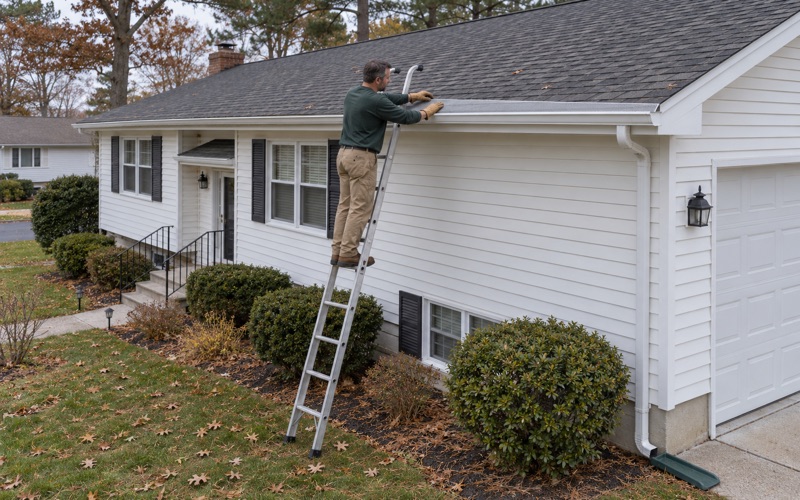
On many houses from those decades, the fascia board behind the gutter is original or close to it. We check it for rot before new gutters go up, and we show the owner any soft wood before it is replaced. Painted fascia and trim on pre-1978 houses fall under the EPA Renovation, Repair and Painting rule, which affects how that wood is handled.
For most of these roofs, 6-inch K-style seamless gutters in .032 aluminum with 3x4 downspouts carry the water well. We size each run to the roof area that drains to it, so a long rear slope may get a larger outlet than a short front one. Hidden hangers hold the run tighter to the fascia than spike and ferrule.
Townhomes and association roofs
On attached homes, the gutters may belong to the owner, the association or both, depending on the master deed. We check the master deed or the management office first, so the owner knows who is responsible before anyone signs. That saves a homeowner from paying for a run the association was meant to cover.
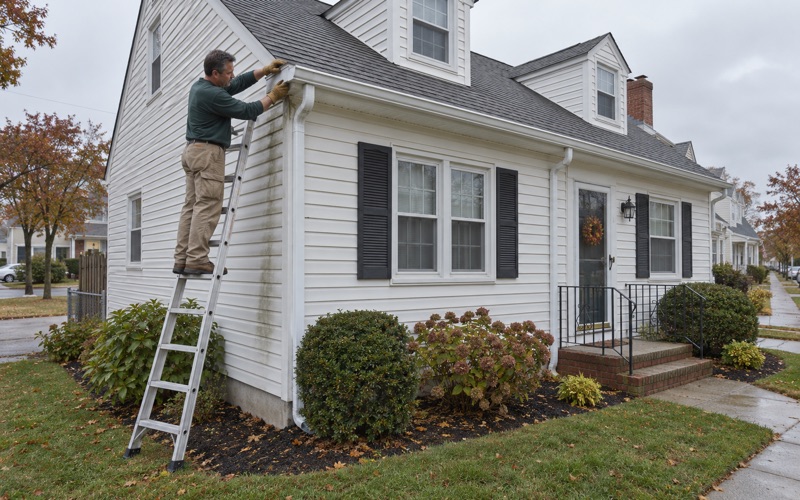
Shared roofs also share water, so a clogged outlet on one unit can overflow onto the next. We look at the whole run on a townhome row, not only the section in front of one door. Guards are matched to what falls on the lot, since pine needles and oak leaves call for different screens.
Cleaning visits and photos
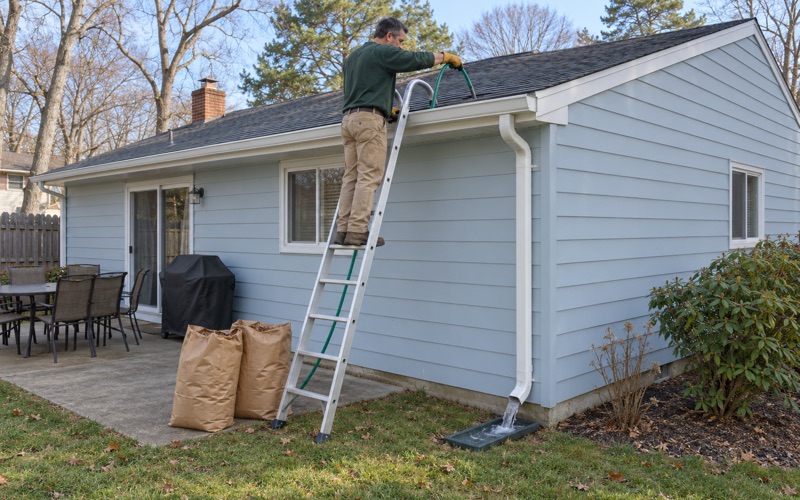
On a cleaning visit, we flush each downspout to confirm it runs clear and bag the debris. The bags leave with our crew, so nothing is left on the lawn or in the street. A clear leader matters more in a watershed that floods, because an overflowing gutter dumps water right where the foundation sits.
Each cleaning and repair comes with before-and-after photos. That suits owners of rental houses and second homes who cannot be on site, and property managers who need a record for the file. The photos show the outlets, the downspout discharge and any fascia or hanger problem we found.
- 20+ Years Experience
- Free Written Estimates
- Before-and-After Photos