
Brick Quality Gutters handles downspout installation and drainage in Brick, NJ, serving surrounding cities including Point Pleasant, Leisure Village East, Brielle, Point Pleasant Beach and Leisure Village. In 20+ years of gutter work we have seen that a gutter system succeeds or fails at the bottom of the downspout, where all the water from the roof finally reaches the ground.
A clean, well-hung gutter can still flood a basement if its downspout empties into a flower bed against the foundation. Most gutter contractors stop at the downspout elbow. We follow every downspout to the spot where its water lands and look at the soil, the slope and what sits nearby before deciding whether it needs an extension, a splash block, an underground line or a different location altogether.
Each drainage estimate shows where every downspout discharges today, what we propose to change, and why. Owners can see the plan on paper before any trench is dug.
Downspout Sizing and Placement
Matching Downspouts to the Roof
A downspout can only empty a gutter as fast as its size allows. Many older houses carry 2x3 downspouts, which are fine for small roofs but fall behind on large or steep ones. We look at how much roof drains to each downspout and step up to 3x4 downspouts, add a second outlet, or both where the roof sends more water than the original layout can carry.
Placement matters as much as size. A downspout at the far end of a long run leaves the opposite end to overflow, while one placed beside a valley catches water where it arrives. We position outlets so each section of gutter has a short path to a downspout.
Elbows, Straps and Outlets
Downspouts connect to the gutter through an outlet and bend toward the wall through A and B elbows, which turn the pipe front to back or side to side. We use wide-flange outlets that sit flat in the gutter, fasten every downspout to the wall with straps, and seal the joints so water does not leak down the siding. On raised houses with long downspouts, extra straps keep the pipe from swaying in a nor’easter.
Getting Water Away From the Foundation
Extensions and Splash Blocks
The simplest drainage fix is a downspout extension that carries water several feet out from the wall, ending on a splash block that keeps it from digging a hole in the lawn. Extensions can be fixed, hinged to swing up for mowing, or flexible for tight spots. We choose the type that fits the yard and the way the owner uses it.
An extension only helps if the ground beyond it slopes away. If the soil is flat or tilts back toward the house, the water simply returns to the foundation by another route.
Grading Around the House
New Jersey’s residential code edition, IRC 2021 R401.3, calls for the ground to fall 6 inches within the first 10 feet from the foundation. Many older lots have settled over the years, and mulch beds and patios often end up sloping the wrong way. We point out where the grade is flat or reversed near each downspout, so the owner can fix the slope along with the drainage.
Underground Downspout Lines and Pop-Up Emitters
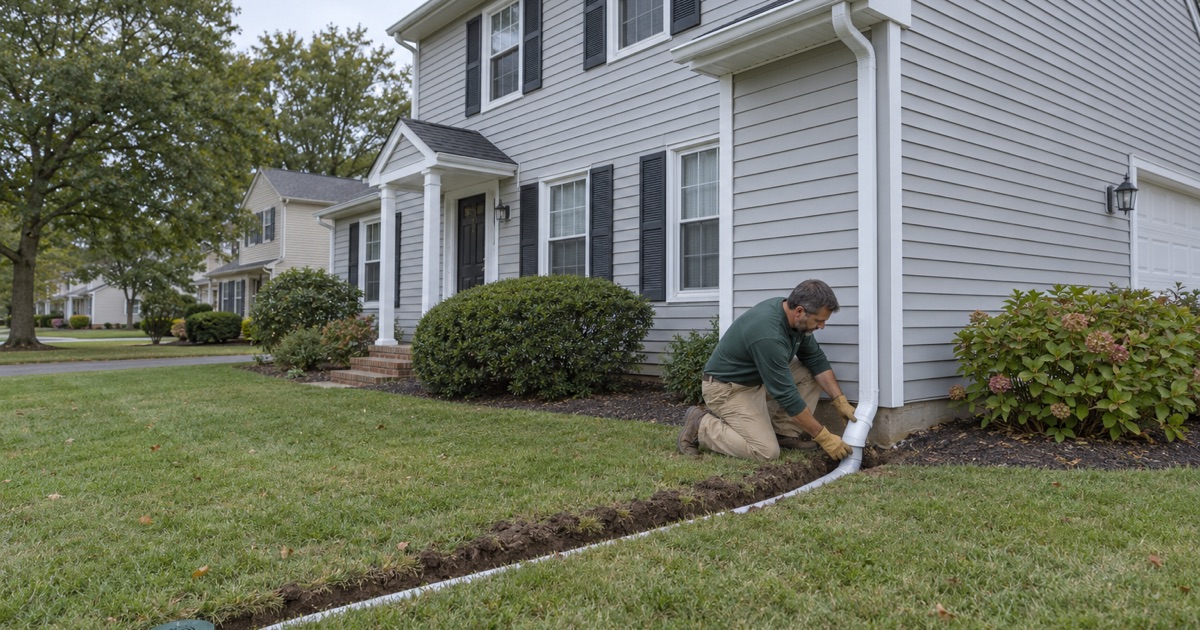
An underground downspout line carries water through a buried pipe to a point well away from the house, ending in a pop-up drainage emitter that opens when water flows and closes when it stops. Buried lines keep walkways and lawns clear and work well where an extension would be in the way. We trench, lay the pipe at a steady fall, install cleanouts where they make sense, and test the line with water before backfilling.
Pipe material and slope decide how long a line keeps working. Lines laid flat or with low spots collect silt and leaves and slowly fill, so we keep the fall steady from the downspout to the outlet.
Underground Drain Problems
Clogged and Backed-Up Lines
When water bubbles out at the bottom of a downspout during rain, the line below it is usually clogged with leaves, silt, roots or a crushed section. We flush the line and watch the outlet, then snake or jet it if the water does not come through. When the problem is a broken or collapsed pipe, we locate it and replace that section rather than digging up the whole run.
Guards and regular gutter cleaning keep most debris out of buried lines. A downspout strainer at the outlet adds one more layer of protection where leaves are heavy.
Sand, High Water and Where Lines Can End
Soils change across the area. Sandy lots near the Pinelands drain quickly, while lots near rivers, lakes and the bay can have a high water table that leaves nowhere for buried water to go. We look at the soil and the low points on the lot before choosing where a line should end, so the water is carried somewhere it can soak in or flow away.
Some towns along the shore require roof water to be piped into a drywell or seepage pit on the lot, while others set limits on where it may be discharged. We check the local rules before designing a line.
Storm Sewers, Neighbors and Sump Pumps
Storm Sewer Connections
Tying a downspout into the street or a storm pipe is not always allowed. Brick Township’s Chapter 396 governs illicit connections to the municipal storm sewer system, and other towns have similar rules. We keep new connections within those rules and point out existing tie-ins that an owner may want to confirm with the township.
Water Running Toward a Neighbor
Property maintenance codes in many New Jersey towns say roof drainage must not be discharged in a way that creates a nuisance, which includes sending it onto a neighbor’s property. On narrow lots, attached homes and duplexes, a downspout aimed at the property line can cause problems next door. We route discharge so it stays on the owner’s lot and away from shared walls.
Sump Pump and Downspout Discharge
Sump pump discharge often runs out near the same corner as a downspout, and the two can overwhelm a small area. We look at both together and route them so they do not dump water back toward the foundation. Brick’s stormwater code lists sump pump water and foundation drains among the discharges excepted from its improper-disposal prohibition, but where that water goes on the lot still matters.
- 20+ Years Experience
- Free Written Estimates
- Before-and-After Photos