
Brick Quality Gutters installs and repairs copper gutters in Brick, NJ, serving surrounding cities including Point Pleasant, Leisure Village East, Brielle, Point Pleasant Beach and Leisure Village. Over 20+ years we have hung copper on shore cottages, older colonials and historic homes, and we match the profile, the weight of the metal and the hardware to the age and style of each house.
Copper is a long-term choice. It costs several times more than aluminum, and published Monmouth County pricing puts installed copper at roughly $20 to $40 per linear foot against $7 to $13 for aluminum. In return it resists rust, takes soldered joints that do not depend on caulk, and changes color over the years in a way no painted gutter can.
We explain what copper will look like in five years, what it needs to stay sound, and which hardware it must never touch, before an owner commits to it. Copper work is priced on its own estimate with the metal weight, profile and fasteners named.
Copper Gutter Profiles and Weights
Half-Round Copper With a Double-Bead Edge
Half-round gutters are a semicircular trough with a rolled bead along the front edge, and the double-bead profile adds a second roll for stiffness and a finished look. Copper half-round sits on round brackets and pairs naturally with round copper downspouts. It suits older homes, Colonial Revival houses and new houses built in a traditional style.
We size half-round to the roof just as we size K-style, since a beautiful gutter that overflows in a summer storm still fails at its job. Larger roofs may need a wider half-round or an extra downspout.
K-Style Copper Gutters
K-style copper gutters have the same flat back and molded front as standard aluminum gutters, formed from copper coil. They give a copper finish on houses where half-round would look out of place, and they carry more water than a half-round gutter of the same width. Many owners choose K-style copper for porches, bay windows and entries where the metal will be seen up close.
Copper can also be used on only part of a house, such as a front porch roof or a bay, while the rest of the house keeps painted gutters. When we do that, we plan where each roof drains so copper runoff never reaches the aluminum sections downstream.
16-Ounce Versus Heavier Copper
Copper gutter stock is described by weight per square foot. 16-ounce copper is the common choice for residential gutters and downspouts, while 20-ounce copper is heavier and stiffer for wider gutters, long runs and commercial or institutional buildings. We recommend the weight based on the gutter width, the run length and the snow and ladder loads the gutter will see.
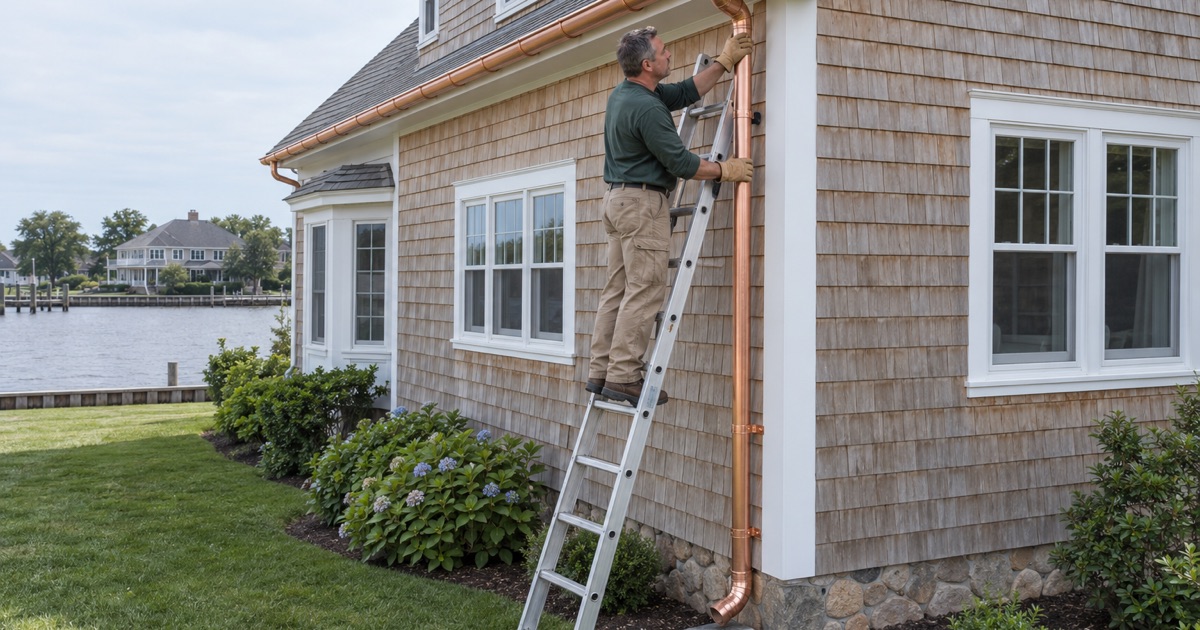
Downspouts follow the same choice. Round copper downspouts suit half-round gutters, while rectangular copper downspouts pair with K-style. Decorative leader heads and conductor boxes at the top of a downspout can be added where they fit the style of the house.
How Copper Weathers Near the Shore
Bright Copper, Brown Patina and Green
New copper is bright and reddish, then darkens to a brown within months as it oxidizes. Over a longer period it develops the green patina many owners want. Near salt water that change comes much sooner, with published estimates of about five years in marine air against roughly eighteen years in a moderate climate, so a copper gutter in Point Pleasant Beach will green long before one on an inland lot.
Owners who want to keep the bright or brown look can have the copper treated, though most of our copper customers prefer to let it weather naturally. Treatments have to be renewed over time, so we explain the upkeep before anyone commits to one.
Staining Below Copper Gutters
As copper weathers, rainwater running off it can carry green or blue staining onto light-colored siding, stone, concrete and paving below. We plan downspout discharge so that water lands where the stain will not matter, and we point out the risk on houses with white trim or light masonry under the eaves.
Lead-Coated Copper and Look-Alike Options
Lead-coated copper weathers to a soft gray rather than green and has long been used where a historic building needs a matching gray finish. Copper-colored aluminum, sometimes called copper penny, gives the color of new copper at a lower price but never develops a patina. We explain these options honestly, since an owner hoping for green patina will be disappointed by painted aluminum.
Installing Copper the Right Way
Soldered Seams and Copper Hardware
Copper gutter joints are soldered rather than caulked, which gives a seal that does not dry out like sealant on an aluminum gutter. Hangers, brackets, straps and fasteners must be copper or a compatible metal, because steel and aluminum corrode quickly in contact with copper. We use matching copper hardware throughout, so the system ages as one piece.
Copper also needs room to move. Long runs expand and contract with the seasons, and on those we add expansion joints so the soldered seams are not torn apart over time. Hangers are spaced closely enough to carry the heavier metal without sagging.
Keeping Copper Away From Aluminum
When water runs off copper onto aluminum, the aluminum corrodes faster. That is why one major aluminum gutter maker voids its warranty on a property with copper on the roof or anywhere water can be directed onto its aluminum. We plan mixed-metal houses carefully, keeping copper drainage separate from any aluminum gutters, flashing or trim below it.
Historic Homes and Review Boards
In historic districts, the gutter can be part of what the review board looks at. Red Bank’s land use code, for example, treats in-kind replacement as ordinary repair while its historic design guidelines address gutters and downspouts directly. Where a house already has copper or half-round gutters, we match them in kind, and we check whether a change of material needs approval before work begins.
We never tell an owner that a house originally had half-round or copper gutters unless the evidence is on the house itself. Old brackets, ghost lines on the fascia and surviving sections are what we look for before recommending a historic profile.
Repairing Existing Copper Gutters
Leaking Joints and Split Seams
Older copper gutters can develop leaks at soldered joints, outlets and end caps as the metal expands and contracts. We clean the joint and resolder it rather than covering it with sealant, which does not bond well to copper and fails quickly.
Matching New Copper to Old
New copper next to old, weathered copper will stand out at first. It darkens to brown within a season or two and continues to blend over time. We explain that up front so owners know what to expect after a repair.
- 20+ Years Experience
- Free Written Estimates
- Before-and-After Photos