
Brick Quality Gutters installs, repairs and maintains commercial gutters in Brick, NJ, serving surrounding cities including Point Pleasant, Leisure Village East, Brielle, Point Pleasant Beach and Leisure Village. For 20+ years we have worked on retail strips, offices, churches, schools, condo buildings and mixed-use blocks, where a gutter failure can mean a wet storefront, a slippery walkway or water inside a tenant’s space.
Commercial roofs move a lot more water than houses. A single low-slope roof over a shopping center can drain into a handful of scuppers and leaders, each carrying the runoff from thousands of square feet, so undersized or clogged components overflow quickly. We size commercial systems from the roof they serve and plan every discharge point before the first section is hung.
Property managers, boards and owners get written estimates that separate new work from repairs and name the metal, gauge and hardware. We schedule around business hours and tenant access, and we document every visit with photos for the building’s records.
Commercial Gutter Systems We Install
Wide Commercial Gutters and Large Downspouts
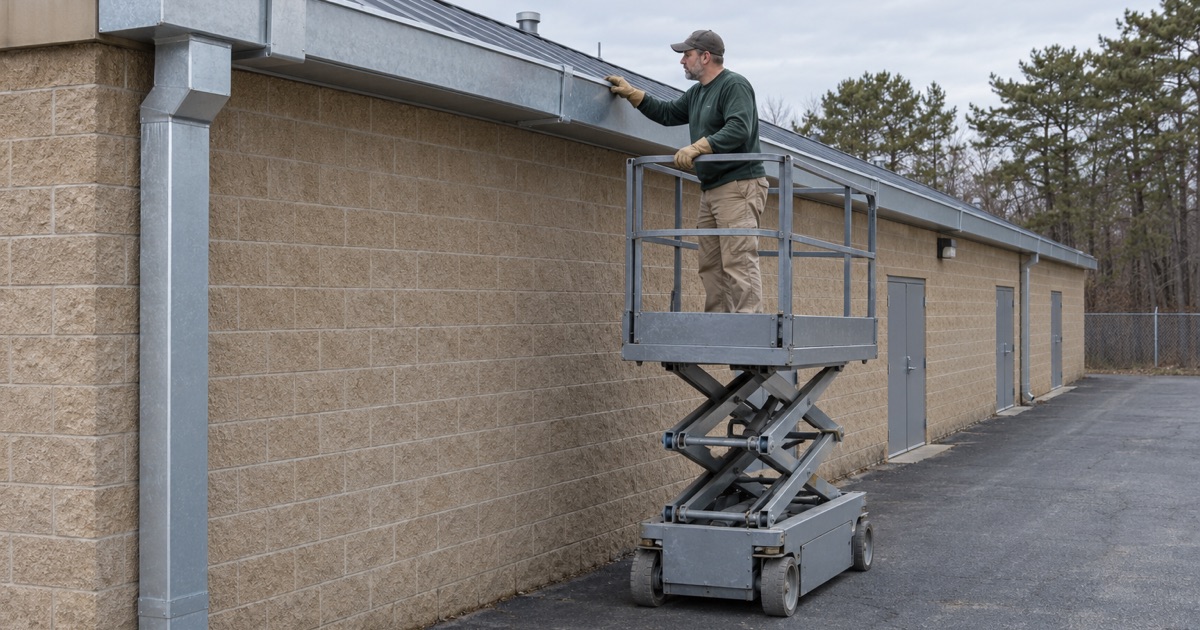
Commercial gutters run wider and deeper than residential ones, often 6-inch K-style at a minimum and larger box-style profiles on big roofs. Downspouts step up to match, with 3x4 or larger rectangular leaders and heavier straps. We form seamless runs on site wherever the length allows, which removes the joints that most often leak on long commercial walls.
Heavier coil and closer hanger spacing keep wide gutters from sagging under the weight of water and snow. On walls exposed to salt air near the ocean and bay, hangers and fasteners are chosen for corrosion resistance and named on the estimate.
Scuppers, Conductor Heads and Leaders
Low-slope and flat commercial roofs usually drain through scuppers, which are openings in the parapet wall that let water spill out to the exterior. A conductor head, or collector box, catches that water and feeds it into a leader that runs down the wall. We install and replace scuppers, conductor heads and leaders sized to the roof area behind each opening.
When a scupper is too small or a conductor head clogs, water backs up on the roof, adds weight and can find its way into the building through flashing or the parapet. Matching each component to the roof is what keeps that from happening.
Box Gutters and Built-In Gutters
Many older churches, schools and downtown buildings have box gutters built into the roof edge or set behind a cornice, lined with metal or a membrane. When the liner fails, water goes straight into the walls and ceilings below. We reline box gutters, rebuild failed sections and replace outlets, and we can convert to an external gutter where the owner and any review board agree.
Box gutters hide their problems well. Stained plaster, peeling interior paint near the top of a wall, or water marks on a ceiling below the roof edge are often the first signs, so we inspect the liner whenever those show up rather than waiting for an active leak.
Repairs and Maintenance for Commercial Buildings
Leaks, Sags and Storm Damage
Commercial gutters fail in the same ways residential ones do, only on a larger scale: leaking seams, loose hangers, sagging runs and outlets torn loose by ice or wind. We reseal joints with tripolymer gutter sealant, rehang runs on heavier hangers and replace damaged sections. Storm damage is photographed and written up for insurance claims.
On buildings where tenants are open for business, we stage repairs so walkways and entrances stay clear, and we work early or late when needed. Lifts and ladders are set up away from doors, and the work area is cleared before customers arrive.
We also look for the cause behind repeat failures. A run that keeps tearing loose may be undersized for the roof above it, and an outlet that keeps clogging may sit below a tree that needs trimming or a roof unit that sheds debris. Fixing the cause costs less than returning for the same repair every season.
Scheduled Cleaning Programs
Retail strips and office parks often sit near tree lines or landscaped islands that drop leaves into the gutters every fall. Churches and schools with tall walls and long runs collect debris that no one sees until a downspout overflows. We set up cleaning schedules, typically in late spring and late fall, flush every leader and send a dated report with photos after each visit.
For managers responsible for several properties, a single schedule and a single report format make it easier to track which buildings were serviced and what needs attention next. Repairs found during a cleaning are listed with photos so the manager can approve them before we return.
Condo, Co-op and Association Buildings
Condo associations and co-ops often maintain gutters on every building in the community. We can quote the whole property, service it building by building and keep a running log of repairs for the board’s reserve planning. Before starting, we confirm with the management office which parts of the exterior the association is responsible for, so the work stays within what the board has approved.
Large communities also benefit from consistency. Using the same gutter color, profile and hardware across every building keeps the property uniform and makes future repairs simpler, since parts and finishes match from one building to the next.
Drainage, Walkways and Local Rules
Keeping Water Off Walkways and Parking Lots
A downspout that empties across a sidewalk or into a parking lot can leave standing water in summer and ice in winter, which is a slip hazard for customers and staff. We route leaders to drains, splash pads or underground lines that carry water away from walkways and entrances. Where a building has no good discharge point, we work with the owner to find one.
Storm Sewer Connections and Site Plans
Many commercial buildings tie their roof leaders directly into a storm sewer. In Brick Township, the site plan code calls for roof leaders on site-plan projects to be tied into a storm sewer pipe system, while Chapter 396 governs illicit connections to the municipal storm sewer. We keep leader connections within those rules and point out existing tie-ins that may need attention.
Property Maintenance Codes
Property maintenance codes in many New Jersey towns put roof drainage on the owner, requiring that roofs and drainage stay sound and that runoff not be discharged in a way that creates a nuisance. Towns with older downtowns, such as Asbury Park, enforce those rules on commercial buildings as well as homes. Keeping gutters and leaders in good repair is part of staying within them.
Under New Jersey’s construction code, the repair, replacement and installation of exterior gutters and leaders counts as ordinary maintenance under N.J.A.C. 5:23-2.7, so most commercial gutter work does not need a construction permit. Historic districts and site plan approvals can still add their own requirements.
- 20+ Years Experience
- Free Written Estimates
- Before-and-After Photos