Brick Quality Gutters has spent more than 20 years on gutters in Cedar Glen West and the rest of Ocean County, and here the first question is rarely about aluminum or downspout size. It is about who owns the problem. A sagging run or a leaking corner on a co-op building usually has a different path to a fix than the same defect on a privately owned home.
We start every call here by sorting that out before anyone talks price. If a gutter belongs to the building, the right first step is a report to the cooperative, and we will tell you so plainly. If the work turns out to be yours, we size, form and hang it the way we would anywhere else, with a written estimate you can take to the board.
This page walks through how gutter work fits the way the community is organized, what a shareholder should check before calling anyone, and what a buyer should ask before closing. It also covers the homes in the area that sit outside the co-op entirely, because their gutters follow a different set of rules.
Shareholders, Not Deed Owners: Who Handles Gutters in Cedar Glen West
A housing cooperative, not a row of private houses
Cedar Glen West is a census-designated place in northern Manchester Township, Ocean County, and most of it is the private residential park run as Cedar Glen West Inc. Residents there hold shares in a housing cooperative rather than a deed to their own building. Listings describe the community as a 55+ co-op, and the buildings are small attached structures rather than freestanding homes.
That ownership model changes how a gutter repair begins. A shareholder looking at a pulled-away hanger is looking at part of a building the cooperative manages, so the decision about who fixes it is not simply the resident’s. We would rather spend five minutes confirming that with you than quote a job that was never yours to buy.
What the monthly carrying charge says about roof and gutters
The clearest evidence comes from recent sale listings. In 2026 they put the monthly charge somewhere between $470 and $510, and it covers property taxes, water, sewer, lawn care and snow removal. Several go further and name the exterior: the 1 B West Lake Drive listing and the 4 C Robin Street listing both say the fee covers repair or replacement of the roof and gutters.
The 20 Dove Street listing, a 1965 unit, is more emphatic, describing a fee that includes replacing or repairing the roof, gutters, hot water heater and heating. Taken together, those listings suggest that many gutter repairs and replacements on co-op buildings fall under the carrying charge. They are listing descriptions, though, not the co-op’s governing documents, so we treat them as a strong hint and ask the office to confirm.
What the listings leave out
None of those three listings mentions gutter cleaning. Repair and replacement are named; routine clearing of leaves and needles is not, and we will not assume it is covered just because the larger items are. A shareholder who wants a clogged run cleared should ask the co-op directly whether that is handled and on what schedule.
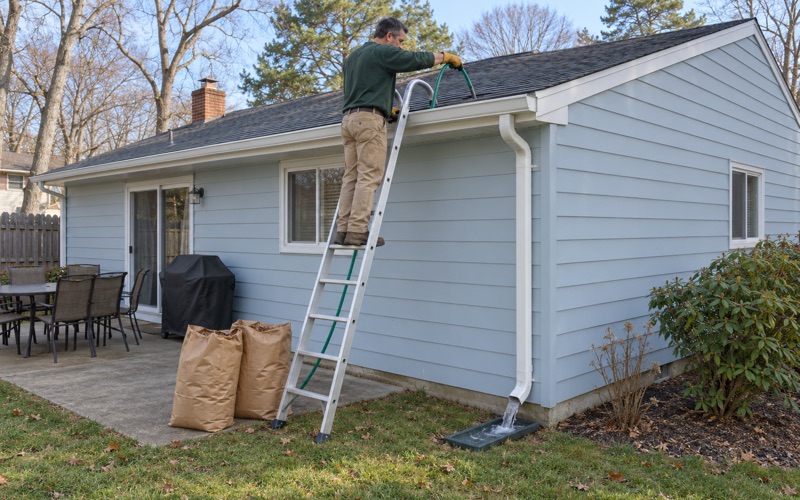
If the answer is that cleaning falls to residents, or that the board would like an outside crew, our visits include flushing every downspout. We bag all of the debris and haul it away with us, so nothing ends up on the lawn, the walk or the street. You also get before-and-after photos, which is handy when the person paying lives elsewhere or wants to show the board the result.
Looking for gutters closer to Howell? See Gutters in Howell.
Reporting a Gutter Problem on a Co-op Building
Start with the co-op office, not a contractor
When a gutter overflows or a downspout comes loose on a co-op building, the first call belongs to the cooperative’s management. Reporting it gets the defect on the co-op’s list and lets the people responsible for the roof and gutters decide how and when it is fixed. Calling a contractor first can lead to work that nobody authorized and nobody wants to pay for.
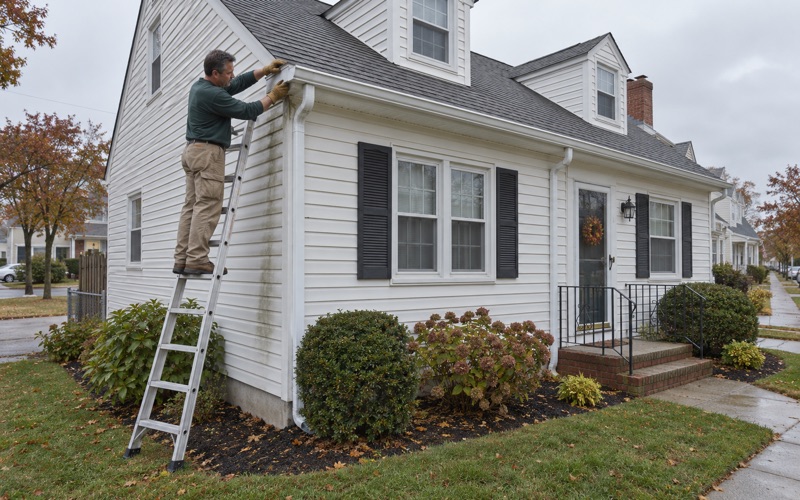
It helps to report with specifics. Note which building and which unit, where along the roofline the water spills, and whether it happens in every rain or only in heavy storms. A phone photo of the overflow or the gap behind the gutter saves the co-op a trip and shortens the wait for a repair.
Why one unit’s gutter is rarely one unit’s problem
Many co-op buildings here hold more than one home under a single roof; one listing calls 20 Dove Street a “co-op quad unit.” Census figures count 353 homes in three- or four-unit buildings across the CDP. A gutter on a building like that drains roof area over more than one household, so a repair decision touches neighbors too.
That is one more reason the cooperative, not an individual shareholder, is usually the right party to schedule exterior work. A single owner cannot size a run for the whole roof that feeds it or settle where its downspout should land. The co-op can look at the building as a whole.
Where our work fits when the co-op calls
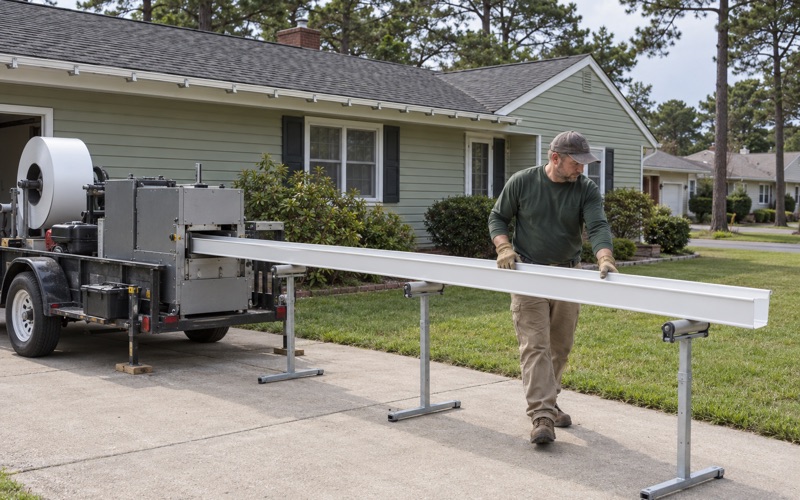
When a board or management office brings us in, we work to the building rather than to a single unit. Gutters and downspouts are sized for the roof area that actually drains to each run, and we form seamless gutters on site from coil so each run is one continuous piece. Fewer seams means fewer places for a leak to start along a long, shared roofline.
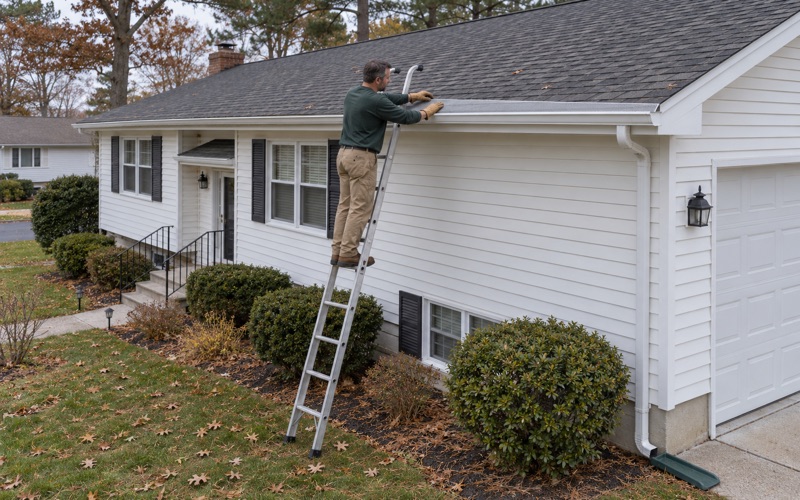
Before new gutters go up, we check the fascia behind them for rot, and we show soft wood to whoever is responsible before we replace it. Our estimates list new gutters and repair work on separate lines because New Jersey taxes them differently. Under the state’s sales tax guidance, new gutters can be an exempt capital improvement, while a repair is taxable, and a board reconciling a budget will want those lines apart.
Buying In: Questions to Ask About Exterior Work
Cash-only purchases and board approval
Buying in here works differently from buying an ordinary house. Listings describe the sales as cash only, and buyers must be approved by the co-op board before the purchase goes through. That approval step is a good moment to ask questions, because you are already in contact with the people who manage the buildings.
Since many listings tie the roof and gutters to the monthly charge, a buyer should not assume the gutters are theirs to maintain or replace. Read what the carrying charge covers, ask for it in writing if you can, and find out how exterior requests are made. Ten minutes of questions now can save confusion the first time a downspout fails.
Questions worth putting to the co-op
A few questions cover most of what a buyer needs. Does the charge cover gutter repair and replacement on this building, and does it cover cleaning? How does a shareholder report an exterior problem, and how long does a typical repair take? Are any gutter or roof projects already planned for the building you are buying into?
It is also fair to ask how drainage is handled at ground level. A downspout that empties against a foundation can push water toward a slab or crawlspace over time. We follow every downspout to where its water lands, and when it lands in the wrong place we propose an extension or an underground line, but on a co-op building that change is the cooperative’s to approve.
What a home inspection can add
New Jersey home inspectors are required to inspect and report deficiencies in a roof drainage system, so an inspection report should say something about the gutters and downspouts. That gives a buyer a written starting point to bring to the board. If the report flags a problem, ask the co-op whether it is already on their list before you factor it into your offer.
We do not stand in for an inspector, and we do not decide who pays. What we can do, if the co-op asks, is look at a building’s gutters and give a written estimate that separates repair from replacement. Our contracts follow New Jersey’s home improvement rules, including the three-day cancellation notice.
Manufactured Homes and Other Houses Outside the Co-op
A separate owner and a separate product
Not every home in the CDP belongs to the cooperative. Census figures count 180 mobile homes in Cedar Glen West, 152 of them owner-occupied, along with a scattering of other houses. Their gutters are a separate case with a separate owner, and the carrying charge described in co-op listings has nothing to say about them.
On a manufactured home, the owner is usually the person who decides on gutter work. Gutters on these homes are often smaller and lighter, and the roof edge they attach to is built differently from a shingled co-op roof. We look at how the edge is framed before recommending a gutter profile or a hanger.
Drainage on sandy ground
The soil at the CDP’s census point maps as Downer sandy loam on a gentle 2 to 5 percent slope, and it is well drained. That helps, but a downspout dumping a whole roof’s water in one spot can still wash out sand beside a foundation or pier. Where the discharge lands matters as much as the gutter above it.
Manchester Township’s code requires that roof runoff be piped to dry wells or an existing drainage system when work needs a plot plan, such as a new or replacement structure or an addition over 225 square feet. Swapping out a gutter alone is ordinary maintenance under state rules, so that requirement attaches to the larger project, not to the gutter. If you are planning an addition anyway, we can lay out downspouts to suit the drainage that project calls for.
Guards, fasteners and materials
Guards should match what actually falls on your roof. Pine needles slip through screens that stop oak leaves, so we look at the trees around the house before recommending a mesh. On a small home with a short run, a well-chosen guard can stretch the time between cleanings without trapping debris on top.
We name the hangers, fasteners and sealant on every estimate, so you know exactly what is going on the house and can compare quotes fairly. Whether the gutter belongs to a co-op building or to your own home, the goal is the same: water off the roof, carried away from the walls, and a clear record of what was done.
- 20+ Years Experience
- Free Written Estimates
- Before-and-After Photos