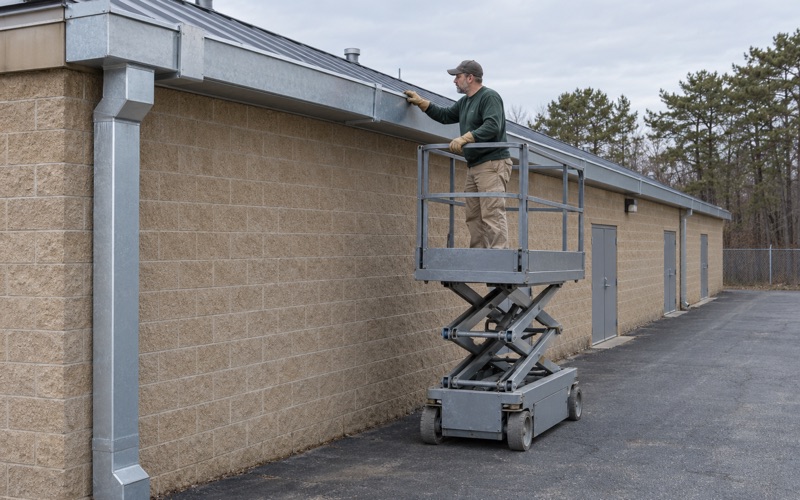
Brick Quality Gutters has spent more than 20 years on gutters in Asbury Park and along the Monmouth County shore, and a good share of that work sits on buildings that look nothing like a ranch house. Flat roofs, parapet walls, storefronts with apartments upstairs and leaders that run three or four stories to the sidewalk all call for a different plan than a simple eave gutter. We size, form and hang that plan to fit the building in front of us.
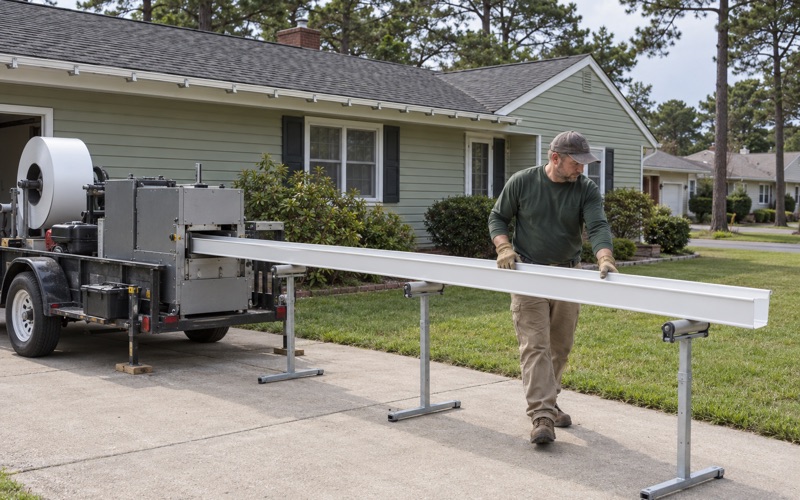
Our crews measure the roof area that drains to each run before we pick a gutter width or a leader size. On a flat or low-slope roof that drains to one edge, that number can be far larger than the facade suggests, and a leader sized by habit backs up the first time the rain gets heavy. Where a run is a gutter rather than a scupper box, we roll it seamless from coil on the job, one continuous piece per run.
Most calls we take in the city come from owners and property managers rather than the people living inside. That shapes how we work: clear photos before and after, an estimate that splits new gutters from repair work, and a written contract that follows New Jersey’s home improvement rules. The sections below cover what changes about the job downtown and who answers for it.
Gutters and Leaders on Downtown’s Older Commercial Buildings
Cookman Avenue, Mattison Avenue and Bond Street
The Asbury Park Commercial Historic District covers the 500, 600 and 700 blocks of Bond Street, Cookman Avenue and Mattison Avenue, roughly between Lake and Bangs Avenues. It went onto the National Register on September 30, 2014, and a report that year found most of its commercial buildings were built between the 1870s and the years before 1960. About 80 percent of downtown’s buildings predate 1960, so the drainage on many of them has been patched, rerouted and replaced more than once.
That history shows up when we get on a roof. We find leaders that were cut short, conductor heads that no longer line up with the outlet, and gutters hung on brackets from three different decades. The Steinbach-Cookman Building, built in 1896 and 1897, is one of the district’s contributing buildings, and its neighbors share the same mix of masonry walls and later storefront changes that make drainage work slow and careful.
No local historic review, but style still matters
The National Register listing does not put private gutters under local design review. No Asbury Park historic preservation commission was found in force, and a 2014 report described the listing as having little, if any, impact on private property owners. An owner on Cookman Avenue can choose gutter material and profile without a board approving it.
We still match the work to the building. Half-round gutters with a double-bead profile and 16-ounce copper suit some of the older facades, and copper weathers to a patina that sits well against old brick. On a plain service elevation or an alley wall, .032 aluminum in a K-style profile does the job and costs less, and we say plainly which side of the building each choice is for.
Looking for gutters closer to Tinton Falls? See Gutters Services in Tinton Falls.
Scuppers, Conductor Heads and Leaders on Flat-Roofed Buildings
How water leaves a flat roof
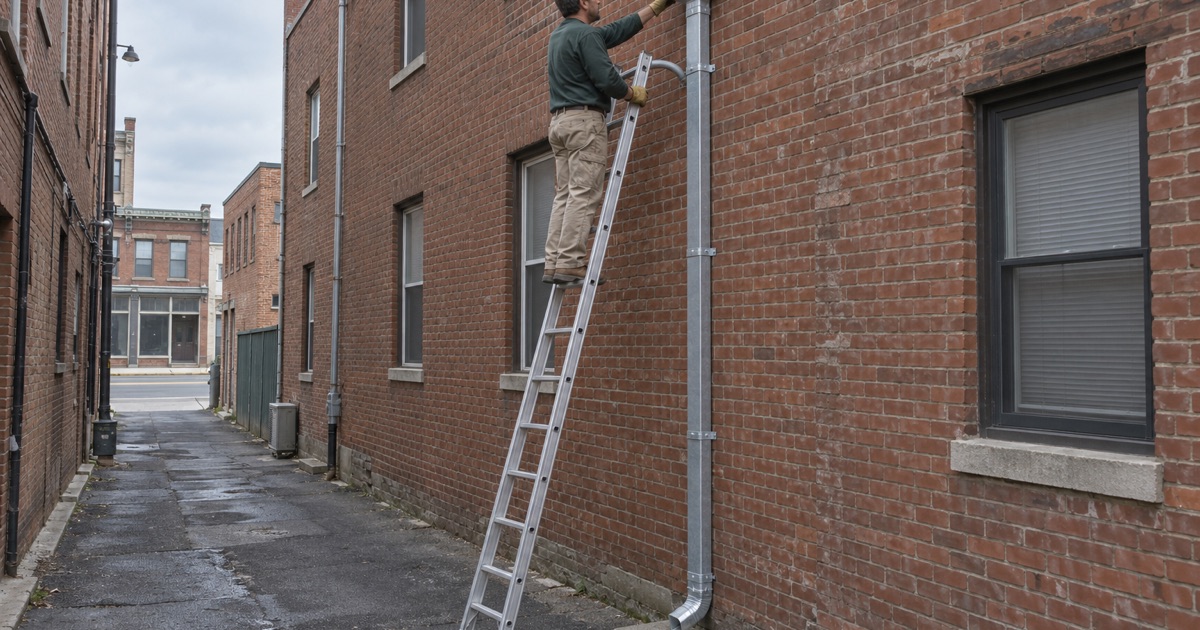
Many mixed-use buildings downtown have a flat roof behind a parapet, and water leaves through a scupper cut in that wall rather than over an eave. The scupper drops into a conductor head, a box that collects the flow and feeds the leader running down the face of the building. When any one of those three pieces is undersized or clogged, the water ponds on the roof or spills down the wall.
We check the scupper opening, the conductor head and the leader as one system. A conductor head that is too small for the scupper above it overflows in a hard rain, and a leader with a crushed elbow at the second floor chokes the whole run. Wide-flange outlets, the right A and B elbows and solid straps on the masonry keep the flow moving to the bottom.
Fascia, flashing and the wood behind the gutter
On buildings with a projecting cornice or a wood fascia, we check that wood for rot before anything new is hung. Soft spots get shown to the owner on site or in photos before we replace them, so nobody pays for wood they have not seen. Drip edge, gutter apron and kickout flashing go in where the roof meets a wall, because those joints are where water slips behind the gutter.
Painted fascia and trim on older buildings bring another step. Asbury Park has a large stock of pre-1978 construction, and the EPA Renovation, Repair and Painting rule covers disturbing painted surfaces on many of those buildings. We plan containment and cleanup into the job when fascia work disturbs old paint.
What Asbury Park’s Property Maintenance Code Says About Roof Drainage
Chapter 13 in plain terms
The city’s property maintenance code, Chapter 13, is its own adaptation of the International Property Maintenance Code. Section 13-304.7, Roofs and Drainage, says the roof and flashing must be sound and tight, that roof drainage shall be adequate, and that roof drains, gutters and downspouts shall be maintained in good repair. That is the rule a downtown building’s drainage answers to, not a historic board.
Section 13-304.1.1 goes a step further and lists roof surfaces with inadequate drainage among the conditions treated as unsafe. Those conditions are to be repaired or replaced under the New Jersey Uniform Construction Code as it applies to existing buildings. For an owner, the practical reading is simple: a scupper that ponds water or a leader that hangs loose is a maintenance item the code expects to see fixed.
Permits and the construction department
Under N.J.A.C. 5:23-2.7(c)1.xvi, the repair, replacement or installation of exterior gutters and leaders counts as ordinary building maintenance. Gutter and leader work on its own usually does not need a construction permit. Roofing, structural or masonry repairs that sometimes come with it are a separate question.
When a job grows past the gutters, the city’s Construction Department at 1 Municipal Plaza, 2nd Floor North, handles permits and inspections. It is open Monday through Friday from 7:30 a.m. to 4 p.m. and takes inspection requests online. We tell an owner up front if any part of the work we propose looks like it reaches past ordinary maintenance.
Where the leader can discharge
Section 18-2.3 of the city’s sewer code bars roof leaders and downspouts from being connected to the sanitary sewer. On a downtown building with no yard, that leaves the sidewalk, a storm connection or a buried line as the place the water goes. A leader tied into a sewer lateral years ago is a connection the code does not allow.
We follow every downspout to where its water actually lands. When a leader dumps against a foundation wall or onto a walkway people use, we propose an extension, a pop-up emitter or an underground line where the lot allows it. On residential lots, grading that falls 6 inches within the first 10 feet of the foundation keeps that water moving away once it leaves the pipe.
Storms, Owners and Who Keeps the Gutters Working
When a cloudburst tests downtown roof drainage
On September 29, 2023, the National Weather Service recorded 4.39 inches of rain in Asbury Park by 6:23 p.m., with the storm still going. The Asbury Park Press reported three feet of water in the basement of the House of Independents on Cookman Avenue that day, though no report tied that water to gutters or roof drains. What the storm does show is the rate a scupper, conductor head and leader may have to carry in a single afternoon.
A flat roof that drains through one scupper sends that whole rainfall to one opening. If the conductor head below is half full of leaves and grit, the excess has nowhere to go but over the parapet or down the masonry. Clearing those pieces before the heavy-rain months and checking that each leader runs open to the bottom costs far less than chasing a leak inside afterward.
A renter city puts the job on the owner
Renters occupy 72.3 percent of homes in Asbury Park, 5,425 of the city’s 7,499 occupied units in the 2024 census estimates. In a city like that, the people who see water spilling from a gutter are often not the people responsible for fixing it. Under Chapter 13, keeping gutters and downspouts in good repair usually falls to the building owner or landlord.
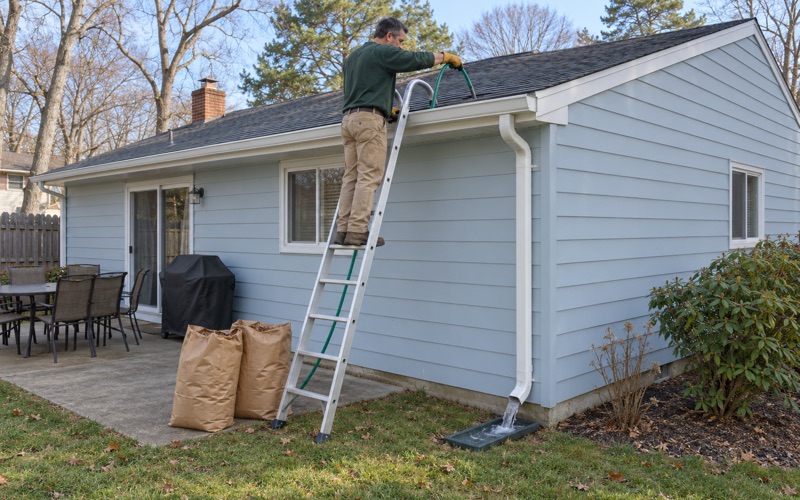
Many of those owners live elsewhere, so our photos do a lot of the talking. Every cleaning and repair visit comes with before-and-after pictures an owner can file or forward to a tenant. Cleaning visits flush every leader and downspout, and the debris goes into bags that leave with our crew rather than staying on the property.
Small multi-unit buildings and condo associations
About 37.1 percent of the city’s housing units were built in 1939 or earlier, and 1,759 units sit in buildings of two to four units. For buildings with three or more units, the state’s multiple-dwelling rule, N.J.A.C. 5:10-7.4, requires exterior walls and roofs to be maintained so they keep water out. Gutters and leaders are part of how a roof does that.
In condominium buildings, we check the master deed or ask the management office before we quote, so an owner knows whether the gutters belong to the unit or the association. On estimates, new gutters and repairs appear on separate lines, because New Jersey taxes them differently. Our contracts follow the state’s home improvement rules, including the three-day cancellation notice.
- 20+ Years Experience
- Free Written Estimates
- Before-and-After Photos