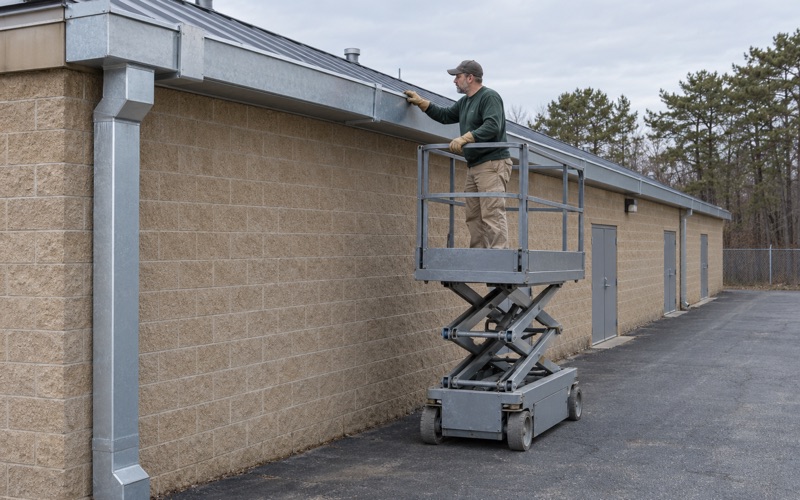
Brick Quality Gutters has spent more than 20 years putting up gutters in Allenwood and the rest of the Jersey Shore, and the part of the job we watch most closely here is the last few feet. A gutter only moves roof water to a corner of the house. Where that water lands, and what the ground does with it once it arrives, decides whether the system protects the foundation or simply relocates the problem.
That is why our estimates start on the ground rather than on the ladder. We walk each downspout to its outlet, look at how the soil around it behaves, and size the gutter runs for the roof area that actually drains into them. A front run catching a broad main roof gets a different gutter and downspout than a short run over a porch.
The work itself is the familiar list: seamless gutters formed on site from coil, downspouts, extensions, underground lines, guards and cleaning. What changes in this corner of Wall Township is the dirt under the splash block, and the sections below explain why two lots a short walk apart can call for opposite answers.
Sand or River Bottom: Two Kinds of Ground Under Allenwood Downspouts
Allenwood is a small census-designated place in the southern part of Wall Township, Monmouth County, covering about 1.86 square miles. Its southern border partly follows the Manasquan River, and that river is the reason the ground changes character so quickly across a short distance.
What the Soil Survey Shows
A 25-point USDA soil sample taken around Allenwood found excessively drained Evesboro sand at 7 of those points and well-drained Downer and Sassafras soils at 9 more. On those upland soils the seasonal high water table sits deeper than 72 inches, and the Evesboro series is rated high to very high for how fast water moves through the subsoil and the layers beneath it.
The same sample found a very different picture toward the river. Four points landed on Humaquepts, a soil the survey rates as frequently flooded and poorly drained, with an annual minimum water table about 15 cm down. One point landed on Manahawkin muck, very poorly drained, where the water table reaches the surface. The sample was not matched to individual lots, so we do not assume which ground a house sits on until we have looked.
Why One Answer Does Not Fit Both
On the sandy upland, roof water soaks in almost as fast as it lands, so the real risks are the soil washing out at the splash point and water pooling close against the foundation. On the river-bottom soils, the ground is often wet before the storm even starts, so water from a downspout has nowhere to go.
That split is our reading of the soil drainage classes, not a measured outcome on any one property. It is still the most useful starting question we can ask on an Allenwood estimate, because it changes nearly every choice that follows, from extension length to whether an underground line is worth burying at all.
What We Look at on the Estimate Visit
On the first visit we check each outlet for signs of how the ground is behaving. Bare, scoured sand and a tilted splash block point one way, while soft turf, standing water or moss along the foundation after a dry spell point the other. We also note where the yard falls, since slope decides where water can travel once it leaves the pipe.
Those notes go on the estimate beside each downspout, so the owner can see why we suggested a longer extension on one corner and left another alone. It keeps the conversation about the specific house rather than about a standard package.
Looking for gutters closer to Dover Beaches North? See Dover Beaches North Gutters.
Downspout Extensions and Splash Blocks on Fast-Draining Sand
On a well-drained sandy lot, the gutter itself rarely causes trouble. The trouble starts where a 3x4 downspout dumps a full roof’s worth of water onto loose sand in one spot, again and again, through every heavy storm.
Splash-Point Washout
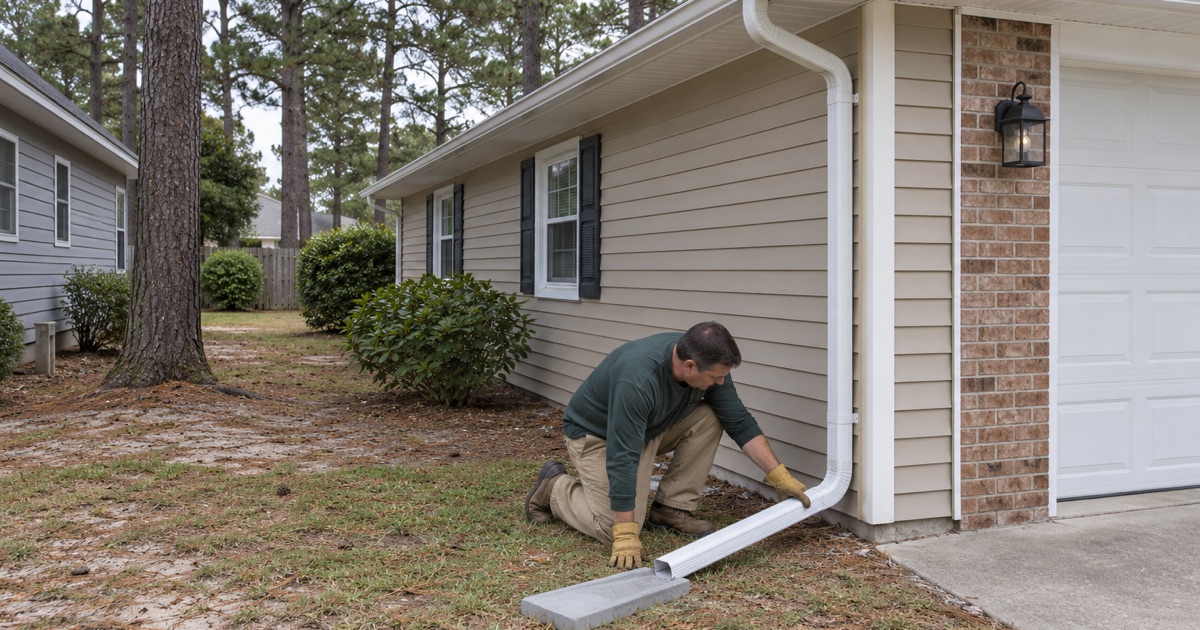
Evesboro sand is excessively drained, which sounds like good news, and mostly it is. The catch is that loose sand moves easily under falling water. A downspout that ends at the foundation can carve a small hollow beside the wall, undercut a splash block until it tips, and wash fill away from the base of the house over a few seasons.
Correct grading helps here. The 2021 New Jersey edition of the residential code calls for the ground to fall 6 inches within the first 10 feet from the foundation, and a washed-out splash point is often the place where that fall has quietly reversed. We point it out when we see it, so the owner can decide whether the grade needs attention along with the gutters.
Getting the Water Past the Foundation
Every downspout we install or service gets followed to where its water actually ends up. When it lands against the foundation, we propose a fix on the estimate, usually a longer extension, a solid splash block set at the right pitch, or a short underground line that carries the water farther out before releasing it.
On fast-draining sand, the goal is simply to land the water far enough out that the sand can take it without eroding. A few extra feet of extension often solves what looks like a gutter problem, and we would rather recommend that than sell a larger system the house does not need.
Extension or Buried Line
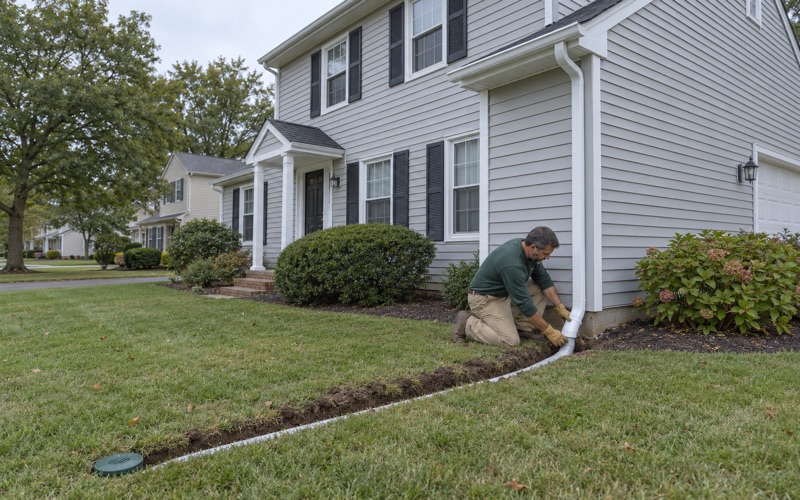
An above-ground extension is cheap, easy to inspect and easy to move, but it sits across the lawn and gets stepped on or mowed over. An underground downspout line hides the pipe and can carry water past a walkway or planting bed, ending in a pop-up emitter that opens only when water is flowing.
On free-draining sand, a buried line usually empties quickly after each storm, which is what makes it practical there. We lay out both choices with their costs on the estimate, and the owner picks the one that fits how the yard is used.
When the Ground Is Already Wet: Downspouts Near the Manasquan River and Where Dry Wells Work
The lower ground toward the Manasquan River needs a different conversation. Soil that holds water about 15 cm below the surface cannot absorb much more, so the usual tricks for hiding a downspout’s discharge stop working.
Wet Soil and Underground Downspout Drains
A buried downspout line on wet, poorly drained ground tends to fill and sit full instead of carrying water away. Pop-up drainage emitters can stay flooded or push water back up the pipe, and a long underground run may freeze in place in winter if it never drains completely. None of that means a buried line is always wrong, but it does mean the outlet has to be somewhere the ground can actually accept water.
On these lots, we often keep the drainage above ground, using extensions to carry water across the yard toward lower ground on the owner’s own property. We explain each option on the estimate and leave the decision with the owner, because the right answer depends on the lot’s slope as much as on its soil.
Dry Wells: The Sand Side Only
A dry well is a buried chamber that holds roof water and lets it soak into the surrounding soil. New Jersey’s stormwater best-practice manual limits dry wells to clean rooftop runoff and sets a minimum of 2 feet between the bottom of the dry well and the seasonal high water table. It also expects a dry well to empty within 72 hours.
On upland Evesboro sand, with the water table deeper than 72 inches, that separation is realistic. On Humaquepts with a water table about 15 cm down, it is not, because there is no room for a chamber with 2 feet of dry soil beneath it. We will not recommend a dry well on ground that cannot meet that separation, and we tell an owner plainly when a lot falls on the wrong side of it.
Gutter Sizing and Upkeep for Allenwood’s Detached Homes
Every home in Allenwood’s census housing count is a single-family detached house, 265 of 265, and 226 of the 237 occupied homes are owner-occupied. That means the gutter, the downspout and the spot where its water lands are usually one owner’s decision on one lot, with no shared wall or neighbor’s roof in the way.
Sizing Runs to the Roof
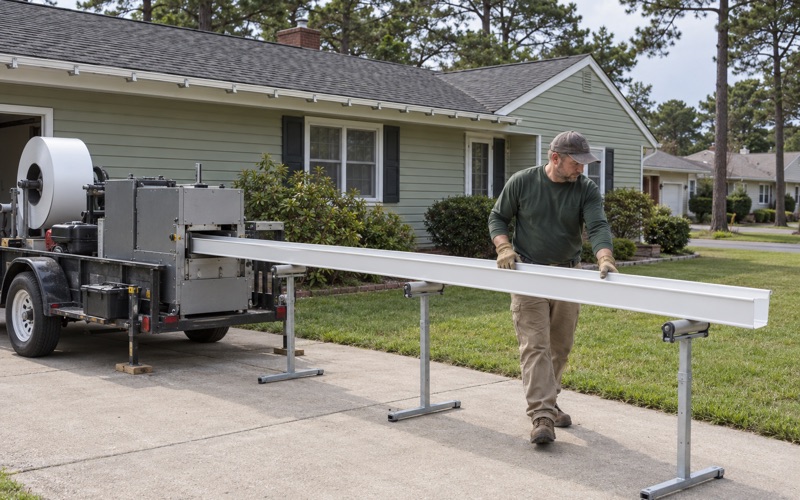
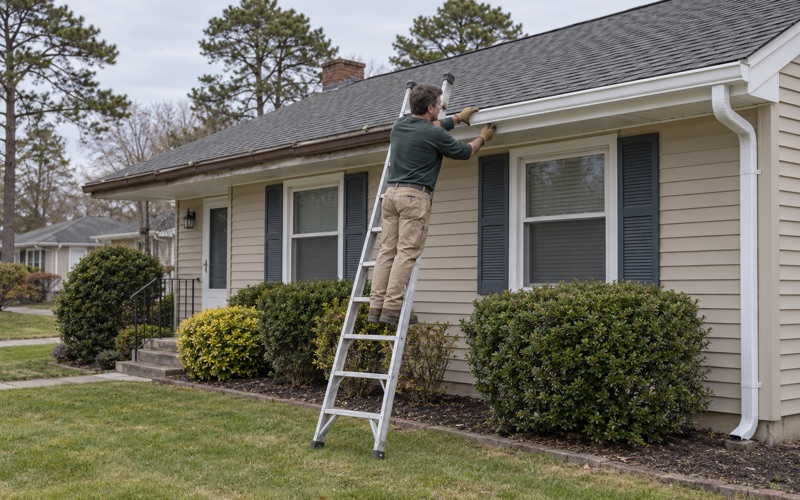
We size gutters and downspouts for the roof area feeding each run, so a long run on a steep main roof may need a 6-inch K-style gutter while a small porch roof does well with less. The gutter is formed on site from .032 aluminum coil into one seamless piece per run, which removes the joints where most leaks begin.
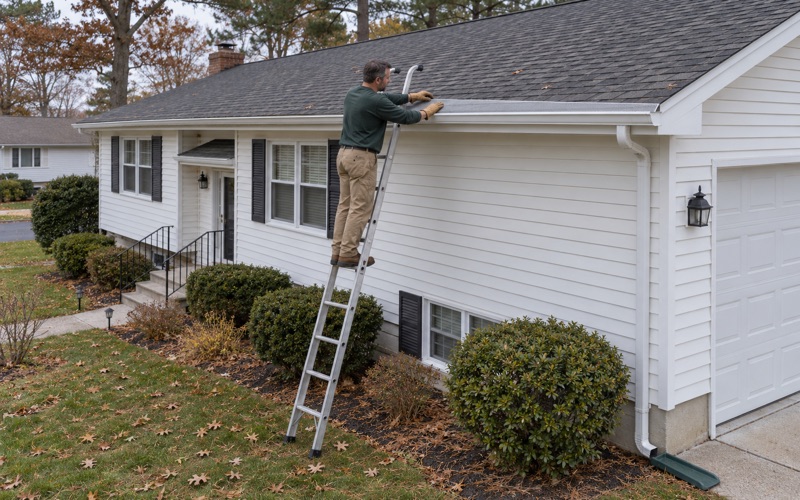
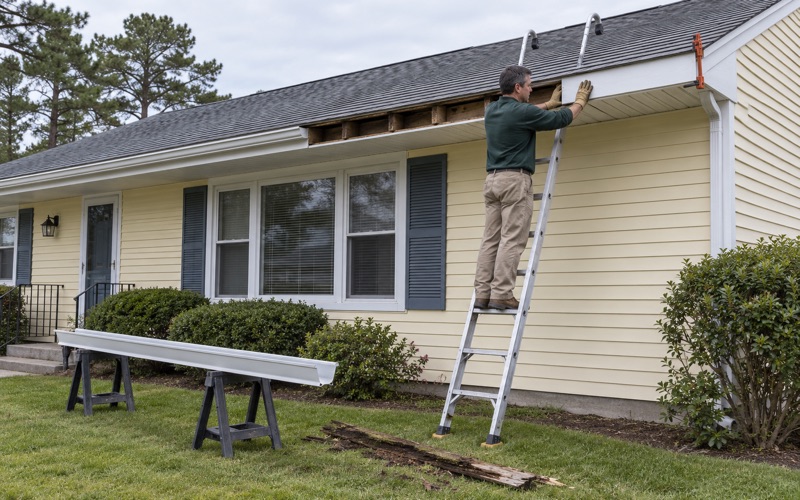
Before anything new goes up, we check the fascia board behind the old gutter for rot. If we find soft wood, we show it to the owner first, then list the repair on the estimate. Repair work and new gutters are written on separate lines, because New Jersey taxes a repair and a capital improvement differently.
Hangers, Seams and Flashing
How the gutter is held up matters as much as its size. We use hidden hangers rather than the old spike and ferrule, because a spike works loose in the fascia over time while a hidden hanger screws in and spreads the load. Corners are cut as box, strip or bay miters and sealed with tripolymer gutter sealant.
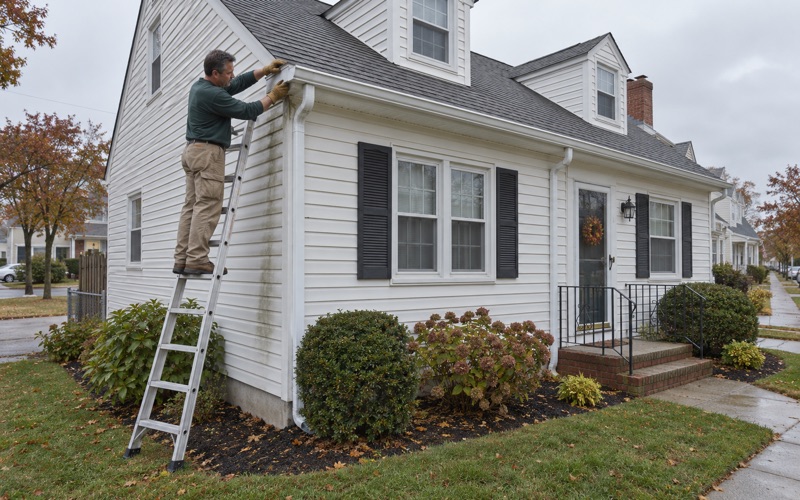
Where a roof edge meets a wall, a kickout flashing turns water into the gutter instead of letting it run down the siding. We also check the gutter apron and drip edge so that water leaving the shingles falls into the trough rather than behind it, which is a common source of the fascia rot we find on older houses.
Older Houses and Part-Time Owners
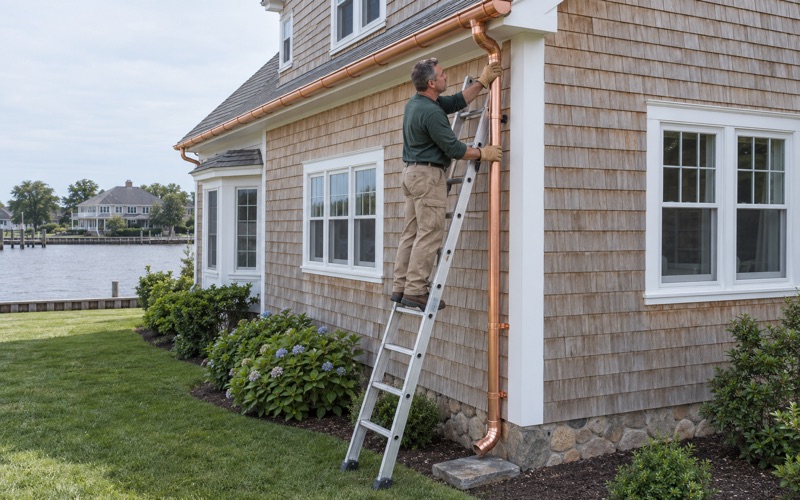
Allenwood’s census count includes 88 homes built in 1939 or earlier, the largest single age group in the place. On a house of that age, half-round or copper gutters can suit the style better than a modern K-style profile, and we match the gutter and its hangers to the period of the house.
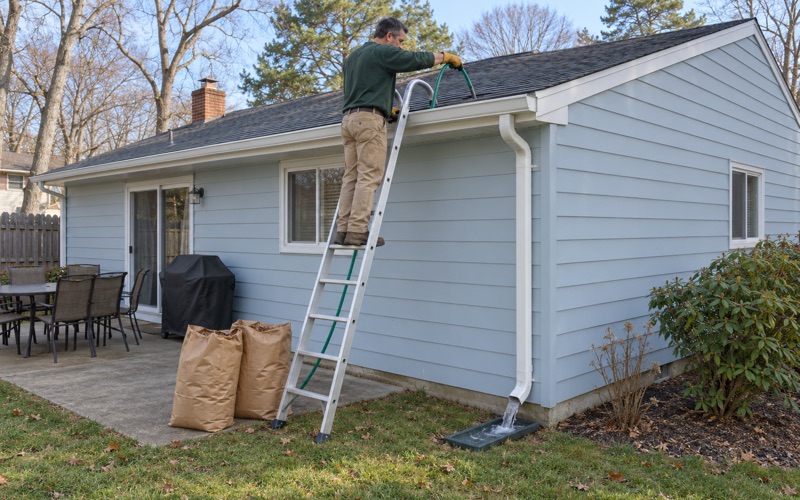
The census also counts 28 Allenwood homes held for seasonal or occasional use. For an owner who is not there every week, our cleaning visits flush each downspout, bag the debris, and come with before-and-after photos, so the condition of the gutters is clear without a trip to see them. Every contract follows New Jersey’s home improvement rules, including the three-day cancellation notice.
- 20+ Years Experience
- Free Written Estimates
- Before-and-After Photos